Elble Rodger J
Department of Neurology, Southern Illinois University School of Medicine, Springfield, IL, United States.
Front Neurol. 2020 Sep 30;11:586606. doi: 10.3389/fneur.2020.586606. eCollection 2020.
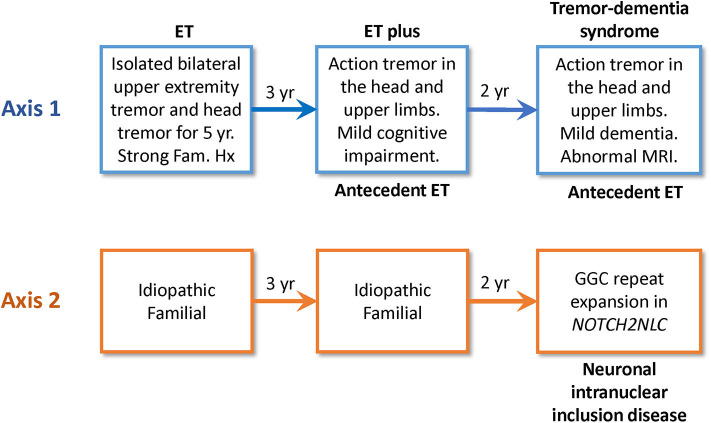
A task force of the International Parkinson and Movement Disorder Society (MDS) recently published a tremor classification scheme that is based on the nosologic principle of two primary axes for classifying an illness: clinical manifestations (Axis 1) and etiology (Axis 2). An Axis 1 clinical syndrome is a recurring group of clinical symptoms, signs (physical findings), and possibly laboratory results that suggests the presence of at least one underlying Axis 2 etiology. Syndromes must be defined and used consistently to be of value in finding specific etiologies and effective treatments. The MDS task force concluded that essential tremor is a common neurological syndrome that has never been defined consistently by clinicians and researchers. The MDS task force defined essential tremor as a syndrome of bilateral upper limb action tremor of at least 3 years duration, with or without tremor in other locations (e.g., head, voice, or lower limbs), in the absence of other neurological signs (e.g., dystonia, parkinsonism, myoclonus, ataxia, peripheral neuropathy, and cognitive impairment). Deviations from this definition should not be labeled as essential tremor. Patients with additional questionably-abnormal signs or with signs of uncertain relevance to tremor are classified as essential tremor plus. The MDS classification scheme encourages a thorough unbiased phenotyping of patients with tremor, with no assumptions of etiology, pathology, pathophysiology, or relationship to other neurological disorders. The etiologies, pathology, and clinical course of essential tremor are too heterogeneous for this syndrome to be viewed as a disease or a family of diseases.
国际帕金森病和运动障碍协会(MDS)的一个特别工作组最近发布了一种震颤分类方案,该方案基于对疾病进行分类的两个主要轴的疾病分类原则:临床表现(轴1)和病因(轴2)。轴1临床综合征是一组反复出现的临床症状、体征(体格检查结果),可能还有实验室检查结果,提示至少存在一种潜在的轴2病因。综合征必须得到一致的定义和应用,才能在寻找特定病因和有效治疗方法方面具有价值。MDS特别工作组得出结论,特发性震颤是一种常见的神经综合征,但临床医生和研究人员从未对其进行过一致的定义。MDS特别工作组将特发性震颤定义为一种双侧上肢动作性震颤综合征,持续时间至少3年,可伴有或不伴有其他部位(如头部、声音或下肢)的震颤,且无其他神经体征(如肌张力障碍、帕金森综合征、肌阵挛、共济失调、周围神经病变和认知障碍)。偏离此定义的情况不应被标记为特发性震颤。有其他可疑异常体征或与震颤相关性不确定体征的患者被分类为特发性震颤加。MDS分类方案鼓励对震颤患者进行全面、无偏倚的表型分析,不假设病因、病理、病理生理学或与其他神经疾病的关系。特发性震颤的病因、病理和临床过程过于异质,以至于该综合征不能被视为一种疾病或一类疾病。