Bradford Teaching Hospitals NHS Foundation Trust, Bradford, BD9 6RJ, UK.
Anglia Ruskin University, Cambridge, CB1, 1PT, UK.
BMC Health Serv Res. 2024 May 9;24(1):603. doi: 10.1186/s12913-024-11011-1.
Healthcare staff deliver patient care in emotionally charged settings and experience a wide range of emotions as part of their work. These emotions and emotional contexts can impact the quality and safety of care. Despite the growing acknowledgement of the important role of emotion, we know very little about what triggers emotion within healthcare environments or the impact this has on patient safety.
To systematically review studies to explore the workplace triggers of emotions within the healthcare environment, the emotions experienced in response to these triggers, and the impact of triggers and emotions on patient safety.
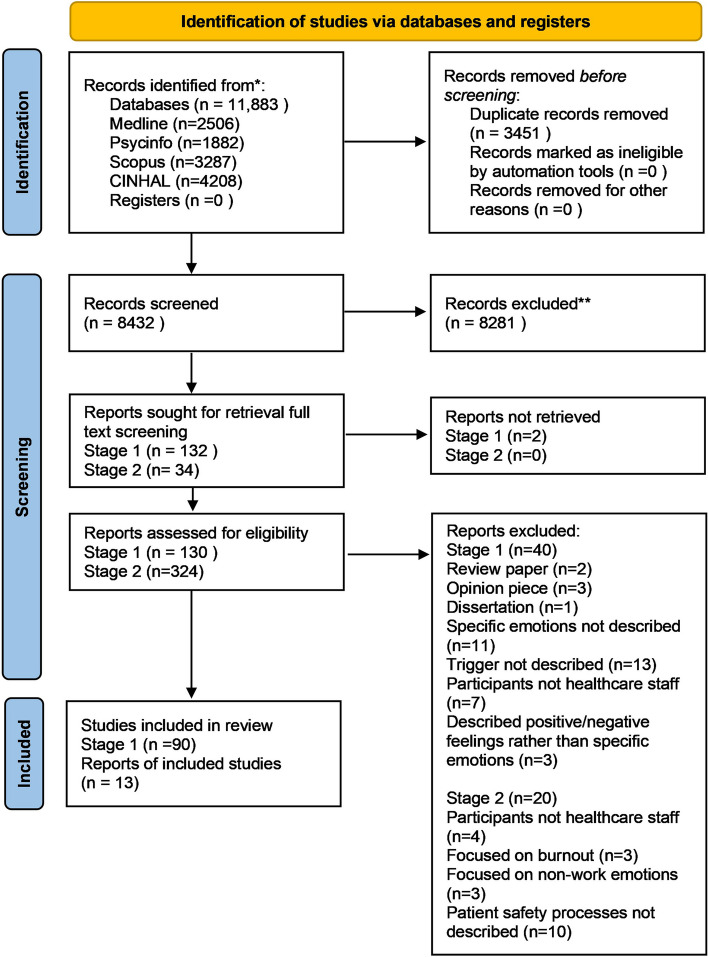
Following the Preferred Reporting Items for Systematic Reviews and Meta-Analyses guidelines, four electronic databases were searched (MEDLINE, PsychInfo, Scopus, and CINAHL) to identify relevant literature. Studies were then selected and data synthesized in two stages. A quality assessment of the included studies at stage 2 was undertaken.
In stage 1, 90 studies were included from which seven categories of triggers of emotions in the healthcare work environment were identified, namely: patient and family factors, patient safety events and their repercussions, workplace toxicity, traumatic events, work overload, team working and lack of supervisory support. Specific emotions experienced in response to these triggers (e.g., frustration, guilt, anxiety) were then categorised into four types: immediate, feeling states, reflective, and longer-term emotional sequelae. In stage 2, 13 studies that explored the impact of triggers or emotions on patient safety processes/outcomes were included.
The various triggers of emotion and the types of emotion experienced that have been identified in this review can be used as a framework for further work examining the role of emotion in patient safety. The findings from this review suggest that certain types of emotions (including fear, anger, and guilt) were more frequently experienced in response to particular categories of triggers and that healthcare staff's experiences of negative emotions can have negative effects on patient care, and ultimately, patient safety. This provides a basis for developing and tailoring strategies, interventions, and support mechanisms for dealing with and regulating emotions in the healthcare work environment.
医护人员在情绪激动的环境中为患者提供护理,作为工作的一部分,他们会体验到各种情绪。这些情绪和情绪背景会影响护理的质量和安全。尽管人们越来越认识到情绪的重要作用,但我们对医疗环境中引发情绪的因素以及这些情绪对患者安全的影响知之甚少。
系统回顾研究,以探索医疗环境中引发情绪的工作场所因素、对这些触发因素的反应情绪,以及触发因素和情绪对患者安全的影响。
根据系统评价和荟萃分析的首选报告项目的指导原则,在四个电子数据库(MEDLINE、PsychInfo、Scopus 和 CINAHL)中搜索相关文献。然后在两个阶段选择和综合研究数据。在第 2 阶段对纳入研究进行了质量评估。
在第 1 阶段,纳入了 90 项研究,从中确定了医疗保健工作环境中情绪触发因素的七个类别,即:患者和家属因素、患者安全事件及其后果、工作场所毒性、创伤性事件、工作负荷过重、团队合作和缺乏监督支持。然后将对这些触发因素的反应(例如,沮丧、内疚、焦虑)的特定情绪分类为四种类型:即时、感觉状态、反思和更长期的情绪后果。在第 2 阶段,纳入了 13 项探讨触发因素或情绪对患者安全过程/结果影响的研究。
本综述中确定的各种情绪触发因素和所经历的情绪类型可以作为进一步研究情绪在患者安全中的作用的框架。本综述的结果表明,某些类型的情绪(包括恐惧、愤怒和内疚)在对特定类别的触发因素的反应中更为常见,医护人员经历的负面情绪会对患者护理产生负面影响,最终影响患者安全。这为制定和调整医疗保健工作环境中的情绪处理和调节策略、干预措施和支持机制提供了依据。