Freese Thomas, Elzinga Nils, Heinemann Matthias, Lerch Michael M, Feringa Ben L
Stratingh Institute for Chemistry, University of Groningen Nijenborgh 4 9747 AG Groningen The Netherlands
Green Office, University of Groningen Broerstraat 5 9712 CP Groningen The Netherlands.
RSC Sustain. 2024 Mar 18;2(5):1300-1336. doi: 10.1039/d4su00056k. eCollection 2024 May 8.
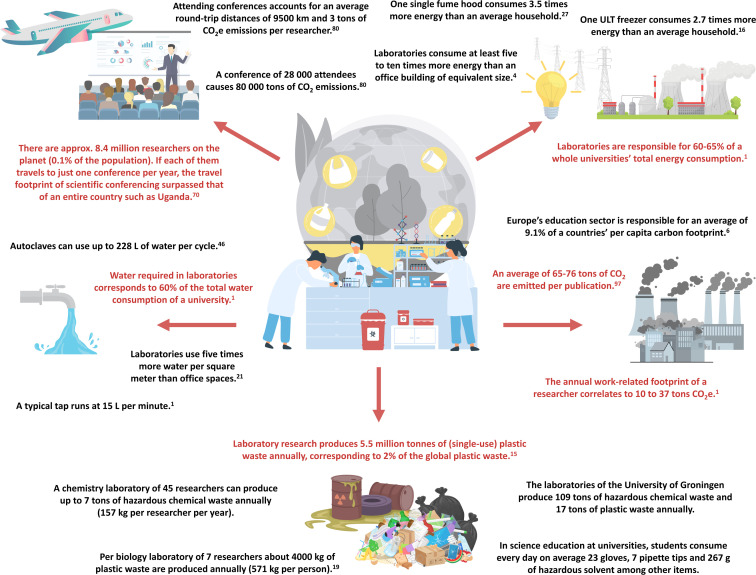
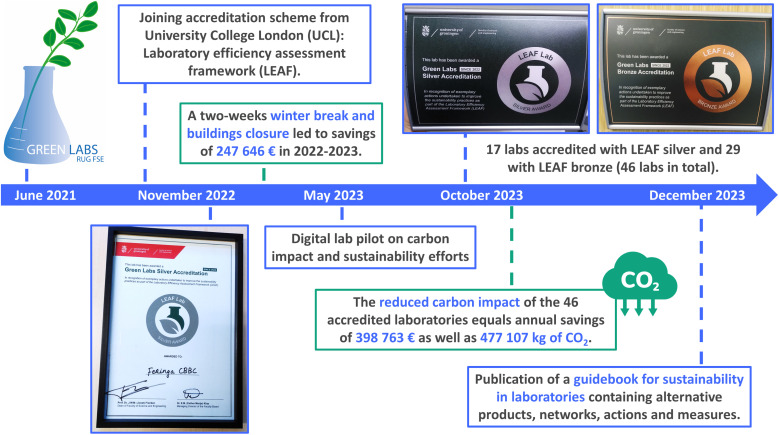
Scientists are of key importance to the society to advocate awareness of the climate crisis and its underlying scientific evidence and provide solutions for a sustainable future. As much as scientific research has led to great achievements and benefits, traditional laboratory practices come with unintended environmental consequences. Scientists, while providing solutions to climate problems and educating the young innovators of the future, are also part of the problem: excessive energy consumption, (hazardous) waste generation, and resource depletion. Through their own research operations, science, research and laboratories have a significant carbon footprint and contribute to the climate crisis. Climate change requires a rapid response across all sectors of society, modeled by inspiring leaders. A broader scientific community that takes concrete actions would serve as an important step in convincing the general public of similar actions. Over the past years, grassroots movements across the sciences have recognized the overlooked impact of the scientific enterprise, and so-called Green Lab initiatives emerged seeking to address the environmental footprint of research. Driven by the voluntary efforts of researchers and staff, they educate peers, develop sustainability guidelines, write scientific publications and maintain accreditation frameworks. With this perspective we want to advocate for and spark leadership to promote a systemic change in laboratory practices and approach to research. Comprehensive evidence for the environmental impact of laboratories and their root-causes is presented, expanded with data from a current case study of the University of Groningen showcasing annual savings of 398 763 € as well as 477.1 tons of COe. This is followed by guidelines for sustainable lab practices and hands-on advice on how to achieve a systemic change at research institutions and industry. How can we expect industry, politics, and society to change, if we as scientists are not changing either? Scientists should lead by example and practice the change they want to see.
科学家对于社会至关重要,他们倡导人们认识气候危机及其背后的科学依据,并为可持续未来提供解决方案。尽管科学研究带来了巨大成就和益处,但传统实验室做法却带来了意想不到的环境后果。科学家在为气候问题提供解决方案并教育未来年轻创新者的同时,也是问题的一部分:能源消耗过度、(有害)废物产生以及资源枯竭。通过自身的研究活动,科学、研究和实验室有着巨大的碳足迹,并加剧了气候危机。气候变化需要社会各部门迅速做出回应,以鼓舞人心的领导者为榜样。一个采取具体行动的更广泛科学界将是说服公众采取类似行动的重要一步。在过去几年里,科学界的基层运动已经认识到科学事业被忽视的影响,于是出现了所谓的绿色实验室倡议,旨在解决研究的环境足迹问题。在研究人员和工作人员的自愿努力推动下,这些倡议对同行进行教育,制定可持续发展指南,撰写科学出版物并维护认证框架。基于这一观点,我们希望倡导并激发领导力,以推动实验室做法和研究方法的系统性变革。本文展示了实验室环境影响及其根源的全面证据,并通过格罗宁根大学当前一个案例研究的数据进行了扩展,该案例显示每年节省398763欧元以及477.1吨二氧化碳当量。接下来是可持续实验室做法的指南,以及关于如何在研究机构和行业实现系统性变革的实用建议。如果我们科学家自己都不改变,又怎能期望行业、政治和社会发生改变呢?科学家应该以身作则,践行他们希望看到的变革。