Norscia Ivan, Collarini Edoardo, Robino Carlo, Chierto Elena, Cordoni Giada
Department of Life Sciences and Systems Biology, University of Torino, Via Accademia Albertina 13, 10123 Torino, Italy.
Department of Public Health Sciences and Pediatrics, University of Torino, C.So Galileo Galilei 22, 10126 Torino, Italy.
Curr Zool. 2023 Apr 27;70(2):233-243. doi: 10.1093/cz/zoad016. eCollection 2024 Apr.
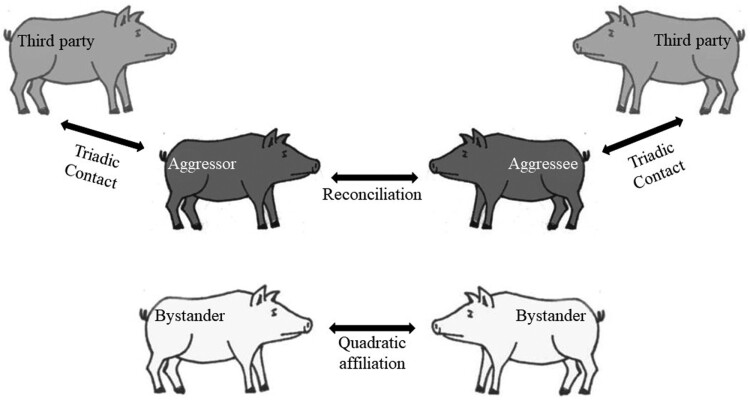
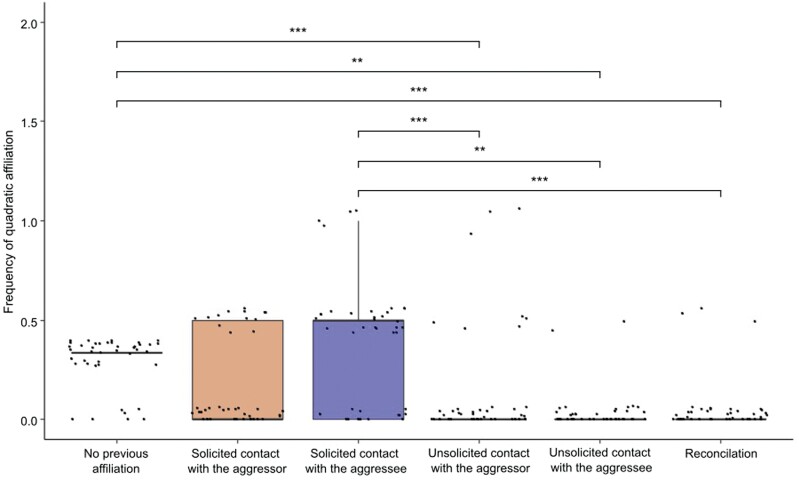
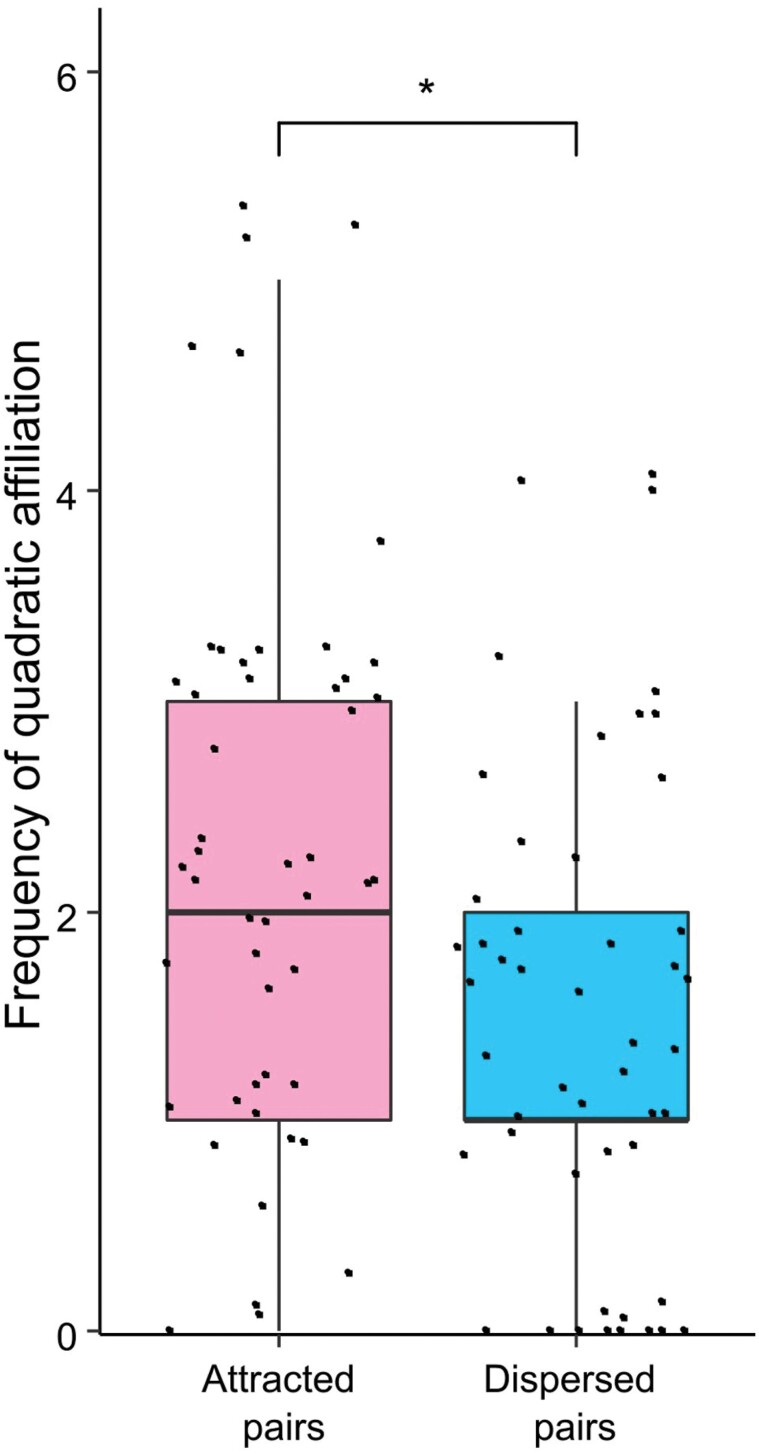
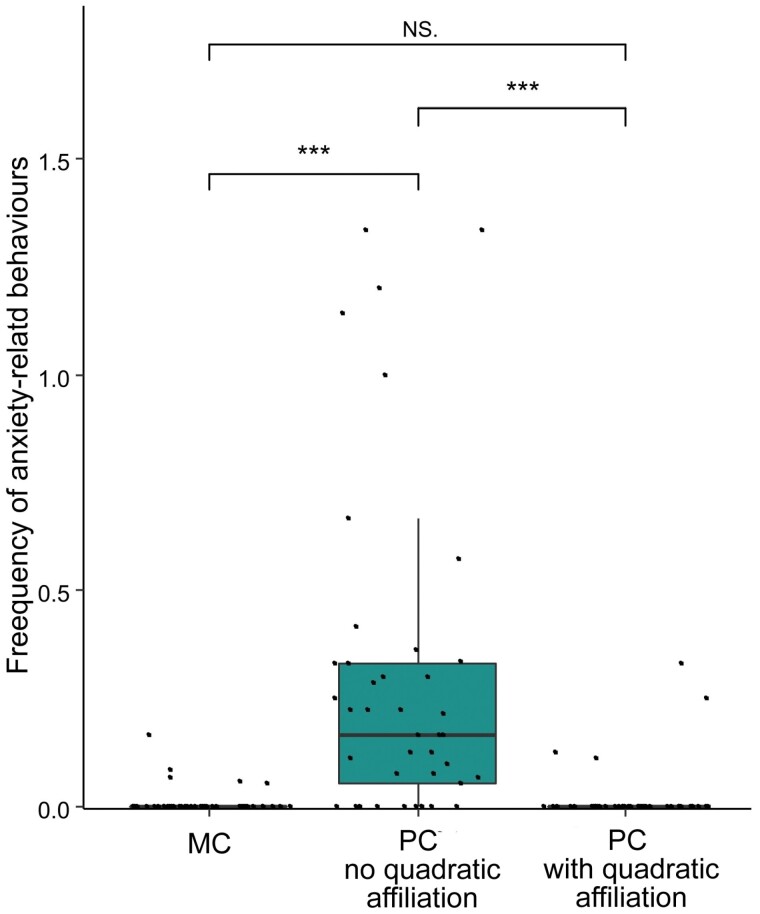
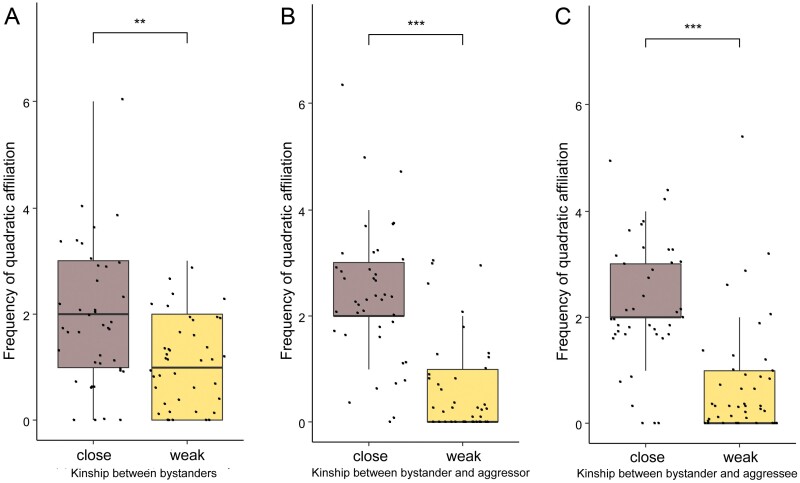
In social mammals, post-conflict resolution can involve the reunion of former opponents (reconciliation), spontaneous/solicited post-conflict affiliation of a third party with either opponent (triadic contacts), and affiliation between other individuals (hereafter bystanders; quadratic contacts). Quadratic contacts-possibly informing complex cognitive abilities-have been neglected in post-conflict studies. We investigated quadratic affiliation in semi-free ranging pigs , at the ethical farm Parva-Domus (Cavagnolo, Italy). Kinship was known. We collected behavioral data on adult pigs ( 104) via video recordings (43 h) followed by video analyses. Affiliative and anxiety behaviors between bystanders were collected under post-conflict (PC; following a conflict between non-bystanders) and matched-control (MC; no conflict) conditions. Quadratic affiliation was present in pigs, as bystanders affiliated more in PC than MC, and such affiliation was followed by a decrease in the anxiety behaviors of both the interacting bystanders. Thus, quadratic contacts may be partly aimed at reducing one's own anxiety (intrinsic regulation). Quadratic affiliation was highest between closely related bystanders, which suggests that such affiliation may be most effective when close kin is involved. Quadratic affiliation was lowest after reconciliation and spontaneous triadic contacts. This suggests that direct peacemaking between opponents and spontaneous triadic contacts with close kin may most likely replace quadratic affiliation. Hence, pigs can be influenced by the negative events that affect other pigs-but not themselves-and their response may be modulated by social factors. Such non-random quadratic affiliation may point toward the presence of elements of social appraisal abilities in pigs.
在群居哺乳动物中,冲突后的解决方式可能包括前对手的重聚(和解)、第三方与任一对手的自发/主动冲突后联系(三元接触)以及其他个体之间的联系(以下称旁观者;四方接触)。四方接触——可能反映了复杂的认知能力——在冲突后研究中一直被忽视。我们在意大利卡瓦尼奥洛的帕瓦 - 多穆斯伦理农场对半散养的猪进行了四方联系的调查。猪的亲缘关系是已知的。我们通过视频记录(43小时)收集成年猪(104头)的行为数据,随后进行视频分析。在冲突后(PC;非旁观者之间发生冲突后)和匹配对照(MC;无冲突)条件下收集旁观者之间的亲和行为和焦虑行为。猪中存在四方联系,因为旁观者在冲突后条件下比在匹配对照条件下有更多的亲和行为,并且这种亲和行为之后,相互作用的旁观者的焦虑行为都有所减少。因此,四方接触可能部分旨在降低自身焦虑(内在调节)。亲缘关系密切的旁观者之间的四方联系最为频繁,这表明当涉及近亲时,这种联系可能最有效。和解和自发三元接触后,四方联系最少。这表明对手之间的直接调解以及与近亲的自发三元接触最有可能取代四方联系。因此,猪会受到影响其他猪但不影响自身的负面事件的影响,并且它们的反应可能会受到社会因素的调节。这种非随机的四方联系可能表明猪存在社会评估能力的要素。