Guangdong Provincial Key Laboratory of Tumor Interventional Diagnosis and Treatment, Zhuhai People's Hospital, (Zhuhai Clinical Medical College of Jinan University), Jinan University, Zhuhai, Guangdong, China.
Centre of Reproduction, Development and Aging, Faculty of Health Sciences, University of Macau, Macau SAR, China.
Cell Death Dis. 2024 May 10;15(5):326. doi: 10.1038/s41419-024-06598-6.
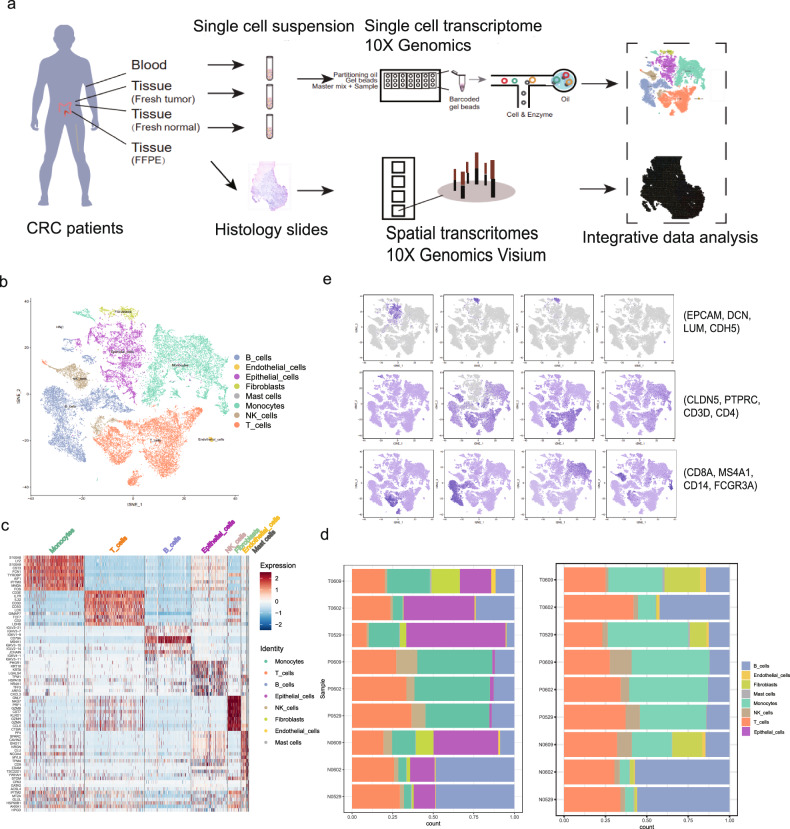
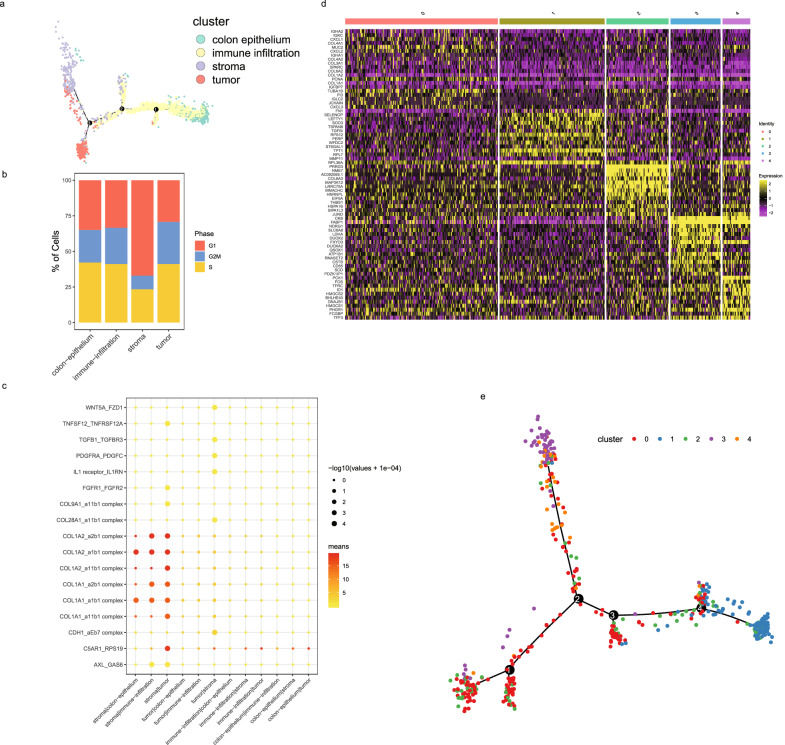
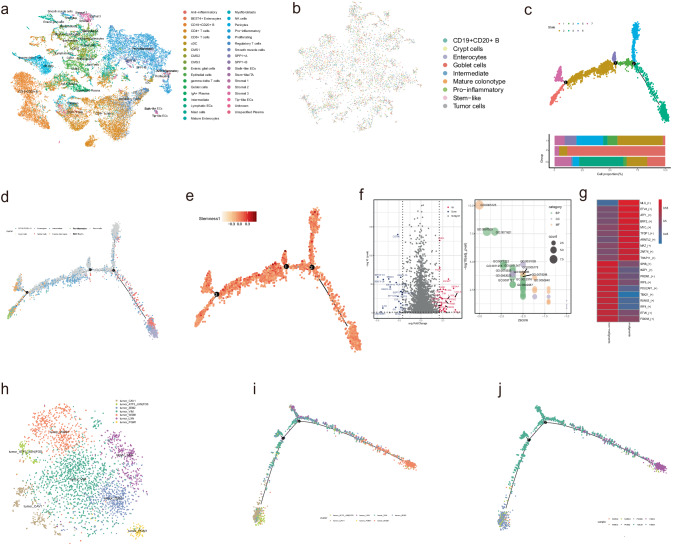
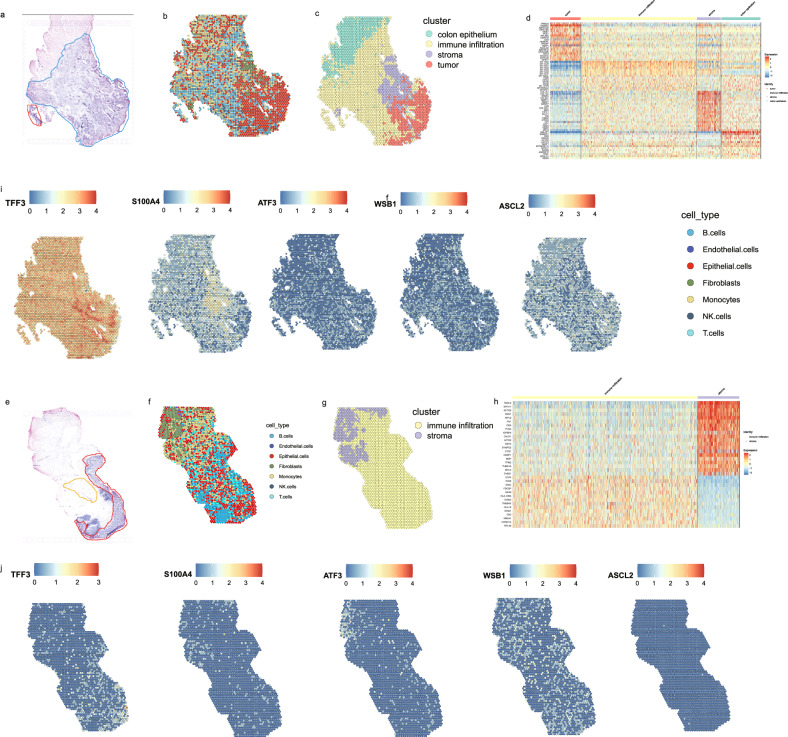
Single cell RNA sequencing (scRNA-seq), a powerful tool for studying the tumor microenvironment (TME), does not preserve/provide spatial information on tissue morphology and cellular interactions. To understand the crosstalk between diverse cellular components in proximity in the TME, we performed scRNA-seq coupled with spatial transcriptomic (ST) assay to profile 41,700 cells from three colorectal cancer (CRC) tumor-normal-blood pairs. Standalone scRNA-seq analyses revealed eight major cell populations, including B cells, T cells, Monocytes, NK cells, Epithelial cells, Fibroblasts, Mast cells, Endothelial cells. After the identification of malignant cells from epithelial cells, we observed seven subtypes of malignant cells that reflect heterogeneous status in tumor, including tumor_CAV1, tumor_ATF3_JUN | FOS, tumor_ZEB2, tumor_VIM, tumor_WSB1, tumor_LXN, and tumor_PGM1. By transferring the cellular annotations obtained by scRNA-seq to ST spots, we annotated four regions in a cryosection from CRC patients, including tumor, stroma, immune infiltration, and colon epithelium regions. Furthermore, we observed intensive intercellular interactions between stroma and tumor regions which were extremely proximal in the cryosection. In particular, one pair of ligands and receptors (C5AR1 and RPS19) was inferred to play key roles in the crosstalk of stroma and tumor regions. For the tumor region, a typical feature of TMSB4X-high expression was identified, which could be a potential marker of CRC. The stroma region was found to be characterized by VIM-high expression, suggesting it fostered a stromal niche in the TME. Collectively, single cell and spatial analysis in our study reveal the tumor heterogeneity and molecular interactions in CRC TME, which provides insights into the mechanisms underlying CRC progression and may contribute to the development of anticancer therapies targeting on non-tumor components, such as the extracellular matrix (ECM) in CRC. The typical genes we identified may facilitate to new molecular subtypes of CRC.
单细胞 RNA 测序(scRNA-seq)是研究肿瘤微环境(TME)的强大工具,它不能提供组织形态和细胞相互作用的空间信息。为了了解 TME 中邻近多种细胞成分之间的串扰,我们对三个结直肠癌(CRC)肿瘤-正常-血液对进行了 scRNA-seq 与空间转录组学(ST)分析,共对 41700 个细胞进行了分析。独立的 scRNA-seq 分析揭示了包括 B 细胞、T 细胞、单核细胞、NK 细胞、上皮细胞、成纤维细胞、肥大细胞和内皮细胞在内的 8 种主要细胞群体。从上皮细胞中鉴定出恶性细胞后,我们观察到七种恶性细胞亚型,反映了肿瘤中的异质性状态,包括肿瘤_CAV1、肿瘤_ATF3_JUN ⁇ FOS、肿瘤_ZEB2、肿瘤_VIM、肿瘤_WSB1、肿瘤_LXN 和肿瘤_PGM1。通过将 scRNA-seq 获得的细胞注释转移到 ST 点上,我们对来自 CRC 患者的冷冻切片的四个区域进行了注释,包括肿瘤、基质、免疫浸润和结肠上皮区域。此外,我们观察到在冷冻切片中非常接近的基质和肿瘤区域之间存在强烈的细胞间相互作用。特别是,一对配体和受体(C5AR1 和 RPS19)被推断在基质和肿瘤区域的串扰中发挥关键作用。对于肿瘤区域,鉴定出 TMSB4X 高表达的一个典型特征,这可能是 CRC 的一个潜在标志物。基质区域被发现以 VIM 高表达为特征,表明它在 TME 中为基质龛提供了支持。总之,我们的单细胞和空间分析揭示了结直肠癌 TME 中的肿瘤异质性和分子相互作用,为理解 CRC 进展的机制提供了线索,并可能有助于开发针对非肿瘤成分的抗癌治疗方法,如 CRC 中的细胞外基质(ECM)。我们鉴定的典型基因可能有助于发现 CRC 的新分子亚型。