Hepatobiliary/Liver Transplantation Center, The First Affiliated Hospital of Nanjing Medical University, Key Laboratory of Living Donor Transplantation, Chinese Academy of Medical Sciences, Nanjing, Jiangsu, China.
Nanjing Medical University, Nanjing, Jiangsu, China.
J Immunother Cancer. 2023 Nov 24;11(11):e007030. doi: 10.1136/jitc-2023-007030.
Single-cell RNA sequencing, also known as scRNA-seq, is a method profiling cell populations on an individual cell basis. It is particularly useful for more deeply understanding cell behavior in a complicated tumor microenvironment. Although several previous studies have examined scRNA-seq for hepatocellular carcinoma (HCC) tissues, no one has tested and analyzed HCC with different stages.
In this investigation, immune cells isolated from surrounding normal tissues and cancer tissues from 3 II-stage and 4 III-stage HCC cases were subjected to deep scRNA-seq. The analysis included 15 samples. We distinguished developmentally relevant trajectories, unique immune cell subtypes, and enriched pathways regarding differential genes. Western blot and co-immunoprecipitation were performed to demonstrate the interaction between fatty acid binding protein 1 (FABP1) and peroxisome proliferator-activated receptor gamma(PPARG). In vivo experiments were performed in a C57BL/6 mouse model of HCC established via subcutaneous injection.
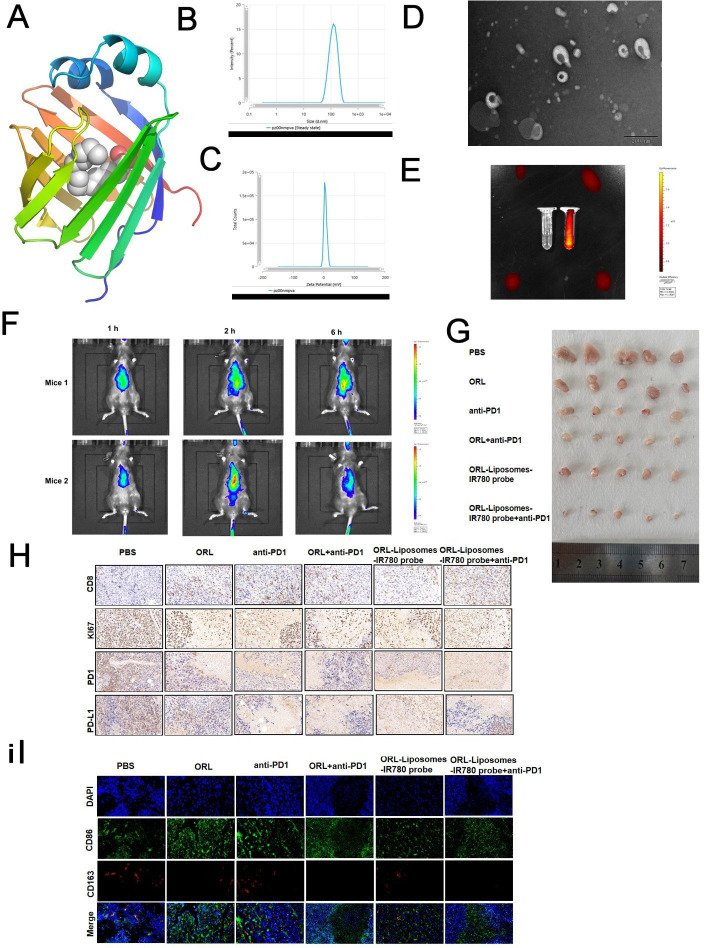
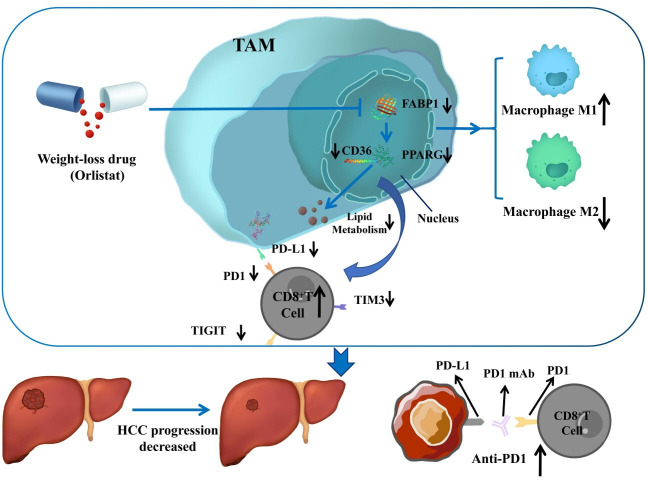
FABP1 was discovered to be overexpressed in tumor-associated macrophages (TAMs) with III-stage HCC tissues compared with II-stage HCC tissues. This finding was fully supported by immunofluorescence detection in significant amounts of HCC human samples. FABP1 deficiency in TAMs inhibited HCC progression in vitro. Mechanistically, FABP1 interacted with PPARG/CD36 in TAMs to increase fatty acid oxidation in HCC. When compared with C57BL/6 mice of the wild type, tumors in FABP1-/- mice consistently showed attenuation. The FABP1-/- group's relative proportion of regulatory T cells and natural killer cells showed a downward trend, while dendritic cells, M1 macrophages, and B cells showed an upward trend, according to the results of mass cytometry. In further clinical translation, we found that orlistat significantly inhibited FABP1 activity, while the combination of anti-programmed cell death 1(PD-1) could synergistically treat HCC progression. Liposomes loaded with orlistat and connected with IR780 probe could further enhance the therapeutic effect of orlistat and visualize drug metabolism in vivo.
ScRNA-seq atlas revealed an FABP1-dependent immunosuppressive environment in HCC. Orlistat significantly inhibited FABP1 activity, while the combination of anti-PD-1 could synergistically treat HCC progression. This study identified new treatment targets and strategies for HCC progression, contributing to patients with advanced HCC from new perspectives.
单细胞 RNA 测序,也称为 scRNA-seq,是一种在单细胞基础上对细胞群体进行分析的方法。它对于更深入地了解复杂肿瘤微环境中的细胞行为特别有用。尽管之前有几项研究检查了用于肝细胞癌 (HCC) 组织的 scRNA-seq,但没有人测试和分析过不同阶段的 HCC。
在这项研究中,从 3 例 II 期和 4 例 III 期 HCC 的周围正常组织和癌组织中分离出免疫细胞,进行深度 scRNA-seq 分析。该分析包括 15 个样本。我们区分了与发育相关的轨迹、独特的免疫细胞亚型以及与差异基因相关的富集途径。进行 Western blot 和免疫共沉淀实验以证明脂肪酸结合蛋白 1 (FABP1) 和过氧化物酶体增殖物激活受体γ (PPARG) 之间的相互作用。在通过皮下注射建立的 C57BL/6 小鼠 HCC 模型中进行了体内实验。
与 II 期 HCC 组织相比,III 期 HCC 组织中的肿瘤相关巨噬细胞 (TAMs) 中发现 FABP1 过度表达。这一发现得到了大量 HCC 人类样本中免疫荧光检测的充分支持。TAMs 中 FABP1 的缺失抑制了 HCC 的体外进展。从机制上讲,FABP1 与 TAMs 中的 PPARG/CD36 相互作用以增加 HCC 中的脂肪酸氧化。与野生型 C57BL/6 小鼠相比,FABP1-/- 小鼠的肿瘤始终显示出衰减。根据质谱细胞术的结果,FABP1-/- 组调节性 T 细胞和自然杀伤细胞的相对比例呈下降趋势,而树突状细胞、M1 巨噬细胞和 B 细胞呈上升趋势。在进一步的临床转化中,我们发现奥利司他显著抑制了 FABP1 的活性,而抗程序性细胞死亡 1 (PD-1) 的联合治疗可以协同治疗 HCC 的进展。负载奥利司他的脂质体与 IR780 探针相连,可进一步增强奥利司他的治疗效果,并在体内可视化药物代谢。
scRNA-seq 图谱揭示了 HCC 中依赖 FABP1 的免疫抑制环境。奥利司他显著抑制 FABP1 活性,而抗 PD-1 的联合治疗可以协同治疗 HCC 的进展。这项研究确定了 HCC 进展的新治疗靶点和策略,为晚期 HCC 患者提供了新的视角。