Depatment of Orthodontics and Dentofacial Orthopedics, Charité - Universitätsmedizin Berlin, Aßmannshauser Straße 4-6, 14197, Berlin, Germany.
School of Design, University of Leeds, Woodhouse Lane, Leeds, LS2 9JT, England.
Clin Oral Investig. 2024 May 11;28(6):308. doi: 10.1007/s00784-024-05695-2.
This study aimed to evaluate the visual improvement of resin infiltration of white spot lesions (WSL) during orthodontic treatment with the multibracket appliance (MBA) compared to fluoride varnish.
Patients aged 12-17 years with at least one WSL with an International Caries Detection and Assessment System (ICDAS) score of 1-2 during an active MBA treatment were included and randomized to receive either resin infiltration (Icon) or fluoride application (Flairesse). Standardized digital images were obtained before, one-day, one-week, one-month, three-months and six-months after treatment using a DSLR camera and a matching polarization filter. A grey reference card was used for color standardization. A Matlab routine was used to measure the color difference between adjacent healthy enamel and treated WSL. The independent-samples t-test was used for intergroup and paired-samples t-test for intragroup comparison.
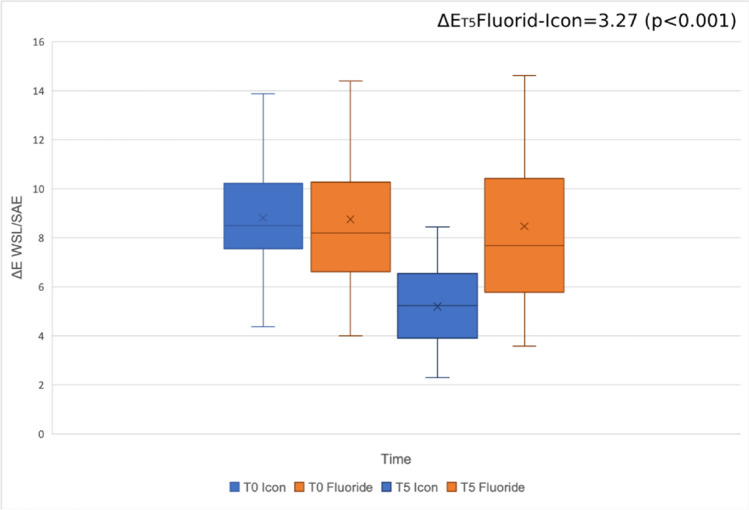
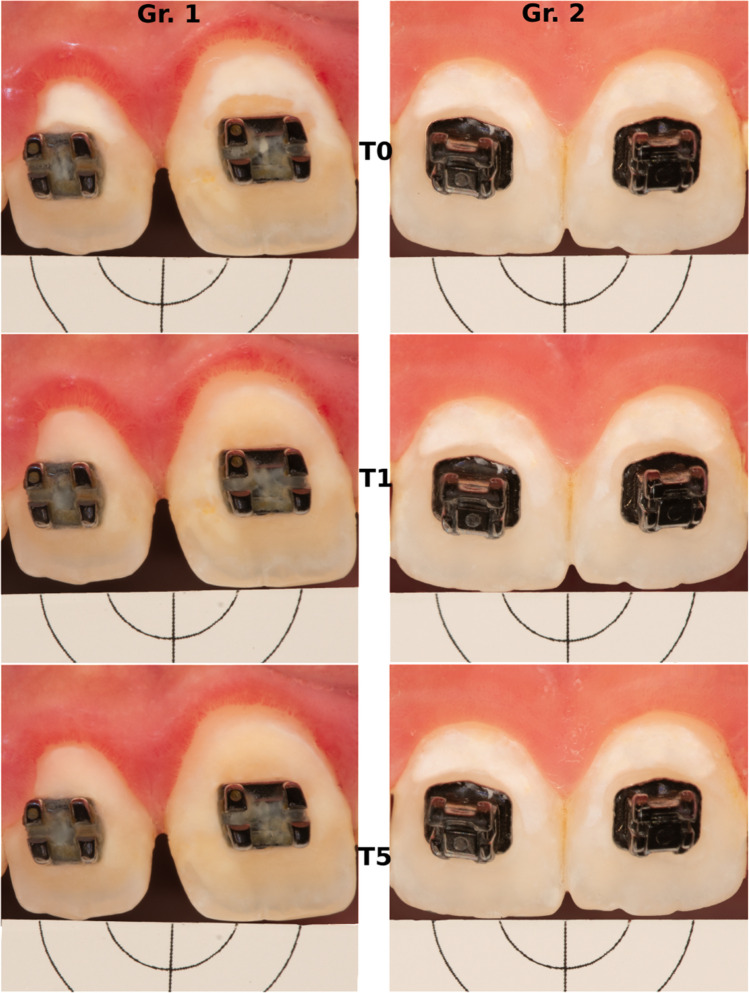
Images of 116 teeth from 36 patients were analyzed. The ΔE for the "Icon" treated WSL was smaller (T1 = 5.0 ± 1.4) than in the fluoride group (T1 = 8.4 ± 3.2). Caries infiltration significantly improved the aesthetic appearance of WSL (p < 0.001), which remained satisfactory at six months (T5 = 5.2 ± 1.6).
WSL infiltration management during orthodontic treatment was superior to topical fluoridation in not only arresting the enamel lesions but also significantly improving the aesthetic appearance of demineralized regions around the brackets.
WSL treatment in orthodontic patients is usually initiated after debonding. Research has shown that the earlier WSL is treated, the better the aesthetic outcome. There is limited data on the efficacy of resin infiltration of WSL during orthodontic treatment.
本研究旨在评估多托槽矫治器(MBA)治疗期间与氟化物涂料相比,树脂渗透对白垩斑(WSL)的视觉改善效果。
纳入年龄在 12-17 岁之间,在 MBA 治疗期间至少有一个 WSL,其国际龋病检测和评估系统(ICDAS)评分为 1-2,并随机分为接受树脂渗透(Icon)或氟化物应用(Flairesse)的患者。在治疗前、治疗后 1 天、1 周、1 个月、3 个月和 6 个月,使用数码单反相机和匹配的偏振滤镜获得标准化的数字图像。使用灰度参考卡进行颜色标准化。使用 Matlab 例程测量相邻健康釉质和治疗 WSL 之间的颜色差异。采用独立样本 t 检验进行组间比较,配对样本 t 检验进行组内比较。
对 36 例患者的 116 颗牙齿的图像进行了分析。“Icon”治疗的 WSL 的 ΔE 较小(T1=5.0±1.4),而氟化物组的 ΔE 较大(T1=8.4±3.2)。牙本质渗透显著改善了 WSL 的美学外观(p<0.001),在 6 个月时仍保持满意(T5=5.2±1.6)。
在正畸治疗中,WSL 渗透管理不仅在阻止釉质病变方面优于局部氟化物处理,而且在显著改善托槽周围脱矿区域的美学外观方面也具有优越性。
正畸患者的 WSL 治疗通常在拆除托槽后开始。研究表明,WSL 越早治疗,美学效果越好。关于正畸治疗期间 WSL 树脂渗透的疗效数据有限。