Yuu Elizabeth Y, Bührer Christoph, Eckmanns Tim, Fulde Marcus, Herz Michaela, Kurzai Oliver, Lindstedt Christin, Panagiotou Gianni, Piro Vitor C, Radonic Aleksandar, Renard Bernhard Y, Reuss Annicka, Siliceo Sara Leal, Thielemann Nadja, Thürmer Andrea, Vorst Kira van, Wieler Lothar H, Haller Sebastian
Data Analytics & Computational Statistics, Hasso Plattner Institute, University of Potsdam, Prof.-Dr.-Helmert-Straße 2-3, 14482 , Potsdam, Germany.
Charité - Universitätsmedizin, Berlin, Germany.
Gut Pathog. 2024 May 12;16(1):27. doi: 10.1186/s13099-024-00616-w.
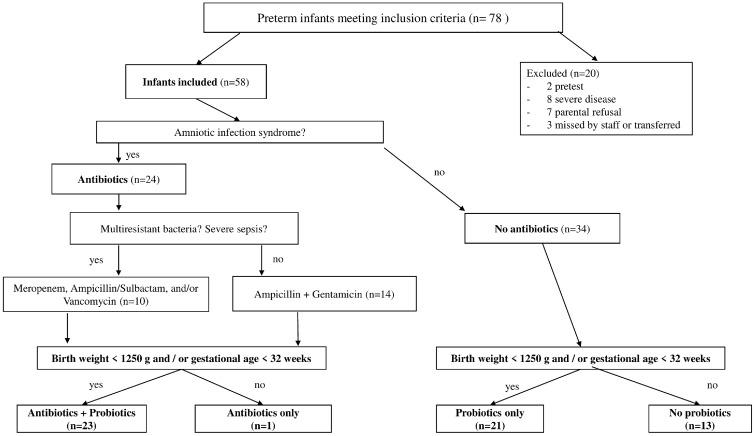
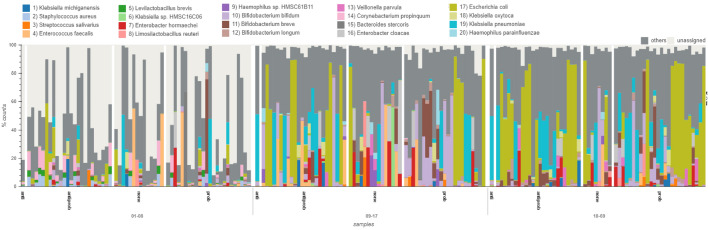
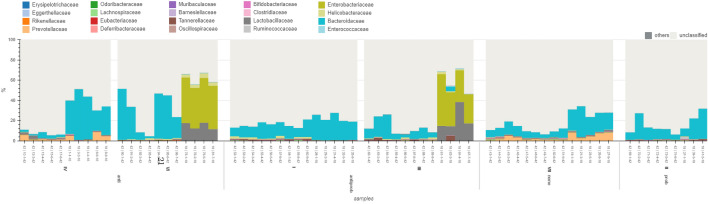
Enhancing our understanding of the underlying influences of medical interventions on the microbiome, resistome and mycobiome of preterm born infants holds significant potential for advancing infection prevention and treatment strategies. We conducted a prospective quasi-intervention study to better understand how antibiotics, and probiotics, and other medical factors influence the gut development of preterm infants. A controlled neonatal mice model was conducted in parallel, designed to closely reflect and predict exposures. Preterm infants and neonatal mice were stratified into four groups: antibiotics only, probiotics only, antibiotics followed by probiotics, and none of these interventions. Stool samples from both preterm infants and neonatal mice were collected at varying time points and analyzed by 16 S rRNA amplicon sequencing, ITS amplicon sequencing and whole genome shotgun sequencing.
The human infant microbiomes showed an unexpectedly high degree of heterogeneity. Little impact from medical exposure (antibiotics/probiotics) was observed on the strain patterns, however, Bifidobacterium bifidum was found more abundant after exposure to probiotics, regardless of prior antibiotic administration. Twenty-seven antibiotic resistant genes were identified in the resistome. High intra-variability was evident within the different treatment groups. Lastly, we found significant effects of antibiotics and probiotics on the mycobiome but not on the microbiome and resistome of preterm infants.
Although our analyses showed transient effects, these results provide positive motivation to continue the research on the effects of medical interventions on the microbiome, resistome and mycobiome of preterm infants.
加深我们对医疗干预对早产婴儿微生物组、耐药基因组和真菌组潜在影响的理解,对于推进感染预防和治疗策略具有重大潜力。我们开展了一项前瞻性准干预研究,以更好地了解抗生素、益生菌及其他医疗因素如何影响早产儿的肠道发育。同时进行了一个对照新生儿小鼠模型,旨在密切反映和预测暴露情况。早产儿和新生小鼠被分为四组:仅使用抗生素、仅使用益生菌、先使用抗生素后使用益生菌,以及不进行这些干预。在不同时间点收集早产儿和新生小鼠的粪便样本,并通过16S rRNA扩增子测序、ITS扩增子测序和全基因组鸟枪法测序进行分析。
人类婴儿微生物组显示出出乎意料的高度异质性。未观察到医疗暴露(抗生素/益生菌)对菌株模式有显著影响,然而,无论之前是否使用过抗生素,暴露于益生菌后双歧杆菌属的丰度更高。在耐药基因组中鉴定出27个抗生素抗性基因。不同治疗组内存在明显的高变异性。最后,我们发现抗生素和益生菌对真菌组有显著影响,但对早产儿的微生物组和耐药基因组没有影响。
尽管我们的分析显示出短暂的影响,但这些结果为继续研究医疗干预对早产儿微生物组、耐药基因组和真菌组的影响提供了积极的动力。