https://ror.org/02e7b5302 Lee Kong Chian School of Medicine, Nanyang Technological University, Singapore, Singapore.
Yong Loo Lin School of Medicine, National University of Singapore, Singapore, Singapore.
Life Sci Alliance. 2024 May 13;7(7). doi: 10.26508/lsa.202402598. Print 2024 Jul.
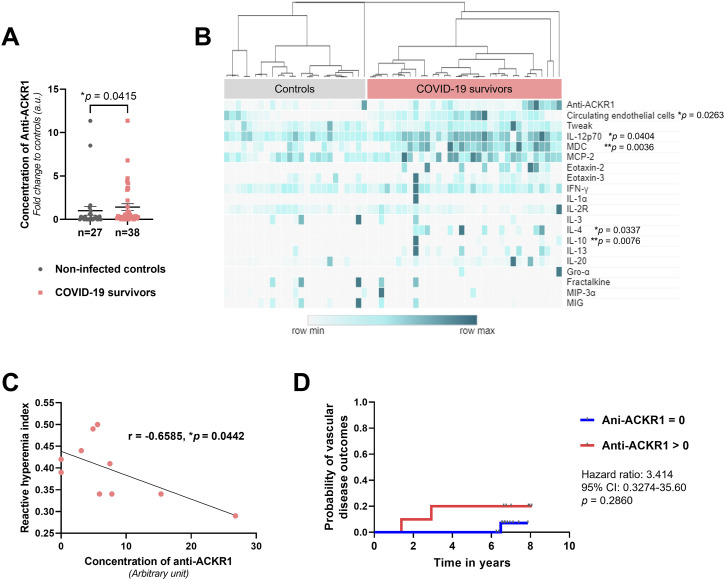
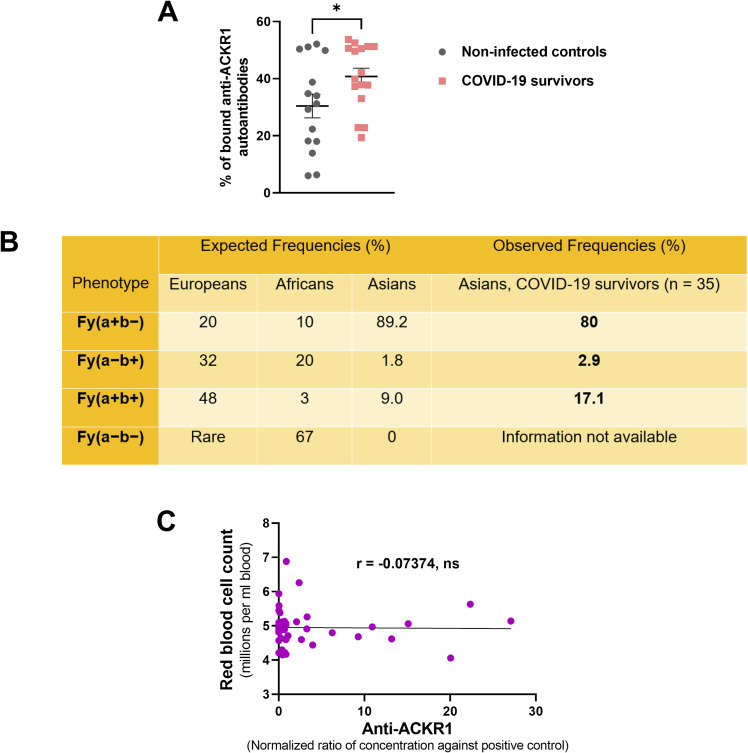
Subclinical vascular impairment can be exacerbated in individuals who experience sustained inflammation after COVID-19 infection. Our study explores the prevalence and impact of autoantibodies on vascular dysfunction in healthy COVID-19 survivors, an area that remains inadequately investigated. Focusing on autoantibodies against the atypical chemokine receptor 1 (ACKR1), COVID-19 survivors demonstrated significantly elevated anti-ACKR1 autoantibodies, correlating with systemic cytokines, circulating damaged endothelial cells, and endothelial dysfunction. An independent cohort linked these autoantibodies to increased vascular disease outcomes during a median 6.7-yr follow-up. We analyzed a single-cell transcriptome atlas of endothelial cells from diverse mouse tissues, identifying enriched expressions in venous regions of the brain and soleus muscle vasculatures, which holds intriguing implications for tissue-specific venous thromboembolism manifestations reported in COVID-19. Functionally, purified immunoglobulin G (IgG) extracted from patient plasma did not trigger cell apoptosis or increase barrier permeability in human vein endothelial cells. Instead, plasma IgG enhanced antibody-dependent cellular cytotoxicity mediated by patient PBMCs, a phenomenon alleviated by blocking peptide or liposome ACKR1 recombinant protein. The blocking peptide uncovered that purified IgG from COVID-19 survivors possessed potential epitopes in the N-terminal extracellular domain of ACKR1, which effectively averted antibody-dependent cellular cytotoxicity. Our findings offer insights into therapeutic development to mitigate autoantibody reactivity in blood vessels in chronic inflammation.
亚临床血管损伤可能在经历 COVID-19 感染后持续炎症的个体中加重。我们的研究探讨了健康 COVID-19 幸存者中自身抗体对血管功能障碍的患病率和影响,这一领域仍未得到充分研究。我们专注于针对非典型趋化因子受体 1(ACKR1)的自身抗体,COVID-19 幸存者表现出明显升高的抗 ACKR1 自身抗体,与全身细胞因子、循环受损内皮细胞和内皮功能障碍相关。一个独立的队列将这些自身抗体与中位随访 6.7 年期间增加的血管疾病结局联系起来。我们分析了来自多种小鼠组织的内皮细胞的单细胞转录组图谱,鉴定出在大脑和比目鱼肌血管的静脉区域中富集的表达,这对 COVID-19 中报告的组织特异性静脉血栓栓塞表现具有有趣的意义。在功能上,从患者血浆中提取的纯化免疫球蛋白 G(IgG)不会引发人静脉内皮细胞的细胞凋亡或增加屏障通透性。相反,血浆 IgG 增强了患者 PBMC 介导的抗体依赖性细胞毒性,这一现象通过阻断肽或脂质体 ACKR1 重组蛋白得到缓解。该阻断肽揭示了 COVID-19 幸存者的纯化 IgG 具有 ACKR1 胞外结构域 N 端的潜在表位,有效地避免了抗体依赖性细胞毒性。我们的研究结果为开发治疗方法提供了思路,以减轻慢性炎症中血管中的自身抗体反应。