Collins M K, Tanigawa G, Kissonerghis A M, Ritter M, Price K M, Tonegawa S, Owen M J
Proc Natl Acad Sci U S A. 1985 Jul;82(13):4503-7. doi: 10.1073/pnas.82.13.4503.
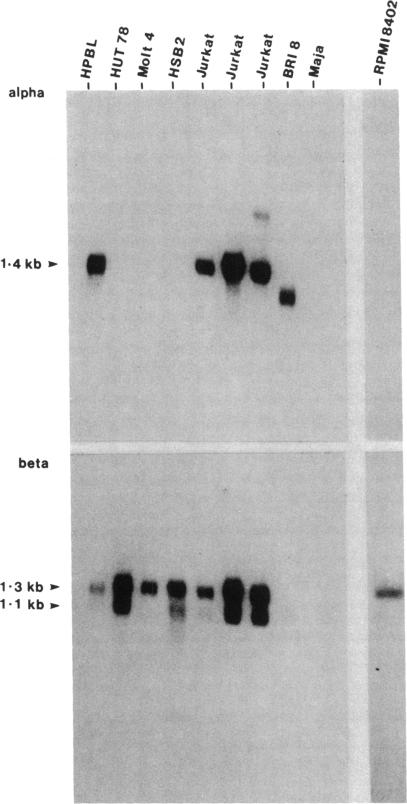
A cDNA clone encoding the alpha chain of the human T-cell antigen receptor was isolated by screening a library from the human T-cell line Jurkat with a mouse alpha-chain cDNA clone. This human alpha-chain clone, together with a human antigen receptor beta-chain cDNA clone, was used to determine the stage of T-cell development at which antigen receptor mRNAs first appear. Blot-hybridization analysis of mRNA isolated from a panel of human thymic tumor lines clearly demonstrated that beta-chain transcripts could be detected in all T-lineage cells. However, alpha-chain transcripts were only found in the most phenotypically mature lines, which express the antigen receptor-associated molecule T3. Furthermore, beta-chain transcripts were abundant in RNA prepared from purified T3-negative thymocytes, whereas alpha-chain transcripts were virtually absent. From these results we conclude that alpha-chain expression occurs later in thymic ontogeny than that of the beta chain and propose that it controls surface expression of the antigen receptor-T3 complex.
通过用小鼠α链cDNA克隆筛选人T细胞系Jurkat的文库,分离出了编码人T细胞抗原受体α链的cDNA克隆。这个人类α链克隆与一个人类抗原受体β链cDNA克隆一起,被用于确定抗原受体mRNA首次出现时的T细胞发育阶段。对从一组人胸腺肿瘤系分离的mRNA进行印迹杂交分析清楚地表明,在所有T系细胞中都能检测到β链转录本。然而,α链转录本仅在最表型成熟的细胞系中发现,这些细胞系表达与抗原受体相关的分子T3。此外,从纯化的T3阴性胸腺细胞制备的RNA中β链转录本丰富,而α链转录本几乎不存在。从这些结果我们得出结论,α链表达在胸腺发育过程中比β链出现得晚,并提出它控制抗原受体-T3复合物的表面表达。