Princess Margaret Cancer Centre, University Health Network, Toronto, Ontario, Canada.
Department of Medical Biophysics, University of Toronto, Toronto, Ontario, Canada.
Protein Sci. 2024 Jun;33(6):e5016. doi: 10.1002/pro.5016.
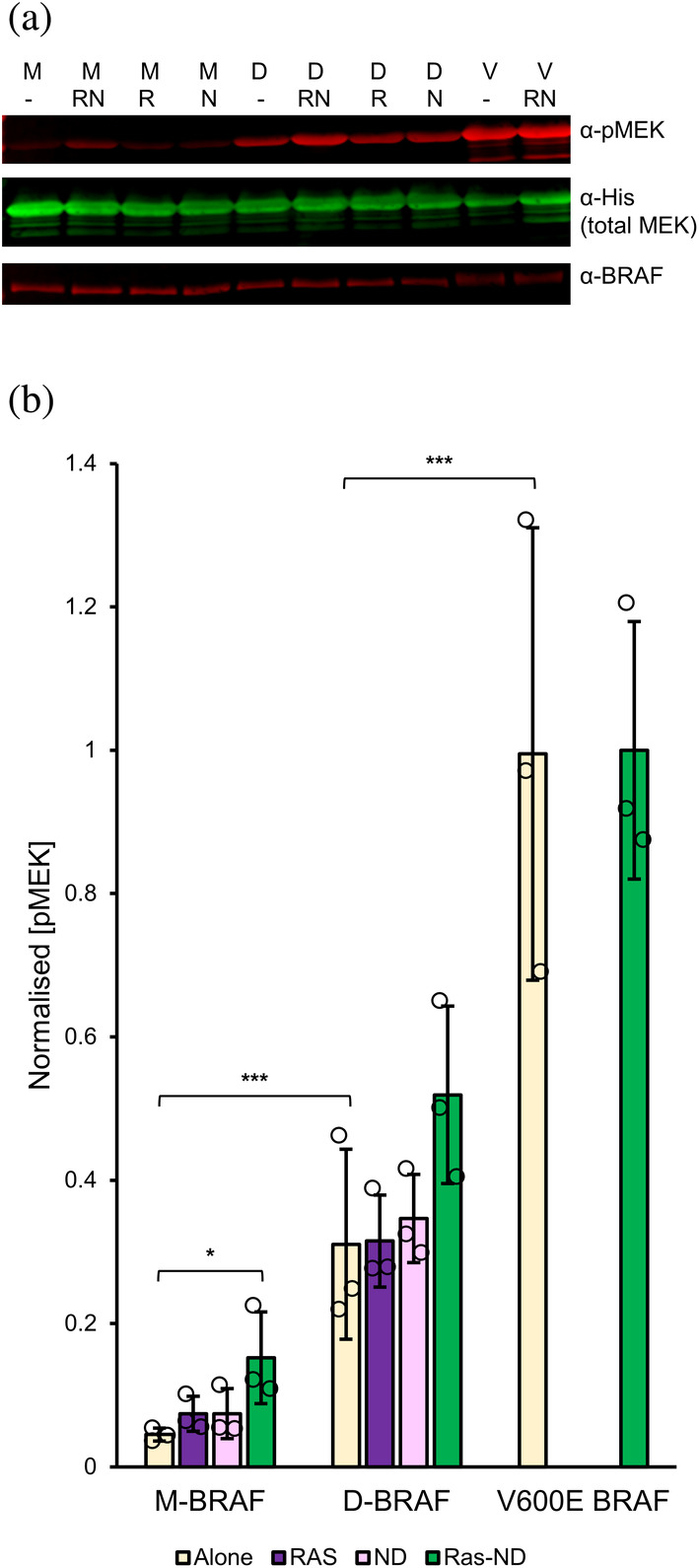
RAF kinases are key components of the RAS-MAPK signaling pathway, which drives cell growth and is frequently overactivated in cancer. Upstream signaling activates the small GTPase RAS, which recruits RAF to the cell membrane, driving a transition of the latter from an auto-inhibited monomeric conformation to an active dimer. Despite recent progress, mechanistic details underlying RAF activation remain unclear, particularly the role of RAS and the membrane in mediating this conformational rearrangement of RAF together with 14-3-3 to permit RAF kinase domain dimerization. Here, we reconstituted an active complex of dimeric BRAF, a 14-3-3 dimer and two KRAS4B on a nanodisc bilayer and verified that its assembly is GTP-dependent. Biolayer interferometry (BLI) was used to compare the binding affinities of monomeric versus dimeric full-length BRAF:14-3-3 complexes for KRAS4B-conjugated nanodiscs (RAS-ND) and to investigate the effects of membrane lipid composition and spatial density of KRAS4B on binding. 1,2-Dioleoyl-sn-glycero-3-phospho-L-serine (DOPS) and higher KRAS4B density enhanced the interaction of BRAF:14-3-3 with RAS-ND to different degrees depending on BRAF oligomeric state. We utilized our reconstituted system to dissect the effects of KRAS4B and the membrane on the kinase activity of monomeric and dimeric BRAF:14-3-3 complexes, finding that KRAS4B or nanodiscs alone were insufficient to stimulate activity, whereas RAS-ND increased activity of both states of BRAF. The reconstituted assembly of full-length BRAF with 14-3-3 and KRAS on a cell-free, defined lipid bilayer offers a more holistic biophysical perspective to probe regulation of this multimeric signaling complex at the membrane surface.
RAF 激酶是 RAS-MAPK 信号通路的关键组成部分,该通路驱动细胞生长,并且在癌症中经常过度激活。上游信号激活小 GTP 酶 RAS,后者将 RAF 募集到细胞膜上,驱动 RAF 从自动抑制的单体构象转变为活性二聚体。尽管最近取得了进展,但 RAF 激活的机制细节仍不清楚,特别是 RAS 和膜在介导 RAF 与 14-3-3 一起构象重排以允许 RAF 激酶结构域二聚化方面的作用。在这里,我们在纳米盘双层上重新构建了二聚体 BRAF、二聚体 14-3-3 和两个 KRAS4B 的活性复合物,并验证了其组装是 GTP 依赖性的。生物层干涉 (BLI) 用于比较单体与二聚全长 BRAF:14-3-3 复合物与 KRAS4B 缀合纳米盘 (RAS-ND) 的结合亲和力,并研究膜脂质组成和 KRAS4B 的空间密度对结合的影响。1,2-二油酰基-sn-甘油-3-磷酸-L-丝氨酸 (DOPS) 和更高的 KRAS4B 密度在不同程度上增强了 BRAF:14-3-3 与 RAS-ND 的相互作用,具体取决于 BRAF 的寡聚状态。我们利用我们重新构建的系统来剖析 KRAS4B 和膜对单体和二聚 BRAF:14-3-3 复合物激酶活性的影响,发现 KRAS4B 或纳米盘本身不足以刺激活性,而 RAS-ND 增加了两种 BRAF 状态的活性。全长 BRAF 与 14-3-3 和 KRAS 在无细胞、定义的脂质双层上的重新组装提供了更全面的生物物理视角,可在膜表面探测这种多聚信号复合物的调节。