Max Planck Institute for Heart and Lung Research, Department of Developmental Genetics, Bad Nauheim, Germany.
German Centre for Cardiovascular Research (DZHK), Partner Site Rhine-Main, Bad Nauheim, Germany.
Sci Adv. 2024 May 17;10(20):eadl0633. doi: 10.1126/sciadv.adl0633. Epub 2024 May 15.
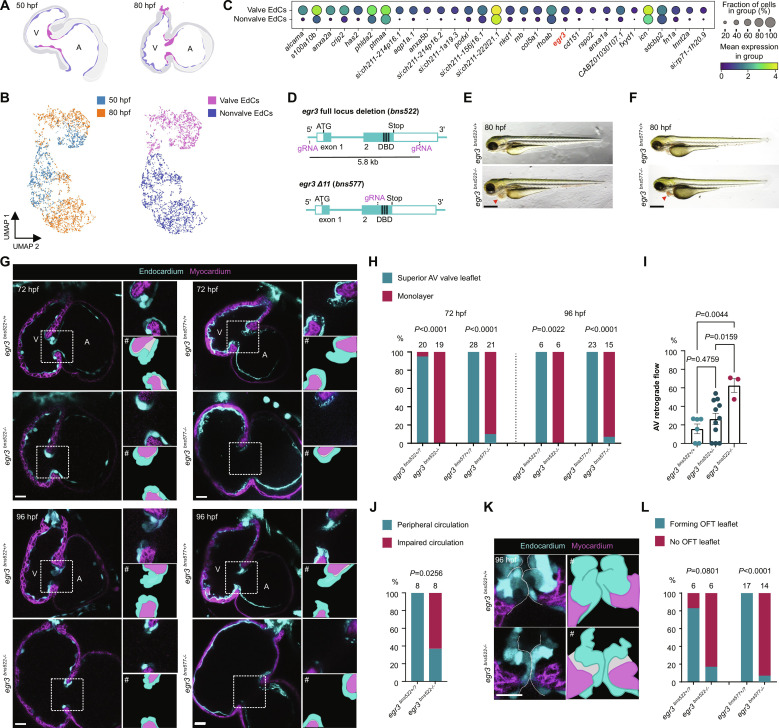
Biomechanical forces, and their molecular transducers, including key mechanosensitive transcription factor genes, such as , are required for cardiac valve morphogenesis. However, mutants fail to completely recapitulate the valveless phenotype observed under no-flow conditions. Here, we identify the transcription factor EGR3 as a conserved biomechanical force transducer critical for cardiac valve formation. We first show that null zebrafish display a complete and highly penetrant loss of valve leaflets, leading to severe blood regurgitation. Using tissue-specific loss- and gain-of-function tools, we find that during cardiac valve formation, Egr3 functions cell-autonomously in endothelial cells, and identify one of its effectors, the nuclear receptor Nr4a2b. We further find that mechanical forces up-regulate / expression in the developing zebrafish heart and in porcine valvular endothelial cells, as well as during human aortic valve remodeling. Altogether, these findings reveal that EGR3 is necessary to transduce the biomechanical cues required for zebrafish cardiac valve morphogenesis, and potentially for pathological aortic valve remodeling in humans.
生物力学力及其分子转导器,包括关键的机械敏感转录因子基因,如 ,是心脏瓣膜形态发生所必需的。然而, 突变体不能完全再现无流条件下观察到的无瓣膜表型。在这里,我们确定转录因子 EGR3 是一种保守的生物力学力转导蛋白,对于心脏瓣膜的形成至关重要。我们首先表明, 缺失的斑马鱼表现出完全且高度穿透性的瓣膜小叶缺失,导致严重的血液倒流。使用组织特异性的缺失和功能获得工具,我们发现,在心脏瓣膜形成过程中,Egr3 在血管内皮细胞中自主发挥作用,并鉴定出其效应物之一,核受体 Nr4a2b。我们进一步发现,机械力在上皮细胞中上调 / 表达,在发育中的斑马鱼心脏和猪瓣膜内皮细胞中,以及在人类主动脉瓣重塑过程中。总之,这些发现表明 EGR3 是必需的,以转导生物力学线索,这对于斑马鱼心脏瓣膜形态发生,以及人类病理性主动脉瓣重塑是必需的。