Gela Yibeltal Yismaw, Limenh Liknaw Workie, Simegn Wudneh, Ayenew Wondim, Chanie Gashaw Sisay, Seid Abdulwase Mohammed, Beyna Alemante Tafese, Esubalew Dereje, Mitku Melese Legesse, Mengesha Assefa Kebad, Melese Mihret
Department of Physiology, College of Medicine and Health Sciences, University of Gondar, Gondar, Ethiopia.
Department of Pharmaceutics, School of Pharmacy, College of Medicine and Health Sciences, University of Gondar, Gondar, Ethiopia.
Front Med (Lausanne). 2024 May 1;11:1366010. doi: 10.3389/fmed.2024.1366010. eCollection 2024.
Poor sleep quality is a common concern in chronic kidney disease (CKD) patients, which can accelerate the progression of chronic renal disease and negatively impact their health-related quality of life, potentially leading to greater morbidity and mortality rates. It can also have an effect on the immune system, cognitive function, and emotional well-being of CKD patients. Furthermore, poor sleep quality may contribute to drug noncompliance and decreased participation in the entire treatment plan. Nonetheless, no research has been undertaken in Ethiopia on the prevalence of poor sleep quality and its associated factors among CKD patients.
This study aimed to assess the prevalence of poor quality of sleep and associated factors among chronic kidney disease patients at the University of Gondar Comprehensive Specialized and Felege Hiwot Referral Hospitals in 2020.
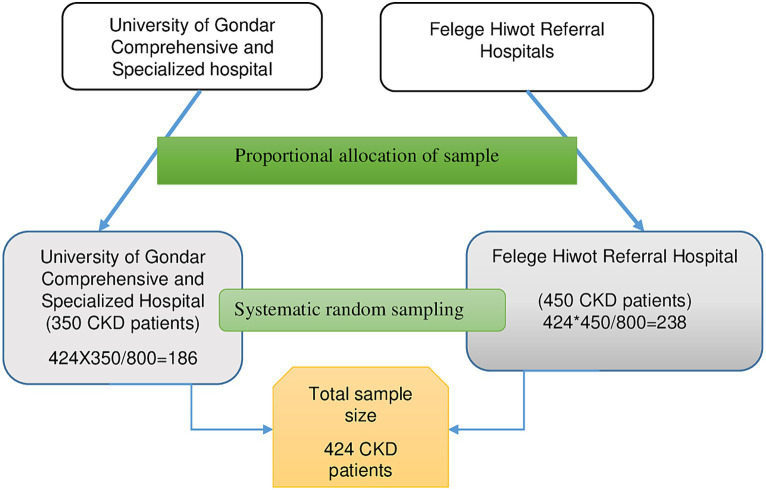
A cross-sectional study design was implemented at the University of Gondar Comprehensive Specialized and Felege Hiwot Referral Hospitals between February and April 2020. The study participants were chosen through systematic random sampling techniques. The Pittsburgh Sleep Quality Index (PSQI), a validated assessment tool, was utilized to measure sleep quality. A PSQI total score > 5 was used as an indicator of poor sleep quality. Subsequently, the data obtained were entered into Epi Data version 3.0 and then transferred to STATA 14 for analysis. Both bivariable and multivariable binary logistic regression analyses were performed to recognize factors associated with poor sleep quality. In the multivariable logistic regression analysis, variables demonstrating a -value of ≤0.05 were considered statistically associated to poor sleep quality.
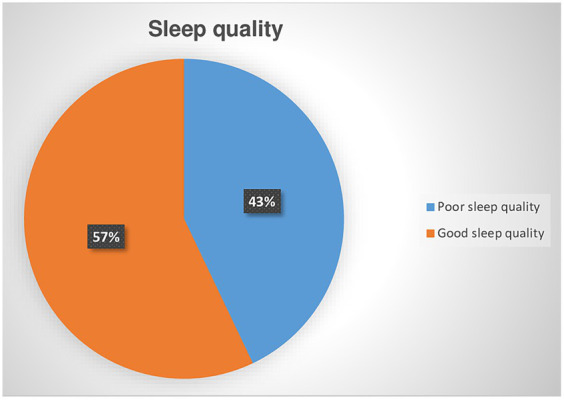
In this study, 424 CKD patients were included. Among screened CKD patients, 42.9% tested positive for poor sleep quality with a 95% CI (38 to 47%). Independent predictors of poor sleep quality among CKD patients were common mental disorder [AOR = 1.8, 95% CI (1.19-2.89)], anemia [AOR = 2.7, 95% CI (1.71-4.36)], declined eGFR between 60 and 89.9 [AOR = 1.6; 95% CI (2.28-5.54)], 30-59.9 [AOR = 2.6, 95% CI (1.53-4.43)], and ≤ 30 [AOR = 3.8, 95% CI (1.17-12.61)], age > 50 years [AOR = 1.7(1.11-2.69)] and duration of disease 2.9 [AOR = 2.9, 95% CI (1.77-4.90)].
In our study, almost 1 out of 2 CKD patients assessed for poor sleep quality tested positive. It was noted that poor sleep quality was more frequent among CKD patients with common mental disorders, anemia, decreased eGFR levels, individuals aged over 50 years, and those with a longer duration of the disease. Consequently, it's advised to regularly screen these CKD patients for poor sleep quality.
睡眠质量差是慢性肾脏病(CKD)患者常见的问题,它会加速慢性肾病的进展,并对其健康相关生活质量产生负面影响,可能导致更高的发病率和死亡率。它还会影响CKD患者的免疫系统、认知功能和情绪健康。此外,睡眠质量差可能导致药物治疗依从性差,并减少对整个治疗计划的参与度。然而,埃塞俄比亚尚未对CKD患者睡眠质量差的患病率及其相关因素进行研究。
本研究旨在评估2020年贡德尔大学综合专科医院和费莱格·希沃特转诊医院慢性肾脏病患者睡眠质量差的患病率及其相关因素。
2020年2月至4月在贡德尔大学综合专科医院和费莱格·希沃特转诊医院采用横断面研究设计。研究参与者通过系统随机抽样技术选取。使用经过验证的评估工具匹兹堡睡眠质量指数(PSQI)来测量睡眠质量。PSQI总分>5被用作睡眠质量差的指标。随后,将获得的数据录入Epi Data 3.0版本,然后转移到STATA 14进行分析。进行双变量和多变量二元逻辑回归分析以识别与睡眠质量差相关的因素。在多变量逻辑回归分析中,显示P值≤0.05的变量被认为与睡眠质量差在统计学上相关。
本研究纳入了424例CKD患者。在筛查的CKD患者中,42.9%睡眠质量差检测呈阳性,95%置信区间为(38%至47%)。CKD患者睡眠质量差的独立预测因素包括常见精神障碍[AOR = 1.8,95%置信区间(1.19 - 2.89)]、贫血[AOR = 2.7,95%置信区间(1.71 - 4.36)]、估算肾小球滤过率(eGFR)在60至89.9之间下降[AOR = 1.6;95%置信区间(2.28 - 5.54)]、30 - 59.9之间[AOR = 2.6,95%置信区间(1.53 - 4.43)]以及≤30[AOR = 3.8,95%置信区间(1.17 - 12.61)]、年龄>50岁[AOR = 1.7(1.11 - 2.69)]和病程2.9年[AOR = 2.9,95%置信区间(1.77 - 4.90)]。
在我们的研究中,接受睡眠质量差评估的CKD患者中,几乎每2人就有1人检测呈阳性。值得注意的是,在患有常见精神障碍、贫血、eGFR水平降低、年龄超过50岁以及病程较长的CKD患者中,睡眠质量差更为常见。因此,建议定期对这些CKD患者进行睡眠质量差的筛查。