
基于pCCD定制耦合簇模型的电离势基准测试
Benchmarking Ionization Potentials from pCCD Tailored Coupled Cluster Models.
作者信息
Gałyńska Marta, Boguslawski Katharina
机构信息
Institute of Physics, Faculty of Physics, Astronomy, and Informatics, Nicolaus Copernicus University in Toruń, Grudziadzka 5, 87-100 Toruń, Poland.
出版信息
J Chem Theory Comput. 2024 May 28;20(10):4182-4195. doi: 10.1021/acs.jctc.4c00172. Epub 2024 May 16.
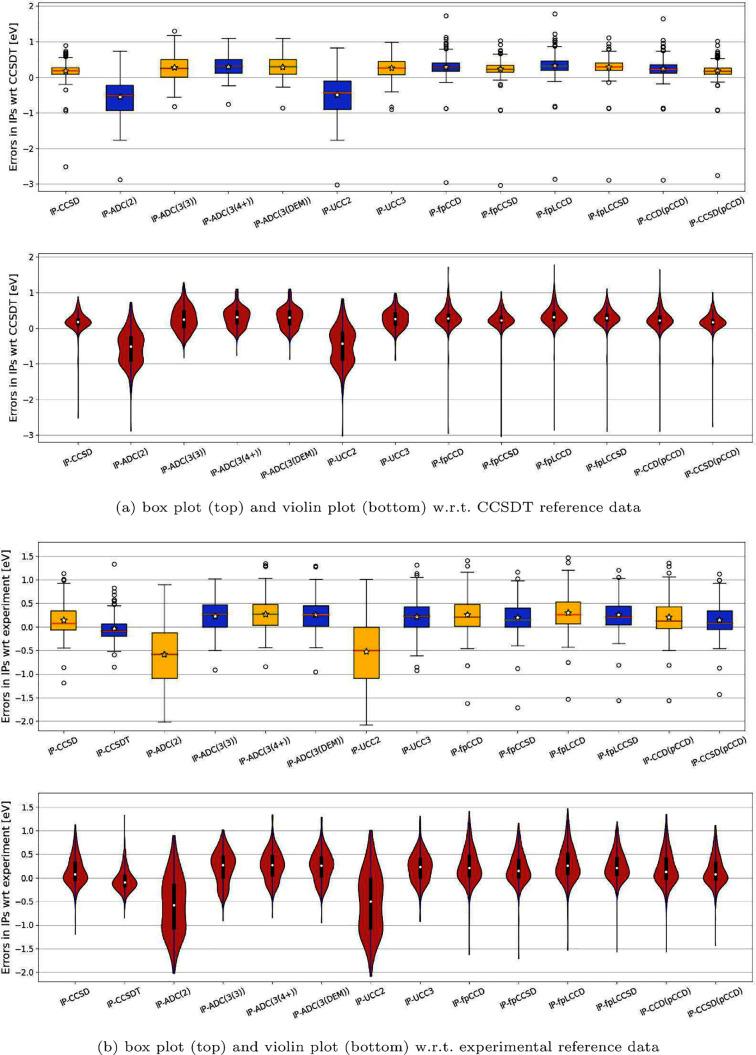
The ionization potential (IP) is an important parameter providing essential insights into the reactivity of chemical systems. IPs are also crucial for designing, optimizing, and understanding the functionality of modern technological devices. We recently showed that limiting the CC ansatz to the seniority-zero sector proves insufficient in predicting reliable and accurate ionization potentials within an IP equation-of-motion coupled-cluster formalism. Specifically, the absence of dynamical correlation in the seniority-zero pair coupled cluster doubles (pCCD) model led to unacceptably significant errors of approximately 1.5 eV. In this work, we aim to explore the impact of dynamical correlation and the choice of the molecular orbital basis (canonical vs localized) in CC-type methods targeting 230 ionized states in 70 molecules, comprising small organic molecules, medium-sized organic acceptors, and nucleobases. We focus on pCCD-based approaches as well as the conventional IP-EOM-CCD and IP-EOM-CCSD. Their performance is compared to the CCSD(T) or CCSDT equivalent and experimental reference data. Our statistical analysis reveals that all investigated frozen-pair coupled cluster methods exhibit similar performance, with differences in errors typically within chemical accuracy (1 kcal/mol or 0.05 eV). Notably, the effect of the molecular orbital basis, such as canonical Hartree-Fock or natural pCCD-optimized orbitals, on the IPs is marginal if dynamical correlation is accounted for. Our study suggests that triple excitations are crucial in achieving chemical accuracy in IPs when modeling electron detachment processes with pCCD-based methods.
电离势(IP)是一个重要参数,能为化学体系的反应活性提供重要见解。电离势对于设计、优化和理解现代技术设备的功能也至关重要。我们最近表明,在运动方程耦合簇形式的电离势方程中,将CC近似限制在零级近似区域内,在预测可靠且准确的电离势方面被证明是不够的。具体而言,零级近似对耦合簇双激发(pCCD)模型中缺乏动态相关性,导致了约1.5 eV的不可接受的显著误差。在这项工作中,我们旨在探索动态相关性和分子轨道基组选择(正则基组与定域基组)对CC型方法的影响,这些方法针对70个分子中的230个电离态,包括小分子有机化合物、中等大小的有机受体和核碱基。我们专注于基于pCCD的方法以及传统的IP - EOM - CCD和IP - EOM - CCSD。将它们的性能与CCSD(T)或CCSDT等效方法以及实验参考数据进行比较。我们的统计分析表明,所有研究的冻结对耦合簇方法都表现出相似的性能,误差差异通常在化学精度范围内(1千卡/摩尔或0.05电子伏特)。值得注意的是,如果考虑动态相关性,分子轨道基组(如正则哈特里 - 福克轨道或自然pCCD优化轨道)对电离势的影响很小。我们的研究表明,在用基于pCCD的方法模拟电子脱离过程时,三重激发对于实现电离势的化学精度至关重要。


 Zotero 插件