Manchester Thoracic Oncology Centre, Manchester University NHS Foundation Trust, Manchester, UK.
Division of Immunology, Immunity to Infection and Respiratory Medicine, The University of Manchester Faculty of Biology Medicine and Health, Manchester, UK.
BMJ Open Respir Res. 2024 May 15;11(1):e002193. doi: 10.1136/bmjresp-2023-002193.
Targeted low-dose CT lung cancer screening reduces lung cancer mortality. England's Targeted Lung Health Check programme uses risk prediction tools to determine eligibility for biennial screening among people with a smoking history aged 55-74. Some participants initially ineligible for lung cancer screening will later become eligible with increasing age and ongoing tobacco exposure. It is, therefore, important to understand how many people could qualify for reinvitation, and after how long, to inform implementation of services.
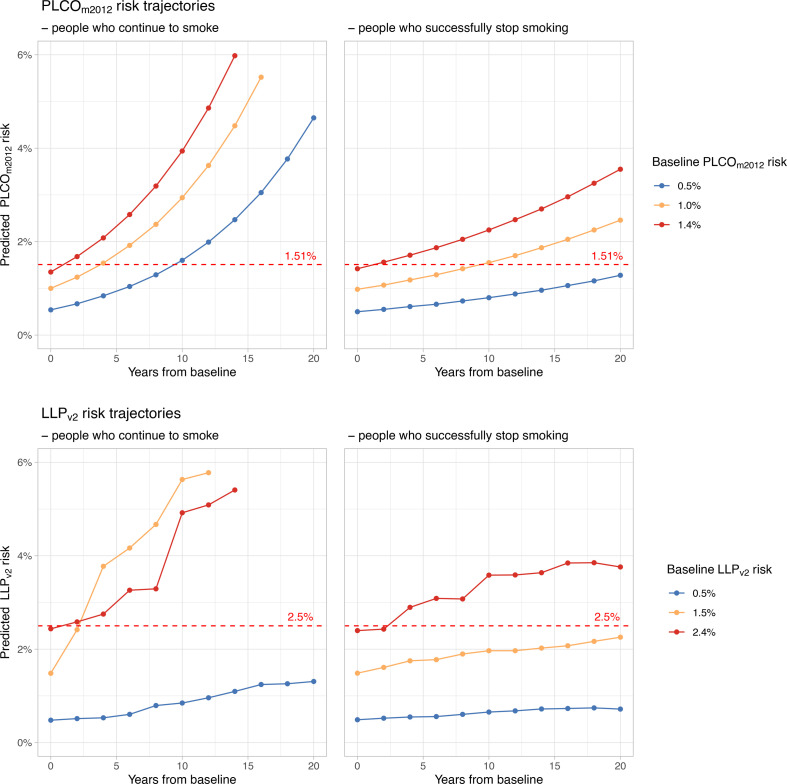
We prospectively predicted future risk (using Prostate, Lung, Colorectal and Ovarian trial's risk model (PLCO) and Liverpool Lung Project version 2 (LLP) risk models) and time-to-eligibility of 5345 participants to estimate how many would become eligible through the course of a Lung Health Check screening programme for 55-74 years.
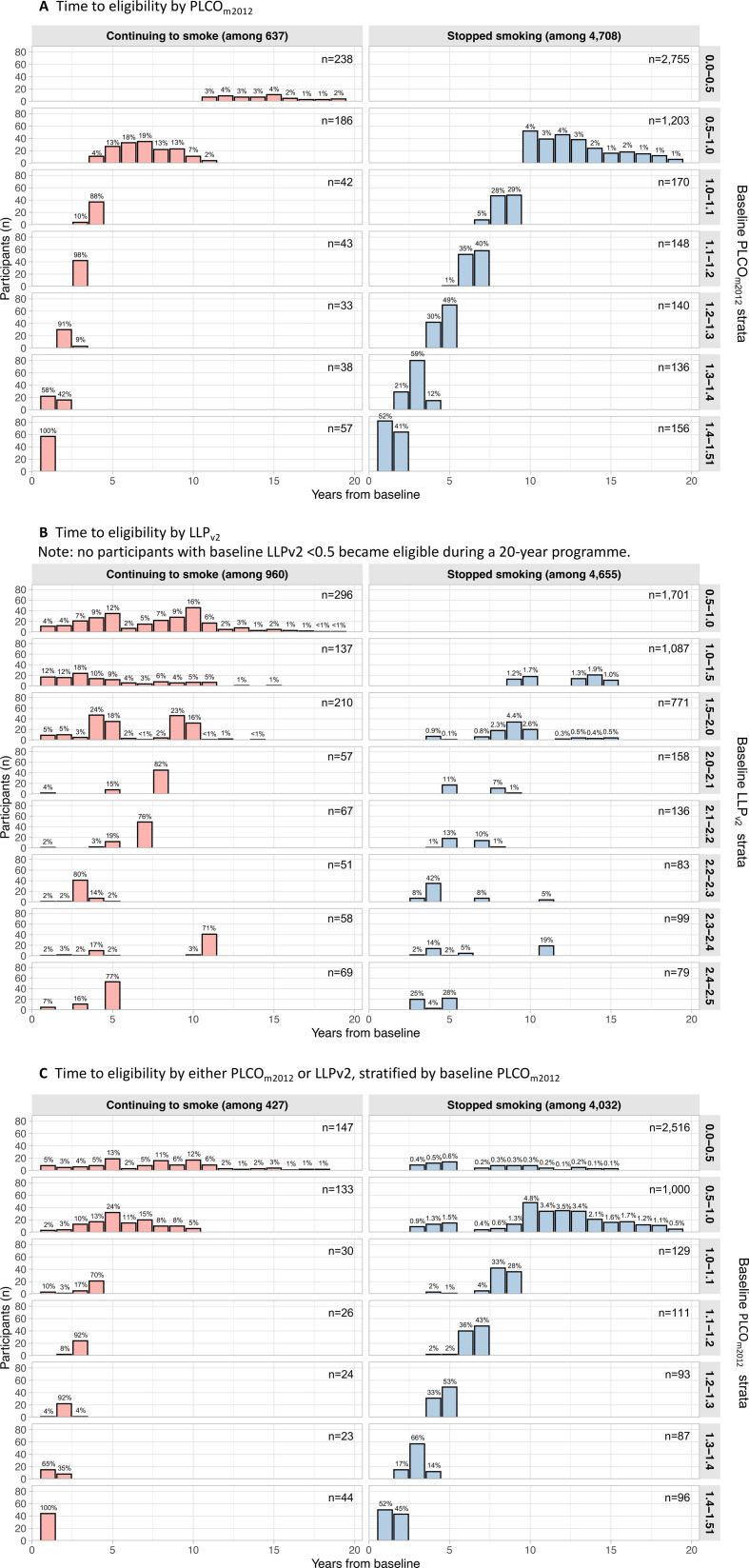
Approximately a quarter eventually become eligible, with those with the lowest baseline risks unlikely to ever become eligible. Time-to-eligibility is shorter for participants with higher baseline risk, increasing age and ongoing smoking status. At a PLCO threshold ≥1.51%, 68% of those who continue to smoke become eligible compared with 18% of those who have quit.
Predicting which participants may become eligible, and when, during a screening programme can help inform reinvitation strategies and service planning. Those with risk scores closer to the eligibility threshold, particularly people who continue to smoke, will reach eligibility in subsequent rounds while those at the lowest risk may be discharged from the programme from the outset.
靶向低剂量 CT 肺癌筛查可降低肺癌死亡率。英国的靶向肺部健康检查计划使用风险预测工具来确定有吸烟史的 55-74 岁人群是否有资格进行两年一次的筛查。一些最初不符合肺癌筛查条件的参与者随着年龄的增长和持续的烟草暴露,以后可能会有资格进行筛查。因此,了解有多少人可以重新邀请以及需要多长时间才能重新邀请,对于为服务的实施提供信息是很重要的。
我们前瞻性地预测了未来的风险(使用前列腺癌、肺癌、结直肠癌和卵巢癌试验的风险模型(PLCO)和利物浦肺癌项目 2 版(LLP)风险模型)和 5345 名参与者的资格时间,以估计有多少人将通过 55-74 岁的肺部健康检查计划获得资格。
大约四分之一的人最终会获得资格,而那些基线风险最低的人不太可能获得资格。对于基线风险较高的参与者,时间到资格的时间更短,年龄和持续吸烟状况增加。在 PLCO 阈值≥1.51%时,与已经戒烟的人相比,继续吸烟的人中约有 68%有资格参加。
预测哪些参与者可能在筛查计划期间获得资格,以及何时获得资格,可以帮助确定重新邀请策略和服务规划。那些风险评分接近资格门槛的人,特别是那些继续吸烟的人,将在随后的轮次中获得资格,而那些风险最低的人可能会从计划一开始就被淘汰。