Department of Neurology, Xuanwu Hospital, Capital Medical University, Beijing, China.
Advanced Center of Stroke, Beijing Institute for Brain Disorders, Beijing, China.
CNS Neurosci Ther. 2024 May;30(5):e14759. doi: 10.1111/cns.14759.
The causal relationship between sarcopenia-related traits and ischemic stroke (IS) remains poorly understood. This study aimed to explore the causal impact of sarcopenia-related traits on IS and to identify key mediators of this association.
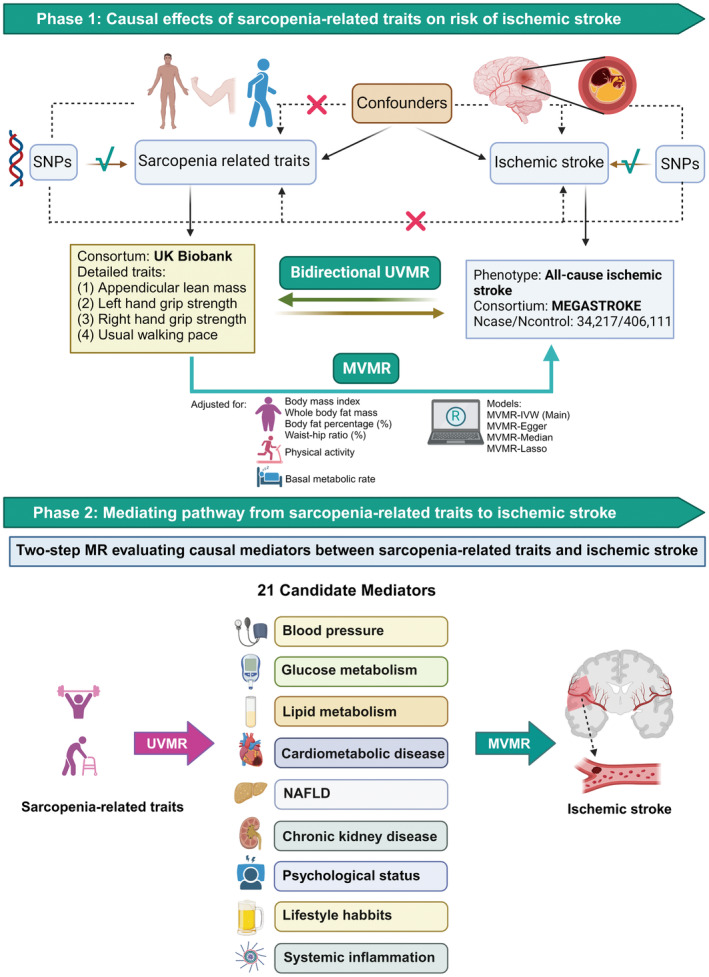
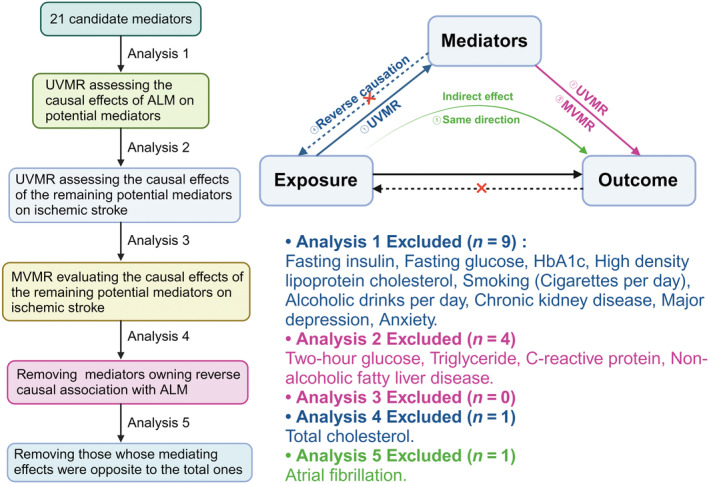
We conducted univariable, multivariable two-sample, and two-step Mendelian randomization (MR) analyses using genome-wide association study (GWAS) data. This included data for appendicular lean mass (ALM), hand grip strength (HGS), and usual walking pace (UWP) from the UK Biobank, and IS data from the MEGASTROKE consortium. Additionally, 21 candidate mediators were analyzed based on their respective GWAS data sets.
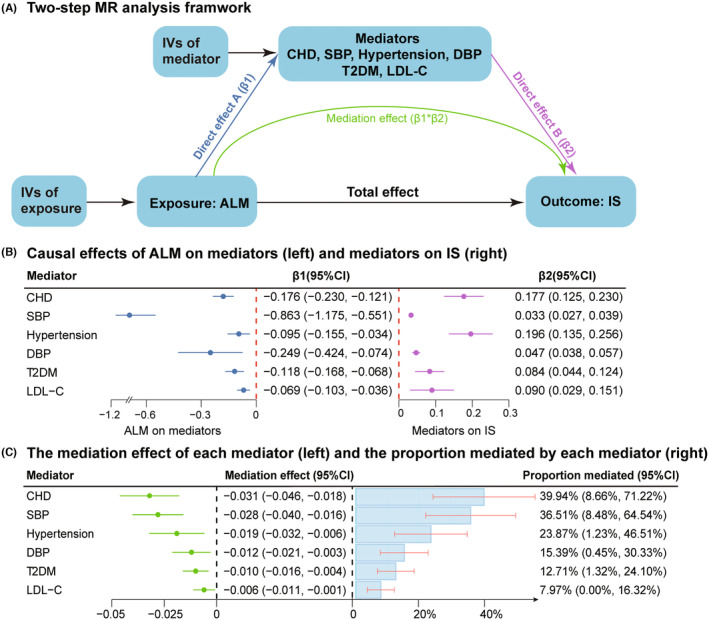
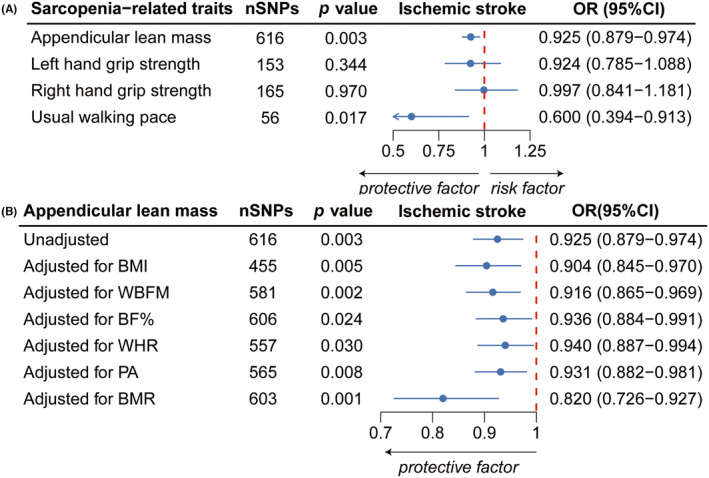
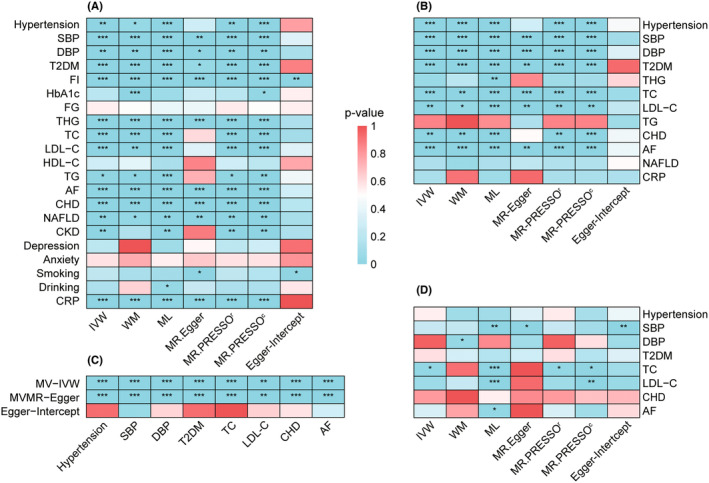
Each 1-SD increase in genetically proxied ALM was associated with a 7.5% reduction in the risk of IS (95% CI: 0.879-0.974), and this correlation remained after controlling for levels of physical activity and adiposity-related indices. Two-step MR identified that six mediators partially mediated the protective effect of higher ALM on IS, with the most significant being coronary heart disease (CHD, mediating proportion: 39.94%), followed by systolic blood pressure (36.51%), hypertension (23.87%), diastolic blood pressure (15.39%), type-2 diabetes mellitus (T2DM, 12.71%), and low-density lipoprotein cholesterol (7.97%).
Our study revealed a causal protective effect of higher ALM on IS, independent of physical activity and adiposity-related indices. Moreover, we found that higher ALM could reduce susceptibility to IS partially by lowering the risk of vascular risk factors, including CHD, hypertension, T2DM, and hyperlipidemia. In brief, we elucidated another modifiable factor for IS and implied that maintaining sufficient muscle mass may reduce the risk of such disease.
肌少症相关特征与缺血性脑卒中(IS)之间的因果关系仍不清楚。本研究旨在探讨肌少症相关特征对 IS 的因果影响,并确定这种关联的关键介导因素。
我们使用全基因组关联研究(GWAS)数据进行了单变量、多变量两样本和两步孟德尔随机化(MR)分析。这包括来自英国生物银行的四肢瘦组织(ALM)、握力(HGS)和通常行走速度(UWP)数据,以及来自 MEGASTROKE 联盟的 IS 数据。此外,还根据各自的 GWAS 数据集分析了 21 个候选中介。
每增加 1 个 SD 的遗传上接近的 ALM,IS 的风险降低 7.5%(95%CI:0.879-0.974),并且在控制体力活动和肥胖相关指数后,这种相关性仍然存在。两步 MR 确定了六个中介物部分介导了较高的 ALM 对 IS 的保护作用,其中最重要的是冠心病(CHD,介导比例:39.94%),其次是收缩压(36.51%)、高血压(23.87%)、舒张压(15.39%)、2 型糖尿病(T2DM,12.71%)和低密度脂蛋白胆固醇(7.97%)。
我们的研究揭示了较高的 ALM 对 IS 的因果保护作用,独立于体力活动和肥胖相关指数。此外,我们发现较高的 ALM 可以通过降低包括 CHD、高血压、T2DM 和高脂血症在内的血管危险因素的风险,部分降低 IS 的易感性。简而言之,我们阐明了 IS 的另一个可改变因素,并暗示维持足够的肌肉量可能会降低这种疾病的风险。