Department of Psychology, University at Buffalo - The State University of New York, Buffalo, New York, USA.
Department of Psychology, Syracuse University, Syracuse, New York, USA.
Clin Psychol Psychother. 2024 May-Jun;31(3):e2987. doi: 10.1002/cpp.2987.
Self-compassion and self-forgiveness are two self-focused, positive coping approaches that may reduce risk of problem drinking and/or aid in treatment/recovery from alcohol use disorder. The present systematic review aimed to evaluate support for the unique and complementary roles of self-compassion and self-forgiveness in alcohol outcomes.
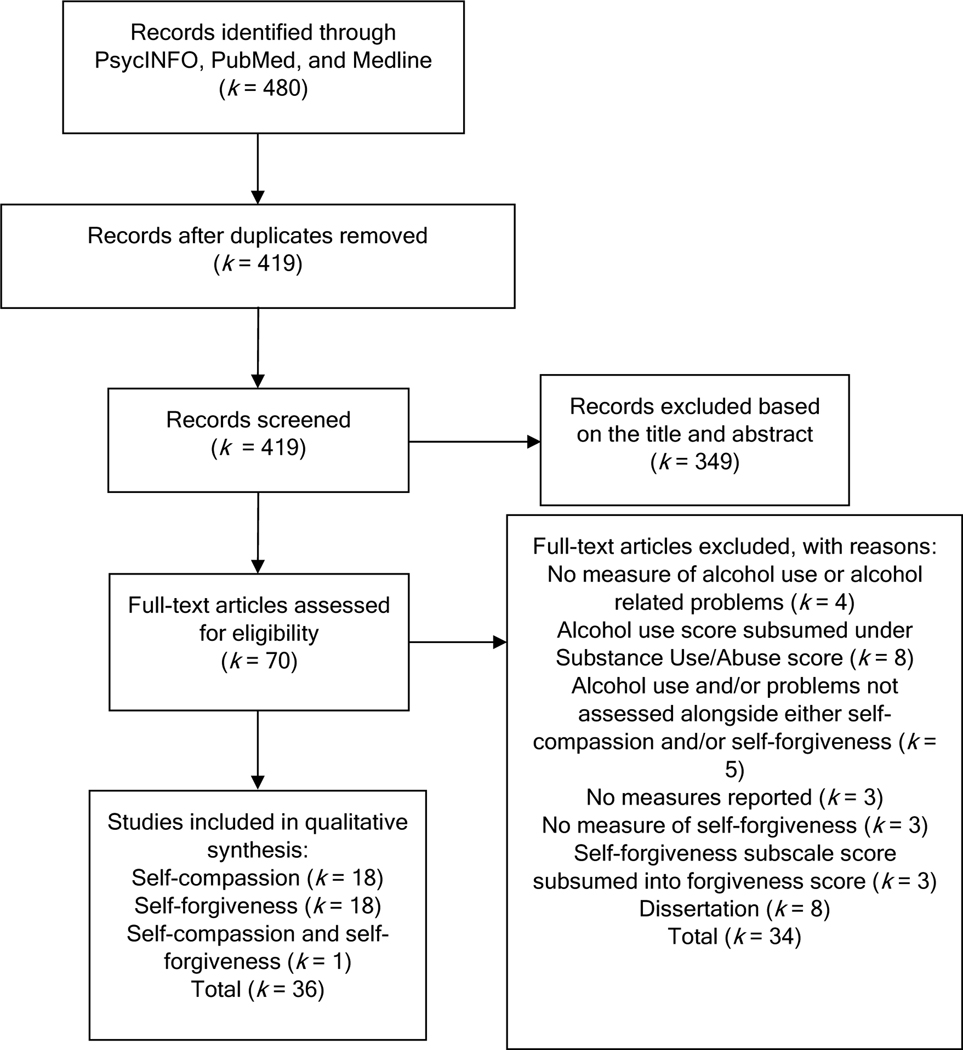
A systematic literature search yielded 18 studies examining self-compassion, 18 studies examining self-forgiveness and 1 study examining both constructs in alcohol outcomes.
Findings suggest greater self-compassion and self-forgiveness relate to lower likelihood of problem drinking. Self-forgiveness was considerably more researched in treatment/recovery outcomes than self-compassion; self-forgiveness-based interventions appear able to improve drinking-adjacent outcomes, and self-forgiveness may increase across various alcohol treatments. Finally, research suggests that associations of self-compassion and/or self-forgiveness with alcohol outcomes could be driven by numerous factors, including coping-motivated drinking, depression, psychache, social support perceptions, mental health status and/or psychiatric distress.
Self-compassion and self-forgiveness both appear protective against harmful alcohol outcomes. Nevertheless, many questions remain about the role of self-forgiveness and, particularly, self-compassion in alcohol treatment and recovery outcomes. Future research should examine whether targeted interventions and/or adjunctive therapeutic supports designed to increase self-compassion or self-forgiveness can reduce alcohol use disorder symptoms to facilitate alcohol treatment and recovery success.
自我同情和自我宽恕是两种以自我为中心的积极应对方式,可能降低出现问题性饮酒的风险,或有助于治疗/康复酒精使用障碍。本系统综述旨在评估自我同情和自我宽恕在酒精相关结果中的独特和补充作用。
系统文献检索共得到 18 项研究关注自我同情,18 项研究关注自我宽恕,1 项研究同时关注这两个概念与酒精相关结果。
研究结果表明,自我同情和自我宽恕程度越高,出现问题性饮酒的可能性越低。在治疗/康复相关结果中,自我宽恕的研究明显多于自我同情;基于自我宽恕的干预措施似乎能够改善与饮酒相关的结果,而自我宽恕在各种酒精治疗中可能会增加。最后,研究表明,自我同情和/或自我宽恕与酒精相关结果的关联可能受到多种因素的影响,包括以应对为动机的饮酒、抑郁、心理痛苦、社会支持感知、心理健康状况和/或精神困扰。
自我同情和自我宽恕似乎都能预防有害的酒精相关结果。然而,关于自我宽恕的作用,特别是自我同情在酒精治疗和康复结果中的作用,仍有许多问题尚未解决。未来的研究应探讨针对自我同情或自我宽恕的干预措施和/或辅助治疗支持是否可以减少酒精使用障碍症状,以促进酒精治疗和康复的成功。