Université Peleforo Gon Coulibaly, Korhogo, Côte d'Ivoire.
Centre Suisse de Recherches Scientifiques en Côte d'Ivoire, Abidjan, Côte d'Ivoire.
BMC Public Health. 2024 May 22;24(1):1380. doi: 10.1186/s12889-024-18838-7.
Handwashing is the first line of hygiene measures and one of the oldest methods of preventing the spread of infectious diseases. Despite its efficacy in the health system, handwashing is often inadequately practiced by populations. This study aimed to assess the presence of SARS-CoV-2, Escherichia coli (E. coli) and Staphylococcus aureus (S. aureus) on hands as indicators of lack of hand hygiene during COVID 19 pandemic.
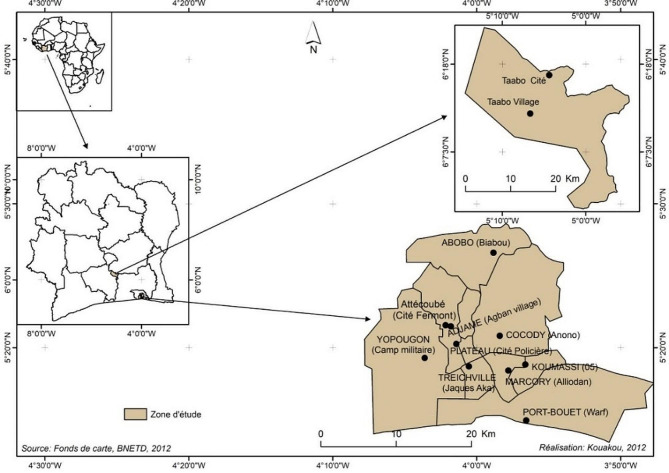
A cross-sectional study was conducted in rural Taabo and urban Abidjan (Côte d'Ivoire) from January to September 2021. A total of 384 participants from 384 households were included in the study. The total households were distributed proportionally within various municipalities in the two study areas according to the number of households in each municipality, based on data of the National Institute of Statistics from the 2014 general population census. Hand swabbing of the 384 participants within households (320 in Abidjan and 64 in Taabo) was performed for the enumeration of E. coli and S aureus, using laboratory standard method and for the detection of SARS-CoV-2 by RT-qPCR. A binary logistic regression model was built with the outcome variable presence of Staphylococcus spp. on hands of respondents that was categorized into binary variables, Staphylococcus spp. (1 = presence, 0 = absence) for the Risk Ratio estimation. Place of living, sex, handwashing, education and age group were used to adjust the model to observe the effects of these explanatory variables.
No presence of SARS-CoV-2 virus was detected on the hands of respondents in both sites. However, in urban Abidjan, only Staphylococcus spp. (Coagulase Negative Staphylococci) was found on the hands of 233 (72.8%, 95%CI: 67.7-77.4) respondents with the average load of 0.56 CFU/ Cm (95% CI, 0.52-0.60). Meanwhile, in rural Taabo, Staphylococcus spp. (Coagulase Negative Staphylococci) and E. coli were found on the hands of 40 (62.5%, 95%CI: 50.3-73.3) and 7 (10.9%, 95%CI: 5.4-20.9) respondents with the respective average load of 0.49 CFU/ Cm (95% CI, 0.39-0.59) and 0.08 CFU/ Cm (95% CI, 0.03-0.18). Participants living in rural Taabo were less likely to have Staphylococcus spp. on their hands (RR = 0.811; 95%IC: 0.661-0.995) compared to those living in urban Abidjan.
No SARS-CoV-2 was detected on the hands of participants in both sites, suggesting that our study did not show direct transmission through hands. No E. coli was found in urban Abidjan while E. coli was found on the hands of participants in rural Taabo indicating poor hand washing and disinfection practices in rural Taabo. Living in urban Abidjan is statistically associated to having Staphylococcus spp. on hands. Further studies are necessary especially to understand to what extent the presence of Staphylococcus spp. on hands indicates a higher infection or fecal colonization rates in the case of E. coli.
洗手是卫生措施的第一道防线,也是预防传染病传播的最古老方法之一。尽管在卫生系统中具有功效,但人群往往无法充分实施洗手。本研究旨在评估 COVID-19 大流行期间,SARS-CoV-2、大肠杆菌(E. coli)和金黄色葡萄球菌(S. aureus)在手上的存在情况,以指示手部卫生不足。
本研究于 2021 年 1 月至 9 月在科特迪瓦的农村 Taabo 和城市阿比让进行了一项横断面研究。共纳入 384 名来自 384 户家庭的参与者。根据国家统计局 2014 年人口普查的家庭数量数据,根据每个城市的家庭数量,将总的家庭数量按比例分配到两个研究区域的各个城市。对家庭内的 384 名参与者(阿比让 320 名,Taabo 64 名)进行手部拭子取样,以使用实验室标准方法对大肠杆菌和金黄色葡萄球菌进行计数,并使用 RT-qPCR 检测 SARS-CoV-2。建立了一个二项逻辑回归模型,因变量为受访者手上存在金黄色葡萄球菌的情况,分为二进制变量,金黄色葡萄球菌(1=存在,0=不存在)用于风险比估计。居住地点、性别、洗手、教育程度和年龄组用于调整模型,以观察这些解释变量的影响。
在两个地点均未在手上来检测到 SARS-CoV-2 病毒。然而,在城市阿比让,仅在 233 名(72.8%,95%CI:67.7-77.4)受访者的手上发现了金黄色葡萄球菌(凝固酶阴性葡萄球菌),平均负荷为 0.56 CFU/Cm(95%CI,0.52-0.60)。与此同时,在农村 Taabo,凝固酶阴性葡萄球菌和大肠杆菌在 40 名(62.5%,95%CI:50.3-73.3)和 7 名(10.9%,95%CI:5.4-20.9)受访者的手上被发现,相应的平均负荷分别为 0.49 CFU/Cm(95%CI,0.39-0.59)和 0.08 CFU/Cm(95%CI,0.03-0.18)。与居住在城市阿比让的受访者相比,居住在农村 Taabo 的受访者手上金黄色葡萄球菌的可能性较小(RR=0.811;95%CI:0.661-0.995)。
在两个地点的参与者的手上均未检测到 SARS-CoV-2,这表明我们的研究并未表明病毒通过手直接传播。在城市阿比让未发现大肠杆菌,而在农村 Taabo 的参与者手上发现了大肠杆菌,表明农村 Taabo 的洗手和消毒措施较差。居住在城市阿比让与手上存在金黄色葡萄球菌有统计学关联。需要进一步研究,特别是要了解手上金黄色葡萄球菌的存在在多大程度上表明大肠杆菌存在更高的感染或粪便定植率。