Unit of Neurology, Fondazione Policlinico Universitario A. Gemelli IRCCS, Rome, Italy.
Real World Data Facility, Fondazione Policlinico Universitario A. Gemelli IRCCS, Rome, Italy.
Eur Stroke J. 2024 Dec;9(4):1053-1062. doi: 10.1177/23969873241253366. Epub 2024 May 22.
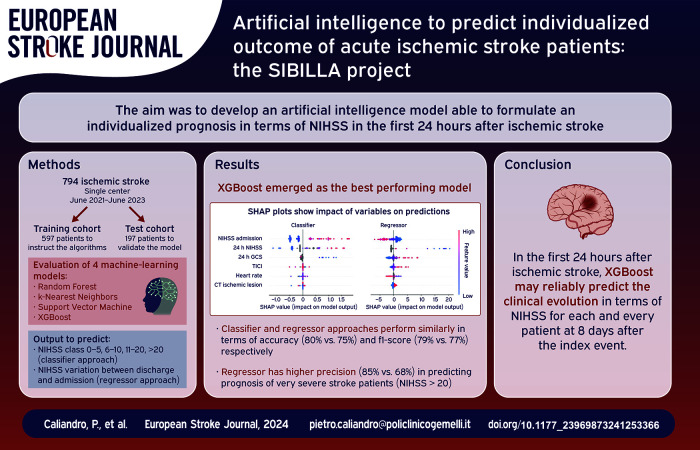
Formulating reliable prognosis for ischemic stroke patients remains a challenging task. We aimed to develop an artificial intelligence model able to formulate in the first 24 h after stroke an individualized prognosis in terms of NIHSS.
Seven hundred ninety four acute ischemic stroke patients were divided into a training (597) and testing (197) cohort. Clinical and instrumental data were collected in the first 24 h. We evaluated the performance of four machine-learning models (Random Forest, -Nearest Neighbors, Support Vector Machine, XGBoost) in predicting NIHSS at discharge both in terms of variation between discharge and admission (regressor approach) and in terms of severity class namely NIHSS 0-5, 6-10, 11-20, >20 (classifier approach). We used Shapley Additive exPlanations values to weight features impact on predictions.
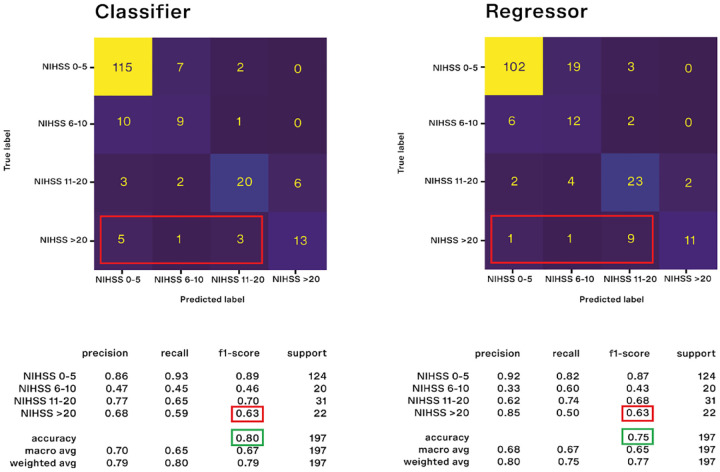
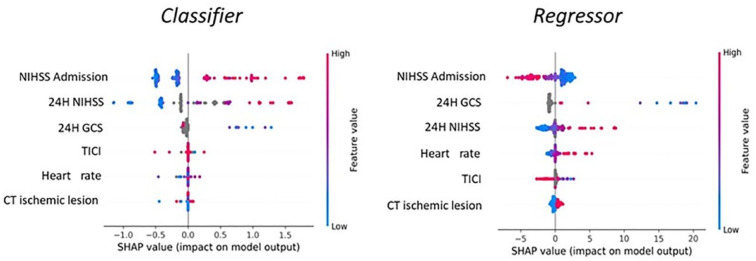
XGBoost emerged as the best performing model. The classifier and regressor approaches perform similarly in terms of accuracy (80% vs 75%) and f1-score (79% vs 77%) respectively. However, the regressor has higher precision (85% vs 68%) in predicting prognosis of very severe stroke patients (NIHSS > 20). NIHSS at admission and 24 hours, GCS at 24 hours, heart rate, acute ischemic lesion on CT-scan and TICI score were the most impacting features on the prediction.
Our approach, which employs an artificial intelligence based-tool, inherently able to continuously learn and improve its performance, could improve care pathway and support stroke physicians in the communication with patients and caregivers.
XGBoost reliably predicts individualized outcome in terms of NIHSS at discharge in the first 24 hours after stroke.
为缺血性脑卒中患者制定可靠的预后仍然是一项具有挑战性的任务。我们旨在开发一种人工智能模型,能够在脑卒中后 24 小时内制定 NIHSS 个体化预后。
794 例急性缺血性脑卒中患者分为训练(597 例)和测试(197 例)队列。在 24 小时内收集临床和仪器数据。我们评估了四种机器学习模型(随机森林、最近邻、支持向量机、XGBoost)在预测出院时 NIHSS 方面的性能,包括出院时和入院时之间的变化(回归器方法)以及严重程度类别(NIHSS 0-5、6-10、11-20、>20)(分类器方法)。我们使用 Shapley Additive exPlanations 值来加权特征对预测的影响。
XGBoost 是表现最好的模型。分类器和回归器方法在准确性(80%对 75%)和 f1 分数(79%对 77%)方面表现相似。然而,回归器在预测非常严重的脑卒中患者(NIHSS>20)的预后方面具有更高的精度(85%对 68%)。入院时和 24 小时的 NIHSS、24 小时的 GCS、心率、CT 扫描上的急性缺血性病变和 TICI 评分是对预测影响最大的特征。
我们的方法采用人工智能为基础的工具,能够不断学习和提高性能,这可能会改善护理路径,并为脑卒中医生与患者和护理人员的沟通提供支持。
XGBoost 能够可靠地预测脑卒中后 24 小时内 NIHSS 个体化预后。