Alshehri Fahad S, Alatawi Yasser, Alghamdi Badrah S, Alhifany Abdullah A, Alharbi Adnan
Department of Pharmacology and Toxicology, College of Pharmacy, Umm Al-Qura University, Makkah, Saudi Arabia.
Department of Pharmacy Practice, Faculty of Pharmacy, University of Tabuk, Tabuk, Saudi Arabia.
Saudi Pharm J. 2020 Dec;28(12):1666-1673. doi: 10.1016/j.jsps.2020.10.013. Epub 2020 Oct 30.
The coronavirus diseases of 2019 (COVID-19) pandemic was classified as one of the worst pandemics in the 21st century. Its rapid transmission, unpredicted mortality rate, and the uncertainty surrounding its transmission method have evoked additional fear and anxiety. Nonetheless, to the best of our knowledge, no prior study has explored PTSD prevalence three months after the start of the quarantine procedures in Saudi Arabia nor has examined PTSD prevalence by three different methods.
This observational cross-sectional study aimed to identify the prevalence, severity, and influencing factors of PTSD in different regions of Saudi Arabia three months after the onset of the quarantine procedures related to the COVID-19 pandemic.
Through the month of June 2020, 1374 people (49.05% men and 50.95% women) completed a 35-item, 10-minute online. The prevalence of PTSD was measured using PCL-S (specific for COVID-19) that assesses the 17 symptoms of PTSD. Resilience was measured using 2-items Arabic version of the Connor-Davidson Resilience Scale 2 (CD-RISC 2).
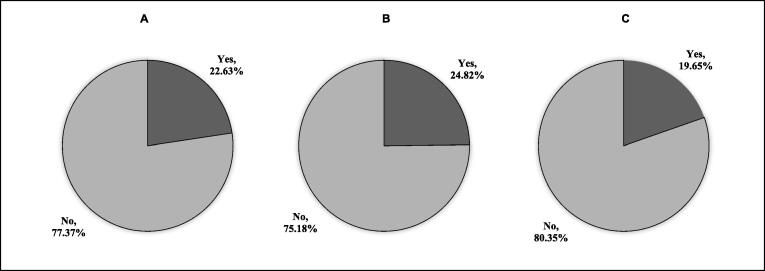
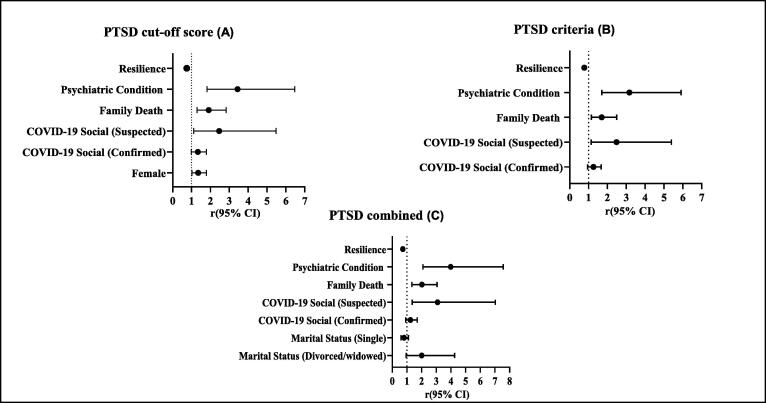
We calculated the prevalence by three methods, namely, PTSD cut-off score, criteria, and combined, and the prevalence was 22.63%, 24.8%, and 19.6%, respectively. Female participants showed higher prevalence than male. As well, participants who were either tested positive or suspected of having been infected with COVID-19 showed higher PTSD prevalence. Higher resilience was associated with lower PTSD prevalence.
This was the first study to report PTSD prevalence by three differential methods three months after the onset of the quarantine procedures related to the COVID-19 pandemic in Saudi Arabia. We observed a significant impact of the COVID-19 pandemic in the Saudi population; therefore, great attention should be performed in implementing new procedures that deal with the highlighted risk factors, especially in vulnerable groups, to overcome the psychological impact of the COVID-19 pandemic.
2019年冠状病毒病(COVID-19)大流行被列为21世纪最严重的大流行之一。其快速传播、不可预测的死亡率以及传播方式的不确定性引发了更多的恐惧和焦虑。尽管如此,据我们所知,此前尚无研究探讨沙特阿拉伯检疫程序开始三个月后的创伤后应激障碍(PTSD)患病率,也未通过三种不同方法检查PTSD患病率。
这项观察性横断面研究旨在确定与COVID-19大流行相关的检疫程序开始三个月后,沙特阿拉伯不同地区PTSD的患病率、严重程度及影响因素。
在2020年6月期间,1374人(49.05%为男性,50.95%为女性)完成了一项35项、10分钟的在线调查。使用评估PTSD 17种症状的PCL-S(针对COVID-19的特定量表)测量PTSD患病率。使用康纳-戴维森韧性量表2(CD-RISC 2)的2项阿拉伯语版本测量韧性。
我们通过三种方法计算患病率,即PTSD截断分数法、标准法和综合法,患病率分别为22.63%、24.8%和19.6%。女性参与者的患病率高于男性。此外,COVID-19检测呈阳性或疑似感染COVID-19的参与者PTSD患病率更高。更高的韧性与更低的PTSD患病率相关。
这是第一项在沙特阿拉伯与COVID-19大流行相关的检疫程序开始三个月后,通过三种不同方法报告PTSD患病率的研究。我们观察到COVID-19大流行对沙特人群有重大影响;因此,在实施应对突出风险因素的新程序时应予以高度关注,尤其是在弱势群体中,以克服COVID-19大流行的心理影响。