Peter Manuel, Shipman Seth, Heo Jaewon, Macklis Jeffrey D
Department of Stem Cell and Regenerative Biology, and Center for Brain Science, Harvard University, Cambridge, MA, USA.
iScience. 2024 May 7;27(6):109911. doi: 10.1016/j.isci.2024.109911. eCollection 2024 Jun 21.
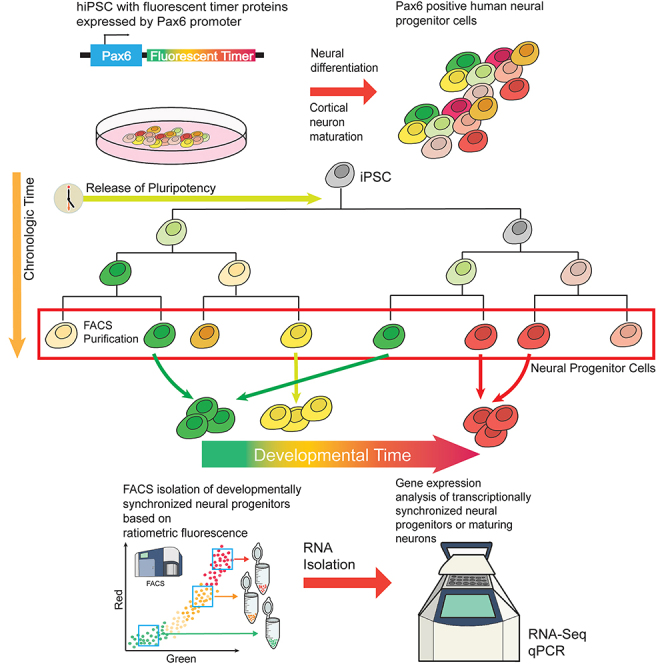
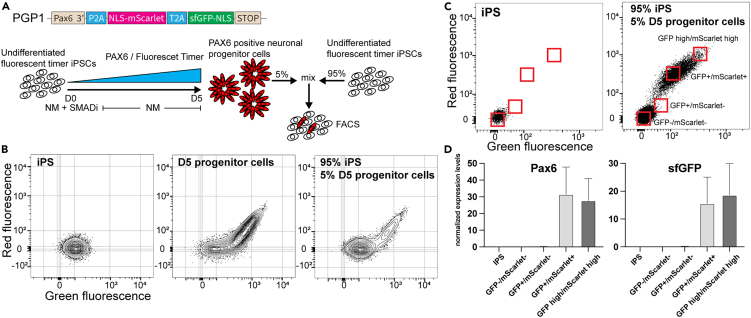
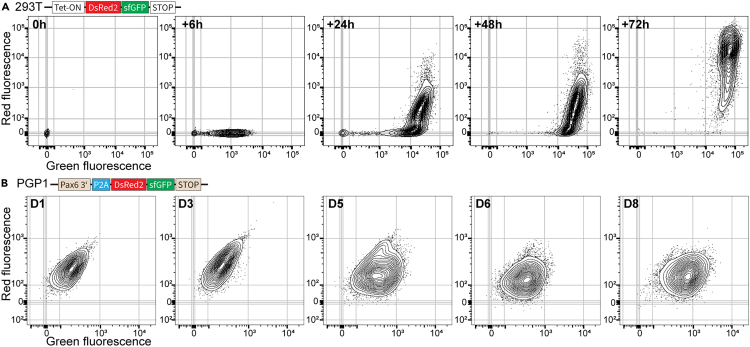
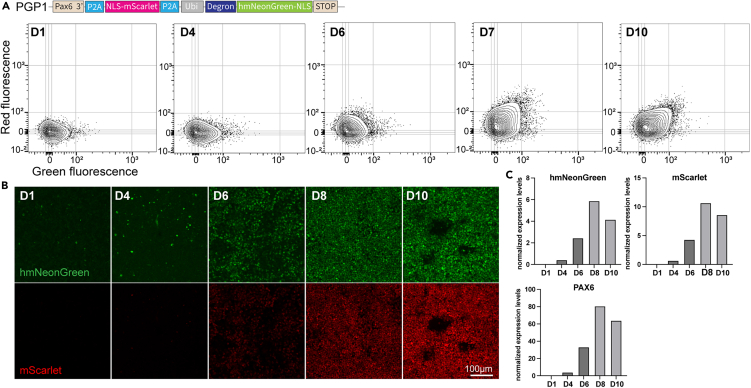
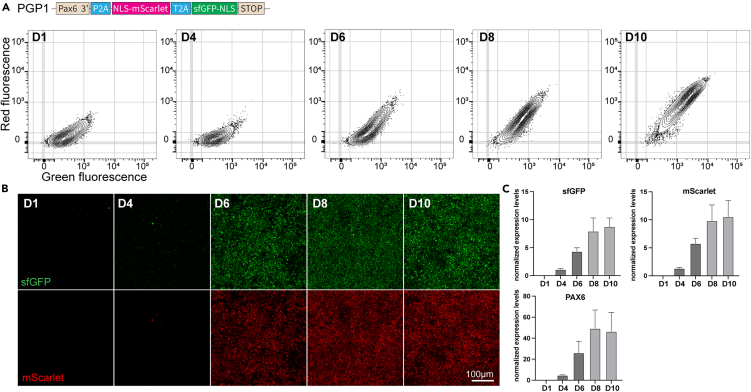
Differentiation of human pluripotent stem cells (hPSCs) into subtype-specific neurons holds substantial potential for disease modeling . For successful differentiation, a detailed understanding of the transcriptional networks regulating cell fate decisions is critical. The heterochronic nature of neurodevelopment, during which distinct cells in the brain and during differentiation acquire their fates in an unsynchronized manner, hinders pooled transcriptional comparisons. One approach is to "translate" chronologic time into linear developmental and maturational time. Simple binary promotor-driven fluorescent proteins (FPs) to pool similar cells are unable to achieve this goal, due to asynchronous promotor onset in individual cells. We tested five fluorescent timer (FT) molecules expressed from the endogenous paired box 6 (PAX6) promoter in 293T and human hPSCs. Each of these FT systems faithfully reported chronologic time in 293T cells, but none of the FT constructs followed the same fluorescence kinetics in human neural progenitor cells.
将人类多能干细胞(hPSC)分化为亚型特异性神经元在疾病建模方面具有巨大潜力。为了成功实现分化,详细了解调节细胞命运决定的转录网络至关重要。神经发育具有异时性,在此过程中,大脑中不同的细胞以及分化过程中的细胞以不同步的方式获得其命运,这阻碍了汇总转录比较。一种方法是将时间顺序转化为线性发育和成熟时间。简单的二元启动子驱动荧光蛋白(FP)用于汇总相似细胞,但由于单个细胞中启动子起始的异步性,无法实现这一目标。我们测试了在内源性配对盒6(PAX6)启动子驱动下在293T细胞和人类hPSC中表达的五种荧光定时器(FT)分子。这些FT系统中的每一个都忠实地报告了293T细胞中的时间顺序,但没有一个FT构建体在人类神经祖细胞中遵循相同的荧光动力学。