Center for Individualized Medicine, Mayo Clinic, Rochester, MN, USA.
Department of Clinical Genomics, Mayo Clinic, Rochester, MN, USA.
Orphanet J Rare Dis. 2024 May 24;19(1):216. doi: 10.1186/s13023-024-03213-x.
Though next-generation sequencing (NGS) tests like exome sequencing (ES), genome sequencing (GS), and panels derived from exome and genome data (EGBP) are effective for rare diseases, the ideal diagnostic approach is debated. Limited research has explored reanalyzing raw ES and GS data post-negative EGBP results for diagnostics.
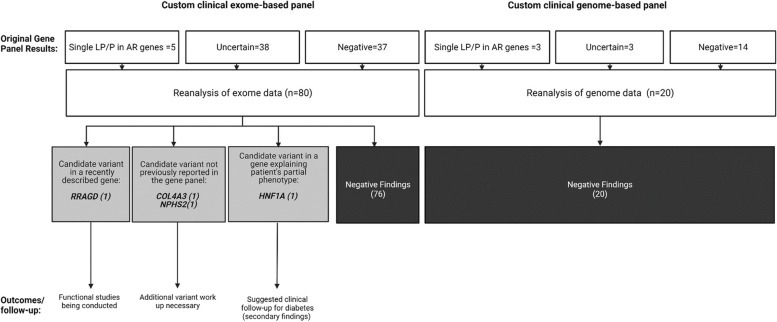
We analyzed complete ES/GS raw sequencing data from Mayo Clinic's Program for Rare and Undiagnosed Diseases (PRaUD) patients to assess whether supplementary findings could augment diagnostic yield. ES data from 80 patients (59 adults) and GS data from 20 patients (10 adults), averaging 43 years in age, were analyzed. Most patients had renal (n=44) and auto-inflammatory (n=29) phenotypes. Ninety-six cases had negative findings and in four cases additional genetic variants were found, including a variant related to a recently described disease (RRAGD-related hypomagnesemia), a variant missed due to discordant inheritance pattern (COL4A3), a variant with high allelic frequency (NPHS2) in the general population, and a variant associated with an initially untargeted phenotype (HNF1A).
ES and GS show diagnostic yields comparable to EGBP for single-system diseases. However, EGBP's limitations in detecting new disease-associated genes underscore the necessity for periodic updates.
尽管下一代测序(NGS)测试,如外显子组测序(ES)、全基因组测序(GS)和基于外显子和基因组数据的面板(EGBP),对于罕见疾病是有效的,但理想的诊断方法仍存在争议。有限的研究探索了在 EGBP 结果阴性后重新分析 ES 和 GS 原始数据以进行诊断。
我们分析了 Mayo 诊所罕见和未确诊疾病计划(PRaUD)患者的完整 ES/GS 原始测序数据,以评估补充发现是否可以提高诊断率。分析了 80 名患者(59 名成人)的 ES 数据和 20 名患者(10 名成人)的 GS 数据,平均年龄为 43 岁。大多数患者具有肾脏(n=44)和自身炎症(n=29)表型。96 例有阴性发现,4 例发现了其他遗传变异,包括与最近描述的疾病(RRAGD 相关低镁血症)相关的变异、由于不一致的遗传模式而错过的变异(COL4A3)、在一般人群中具有高等位基因频率(NPHS2)的变异以及与最初未靶向表型相关的变异(HNF1A)。
ES 和 GS 在外显子组疾病方面的诊断率与 EGBP 相当。然而,EGBP 在检测新的疾病相关基因方面的局限性突出了定期更新的必要性。