Alshawaf Eman, Abu-Farha Mohamed, Mohammad Anwar, Devarajan Sriraman, Al-Khairi Irina, Cherian Preethi, Ali Hamad, Al-Matrouk Hawra, Al-Mulla Fahd, Al Attar Abdulnabi, Abubaker Jehad
Department of Biochemistry and Molecular Biology, Dasman Diabetes Institute, Dasman 15462, Kuwait.
Diabetology Unit, Amiri Hospital, Dasman Diabetes Institute, Dasman 15462, Kuwait.
Biomedicines. 2024 Apr 24;12(5):949. doi: 10.3390/biomedicines12050949.
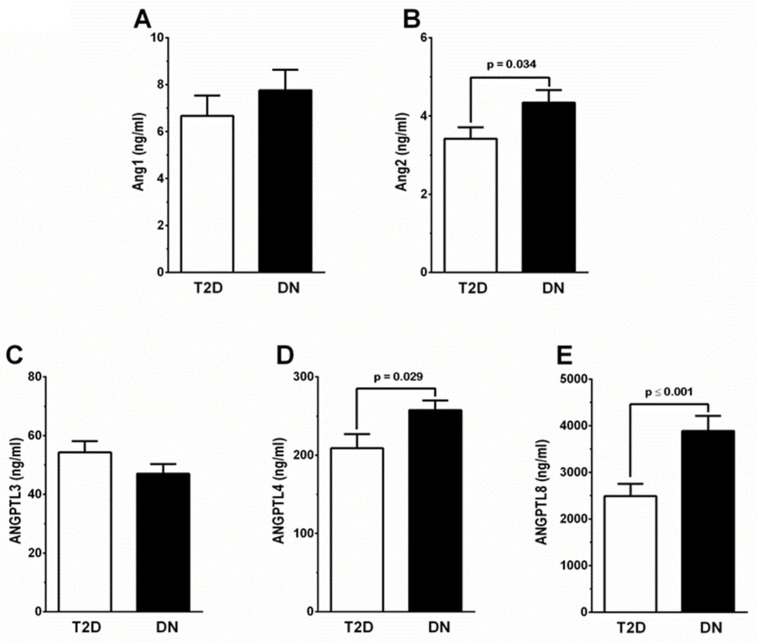
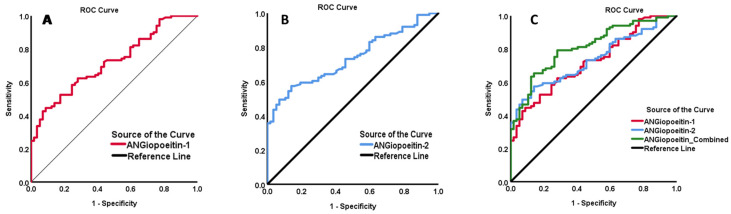
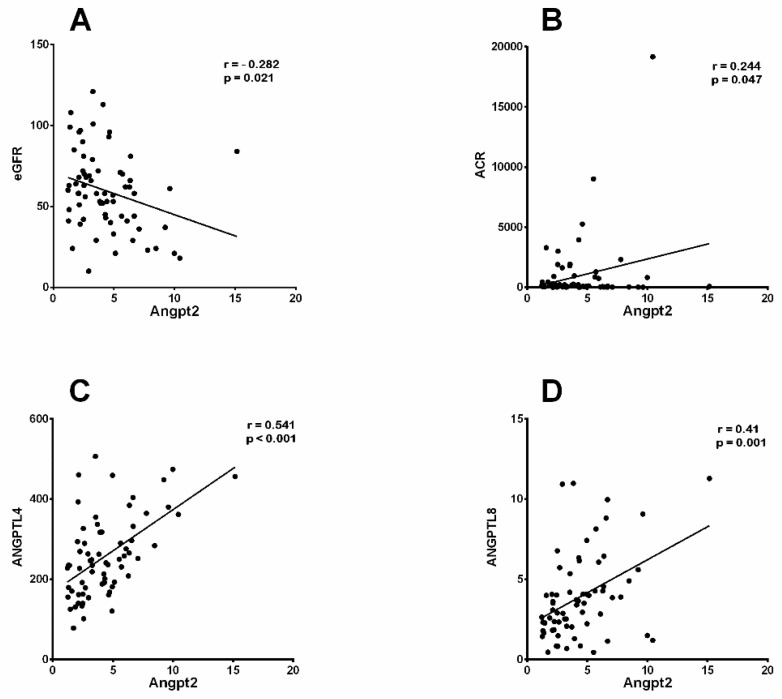
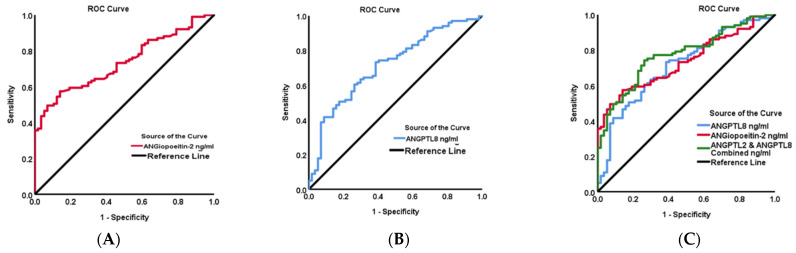
Angiopoietins are crucial growth factors for maintaining a healthy, functional endothelium. Patients with type 2 diabetes (T2D) exhibit significant levels of angiogenic markers, particularly Angiopoietin-2, which compromises endothelial integrity and is connected to symptoms of endothelial injury and failure. This report examines the levels of circulating angiopoietins in people with T2D and diabetic nephropathy (DN) and explores its link with ANGPTL proteins. We quantified circulating ANGPTL3, ANGPTL4, ANGPTL8, Ang1, and Ang2 in the fasting plasma of 117 Kuwaiti participants, of which 50 had T2D and 67 participants had DN. The Ang2 levels increased with DN (4.34 ± 0.32 ng/mL) compared with T2D (3.42 ± 0.29 ng/mL). This increase correlated with clinical parameters including the albumin-to-creatinine ratio (ACR) (r = 0.244, = 0.047), eGFR (r = -0.282, = 0.021), and SBP (r = -0.28, = 0.024). Furthermore, Ang2 correlated positively to both ANGPTL4 (r = 0.541, < 0.001) and ANGPTL8 (r = 0.41, = 0.001). Multiple regression analysis presented elevated ANGPTL8 and ACRs as predictors for Ang2's increase in people with DN. In people with T2D, ANGPTL4 positively predicted an Ang2 increase. The area under the curve (AUC) in receiver operating characteristic (ROC) analysis of the combination of Ang2 and ANGPTL8 was 0.77 with 80.7% specificity. In conclusion, significantly elevated Ang2 in people with DN correlated with clinical markers such as the ACR, eGFR, and SBP, ANGPTL4, and ANGPTL8 levels. Collectively, this study highlights a close association between Ang2 and ANGPTL8 in a population with DN, suggesting them as DN risk predictors.
血管生成素是维持健康、功能正常的内皮细胞的关键生长因子。2型糖尿病(T2D)患者的血管生成标志物水平显著升高,尤其是血管生成素-2,它会损害内皮细胞的完整性,并与内皮损伤和功能衰竭的症状有关。本报告检测了T2D患者和糖尿病肾病(DN)患者循环血管生成素的水平,并探讨了其与血管生成素样蛋白(ANGPTL)的联系。我们对117名科威特参与者空腹血浆中的循环ANGPTL3、ANGPTL4、ANGPTL8、血管生成素-1(Ang1)和血管生成素-2(Ang2)进行了定量分析,其中50人患有T2D,67人患有DN。与T2D患者(3.42±0.29 ng/mL)相比,DN患者的Ang2水平升高(4.34±0.32 ng/mL)。这种升高与包括白蛋白与肌酐比值(ACR)(r = 0.244,P = 0.047)、估算肾小球滤过率(eGFR)(r = -0.282,P = 0.021)和收缩压(SBP)(r = -0.28,P = 0.024)在内的临床参数相关。此外,Ang2与ANGPTL4(r = 0.541,P < 0.001)和ANGPTL8(r = 0.41,P = 0.001)均呈正相关。多元回归分析显示,ANGPTL8升高和ACR升高是DN患者Ang2升高的预测因素。在T2D患者中,ANGPTL4可正向预测Ang2升高。在Ang2和ANGPTL8联合检测的受试者工作特征(ROC)分析中,曲线下面积(AUC)为0.77,特异性为80.7%。总之,DN患者中Ang2显著升高与ACR、eGFR、SBP、ANGPTL4和ANGPTL8水平等临床标志物相关。总体而言,本研究强调了在DN人群中Ang2与ANGPTL8之间的密切关联,提示它们可作为DN的风险预测指标。