State Key Laboratory of Animal Nutrition, College of Animal Science and Technology, China Agricultural University, Beijing 100193, China.
Int J Mol Sci. 2024 May 14;25(10):5333. doi: 10.3390/ijms25105333.
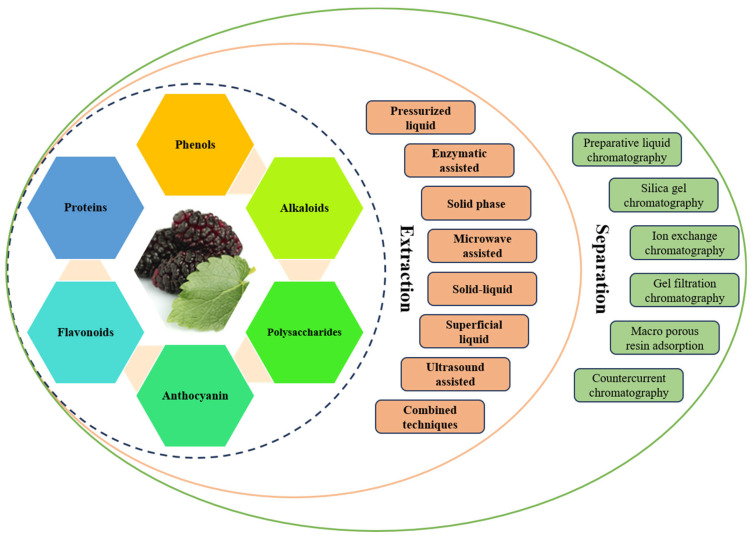
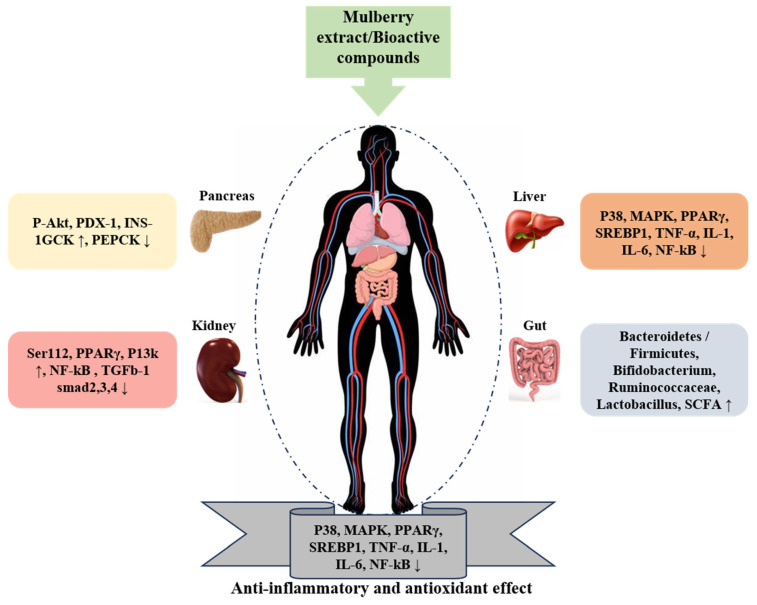
Mulberry is a rapidly growing plant that thrives in diverse climatic, topographical, and soil types, spanning temperature and temperate countries. Mulberry plants are valued as functional foods for their abundant chemical composition, serving as a significant reservoir of bioactive compounds like proteins, polysaccharides, phenolics, and flavonoids. Moreover, these compounds displayed potent antioxidant activity by scavenging free radicals, inhibiting reactive oxygen species generation, and restoring elevated nitric oxide production induced by LPS stimulation through the downregulation of inducible NO synthase expression. Active components like oxyresveratrol found in demonstrated anti-inflammatory effects by inhibiting leukocyte migration through the MEK/ERK signaling pathway. Gallic and chlorogenic acids in mulberry leaves (ML) powder-modulated TNF, IL-6, and IRS1 proteins, improving various inflammatory conditions by immune system modulation. As we delve deeper into understanding its anti-inflammatory potential and how it works therapeutically, it is crucial to refine the extraction process to enhance the effectiveness of its bioactive elements. Recent advancements in extraction techniques, such as solid-liquid extraction, pressurized liquid extraction, superficial fluid extraction, microwave-assisted extraction, and ultrasonic-assisted extraction, are being explored. Among the extraction methods tested, including Soxhlet extraction, maceration, and ultrasound-assisted extraction (UAE), UAE demonstrated superior efficiency in extracting bioactive compounds from mulberry leaves. Overall, this comprehensive review sheds light on the potential of mulberry as a natural immunomodulatory agent and provides insights into its mechanisms of action for future research and therapeutic applications.
桑树是一种生长迅速的植物,能在不同的气候、地形和土壤类型中茁壮成长,分布于热带和温带国家。桑树植物因其丰富的化学成分而被视为功能性食品,是生物活性化合物如蛋白质、多糖、酚类和类黄酮的重要来源。此外,这些化合物通过清除自由基、抑制活性氧物种生成以及通过下调诱导型一氧化氮合酶表达来恢复 LPS 刺激引起的升高的一氧化氮产生,显示出强大的抗氧化活性。研究表明,在中发现的活性成分如氧白藜芦醇通过抑制白细胞迁移通过 MEK/ERK 信号通路发挥抗炎作用。桑树叶(ML)粉末中的没食子酸和绿原酸调节 TNF、IL-6 和 IRS1 蛋白,通过免疫系统调节改善各种炎症状况。随着我们深入了解其抗炎潜力及其治疗作用机制,精细提取过程以增强其生物活性元素的有效性至关重要。最近,人们探索了提取技术的进步,如固液提取、加压液体提取、表面流体提取、微波辅助提取和超声辅助提取。在测试的提取方法中,包括索氏提取、浸渍和超声辅助提取(UAE),UAE 证明在从桑树叶中提取生物活性化合物方面具有更高的效率。总的来说,这篇综合综述揭示了桑树作为天然免疫调节剂的潜力,并为其作用机制提供了未来研究和治疗应用的见解。