
世界卫生组织2021年更新时代下神经胶质瘤分类的新型成像方法:一项范围综述
Novel Imaging Approaches for Glioma Classification in the Era of the World Health Organization 2021 Update: A Scoping Review.
作者信息
Richter Vivien, Ernemann Ulrike, Bender Benjamin
机构信息
Department of Diagnostic and Interventional Neuroradiology, University Hospital Tübingen, 72076 Tübingen, Germany.
出版信息
Cancers (Basel). 2024 May 8;16(10):1792. doi: 10.3390/cancers16101792.
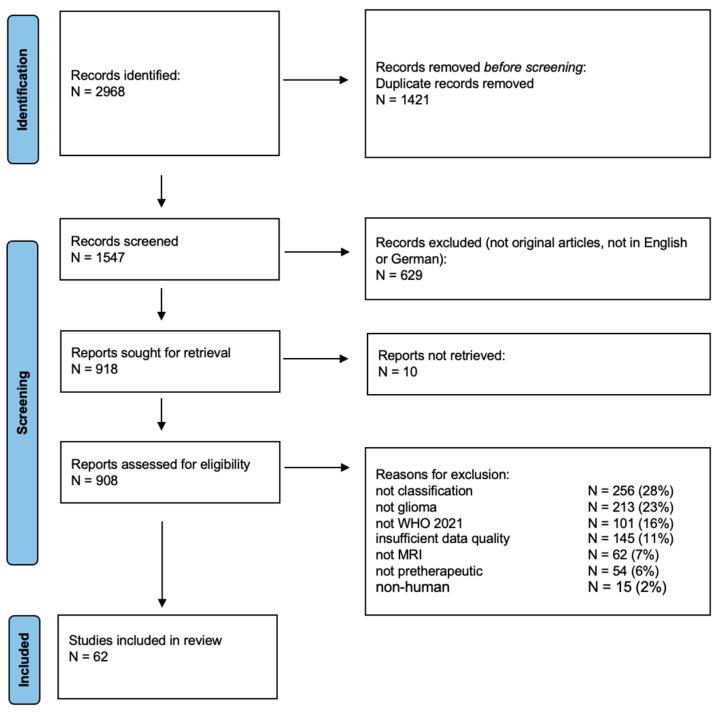
The 2021 WHO classification of CNS tumors is a challenge for neuroradiologists due to the central role of the molecular profile of tumors. The potential of novel data analysis tools in neuroimaging must be harnessed to maintain its role in predicting tumor subgroups. We performed a scoping review to determine current evidence and research gaps. A comprehensive literature search was conducted regarding glioma subgroups according to the 2021 WHO classification and the use of MRI, radiomics, machine learning, and deep learning algorithms. Sixty-two original articles were included and analyzed by extracting data on the study design and results. Only 8% of the studies included pediatric patients. Low-grade gliomas and diffuse midline gliomas were represented in one-third of the research papers. Public datasets were utilized in 22% of the studies. Conventional imaging sequences prevailed; data on functional MRI (DWI, PWI, CEST, etc.) are underrepresented. Multiparametric MRI yielded the best prediction results. IDH mutation and 1p/19q codeletion status prediction remain in focus with limited data on other molecular subgroups. Reported AUC values range from 0.6 to 0.98. Studies designed to assess generalizability are scarce. Performance is worse for smaller subgroups (e.g., 1p/19q codeleted or IDH1/2 mutated gliomas). More high-quality study designs with diversity in the analyzed population and techniques are needed.
由于肿瘤分子特征的核心作用,2021年世界卫生组织(WHO)中枢神经系统肿瘤分类对神经放射学家来说是一项挑战。必须利用神经影像学中新型数据分析工具的潜力,以维持其在预测肿瘤亚组方面的作用。我们进行了一项范围综述,以确定当前的证据和研究差距。针对根据2021年WHO分类的胶质瘤亚组以及MRI、放射组学、机器学习和深度学习算法的应用,进行了全面的文献检索。纳入62篇原创文章,并通过提取研究设计和结果的数据进行分析。只有8%的研究纳入了儿科患者。低级别胶质瘤和弥漫性中线胶质瘤在三分之一的研究论文中有所体现。22%的研究使用了公共数据集。传统成像序列占主导地位;功能MRI(DWI、PWI、CEST等)的数据代表性不足。多参数MRI产生了最佳预测结果。IDH突变和1p/19q共缺失状态预测仍然是重点,而关于其他分子亚组的数据有限。报告的AUC值范围为0.6至0.98。旨在评估可推广性的研究很少。对于较小的亚组(例如,1p/19q共缺失或IDH1/2突变的胶质瘤),性能较差。需要更多高质量的研究设计,在分析人群和技术方面具有多样性。
 Zotero 插件