Laboratório de Cromatografia, Departamento de Química, Instituto de Ciências Exatas, Universidade Federal do Amazonas, Manaus 69077-000, Brazil.
Laboratório de Plantas Medicinais e Derivados, Farmanguinhos, Fundação Oswaldo Cruz, Rio de Janeiro 21041-250, Brazil.
Molecules. 2024 May 10;29(10):2240. doi: 10.3390/molecules29102240.
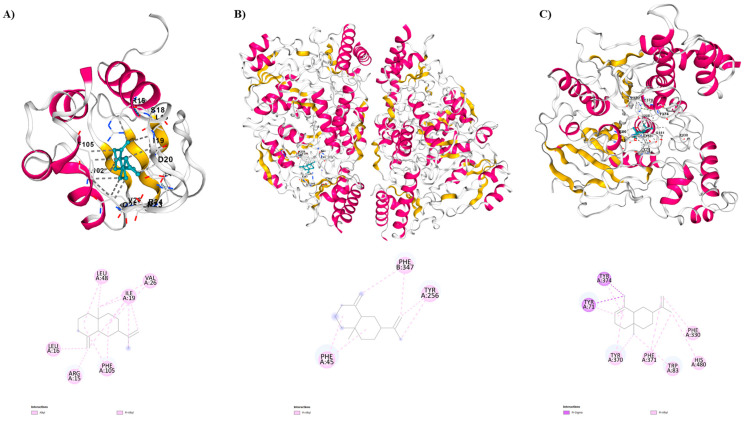
This study investigates the chemical composition of the essential oil obtained from the leaves of (Mart.) R.E.Fr (Annonaceae), examining its effectiveness in combating both the larvae and adult forms of mosquitoes. Additionally, for a deeper understanding of the insecticidal activity, toxicity properties and molecular docking calculations were conducted using the main compounds of this essential oil. GC/MS analysis revealed the presence of 26 constituents, representing 95.2% of the essential oil, with the major components identified as the sesquiterpenes -selinene, -selinene, and -elemene. Larvicidal assays demonstrated potent activity of this essential oil with significant LC values of 40.8 and 39.4 μg/mL at 24 and 48 h, respectively. Adulticidal assessments highlighted strong efficacy with LC of 12.5 µg/mL. Molecular docking analysis identified optimal interaction activities of -selinene and -selinene with key proteins. The in silico studies comparing synthetic insecticides with the major sesquiterpenes of the essential oil revealed that -selinene exhibited a significantly higher binding affinity compared to the other two sesquiterpenes. Also, ADMET studies of the three main sesquiterpenes indicated acceptable drug-like properties. In these findings, safety evaluations showed low toxicity and skin sensitization for the main sesquiterpenes, contrasting with commercial synthetic insecticides. Therefore, in silico analyses suggest promising interactions with proteins, indicating its potential as an effective alternative to conventional insecticides These results show the larvicidal and adulticidal potential of the essential oil from against , supported by its predominant constituents, -selinene, -selinene and -elemene.
本研究调查了(Mart.)R.E.Fr(番荔枝科)叶挥发油的化学成分,考察了其对 幼虫和成虫的防治效果。此外,为了更深入地了解杀虫活性,对该精油的主要化合物进行了毒性特性和分子对接计算。GC/MS 分析显示,26 种成分的存在代表了精油的 95.2%,主要成分是半萜类化合物-selinene、-selinene 和 -elemene。幼虫致死率试验表明,该精油具有很强的活性,在 24 和 48 小时时,LC 值分别为 40.8 和 39.4μg/mL。成虫致死率评估显示,LC 值为 12.5μg/mL 时,具有很强的疗效。分子对接分析确定了-selinene 和 -selinene 与关键蛋白的最佳相互作用活性。与主要半萜类化合物相比,对合成杀虫剂的计算机模拟研究表明,-selinene 表现出比其他两种半萜类化合物更高的结合亲和力。此外,对三种主要半萜类化合物的 ADMET 研究表明,它们具有可接受的类药性。在这些发现中,安全性评估表明主要半萜类化合物的毒性和皮肤致敏性较低,与商业合成杀虫剂形成对比。因此,计算机模拟分析表明与 蛋白具有良好的相互作用,表明其作为传统杀虫剂的有效替代品具有潜力。这些结果表明,-selinene、-selinene 和 -elemene 等主要成分支持从 中提取的精油对 具有潜在的杀幼虫和杀成虫作用。