Institute of Virology, University Medical Center Freiburg, Medical Faculty, University of Freiburg, 79104 Freiburg, Germany.
Viruses. 2024 Apr 23;16(5):658. doi: 10.3390/v16050658.
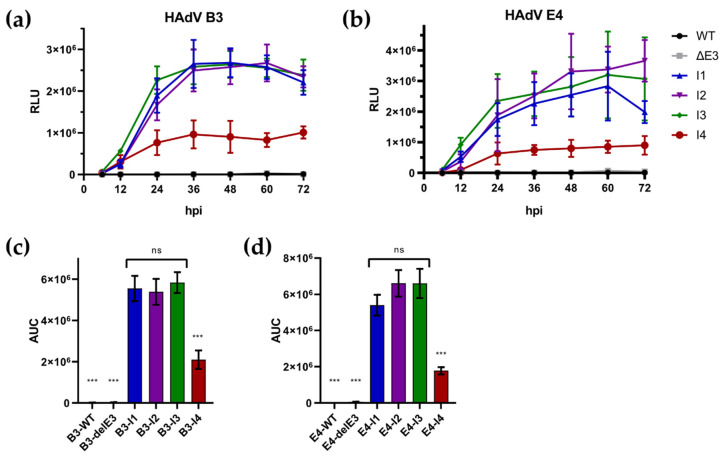
Recombinant adenoviruses are widely used in clinical and laboratory applications. Despite the wide variety of available sero- and genotypes, only a fraction is utilized in vivo. As adenoviruses are a large group of viruses, displaying many different tropisms, immune epitopes, and replication characteristics, the merits of translating these natural benefits into vector applications are apparent. This translation, however, proves difficult, since while research has investigated the application of these viruses, there are no universally applicable rules in vector design for non-classical adenovirus types. In this paper, we describe a generalized workflow that allows vectorization, rescue, and cloning of all adenoviral species to enable the rapid development of new vector variants. We show this using human and simian adenoviruses, further modifying a selection of them to investigate their gene transfer potential and build potential vector candidates for future applications.
重组腺病毒广泛应用于临床和实验室应用。尽管有多种可用的血清型和基因型,但只有一小部分在体内得到利用。由于腺病毒是一大类病毒,具有许多不同的嗜性、免疫表位和复制特性,因此将这些天然优势转化为载体应用的优点是显而易见的。然而,这种转化证明是困难的,因为尽管研究已经调查了这些病毒的应用,但对于非典型腺病毒类型,载体设计中没有普遍适用的规则。在本文中,我们描述了一种通用的工作流程,允许对所有腺病毒物种进行载体化、拯救和克隆,从而能够快速开发新的载体变体。我们使用人腺病毒和猴腺病毒来证明这一点,进一步修饰其中的一些来研究它们的基因转移潜力,并为未来的应用构建潜在的载体候选物。