Department of Trauma and Orthopaedic Surgery, University Medical Center Hamburg-Eppendorf, Hamburg, Germany.
Department of Orthopaedic Surgery, Trauma Surgery, and Sports Medicine Cologne Merheim Medical Center, Witten/Herdecke University, Ostmerheimer Str. 200, 51109, Cologne, Germany.
Arch Orthop Trauma Surg. 2024 Jun;144(6):2745-2752. doi: 10.1007/s00402-024-05355-w. Epub 2024 May 25.
Arthroscopic reconstruction techniques for higher-grade posterolateral corner (PLC) injuries (Fanelli Type B, PoLIS LI-B) have not yet been validated in clinical studies. The open reconstruction technique described by Arciero is well-established and showed good restoration of joint stability in previous studies. This study aimed to compare clinical outcomes of this established open surgery technique to a newly developed arthroscopic technique in a prospective randomized clinical trial.
Between 2019 and 2021, this study focused on chronic high-grade PLC injuries (Fanelli Type B, PoLIS LI-B). Group A consisted of patients treated with conventional open surgery following Arciero's technique, while Group B included patients treated with Arciero's arthroscopic technique. All cases underwent additional PCL reconstruction. After a minimum 12-month follow-up, clinical scores and objective stability assessments were compared between the groups.
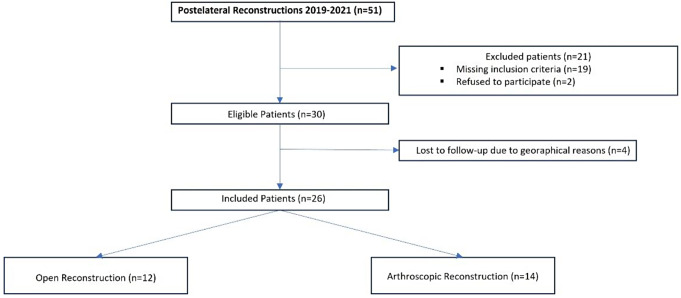
In total, 26 (group A 12, group B 14) eligible patients with a mean follow-up of 14.9 ± 7.2 months were evaluated in the present study. Knee stability and patient-reported outcome scores (PROMS) were significantly improved when comparing pre- and post-operative values (p < 0.0001). No clinically relevant differences in PROMS (Lysholm: A 83.9 ± 11.4 vs. B 85.3 ± 13.8; IKDC: A 76.91 ± 12.6 vs. B 76.8 ± 15.7) were shown in both groups. Additionally, no statistically significant differences were detected between groups with respect to external rotation, range of motion and instrumental stability testing. Arthroscopic reconstruction showed significantly shorter operation time (p = 0.0109). There were no clinical failures or neurovascular complications of the surgical procedures.
Both surgical techniques for isolated chronic PLC Fanelli Type B injuries significantly improved the knee stability, were equivalent with respect to PROMs and led to good clinical results. However, arthroscopic PLC reconstruction was associated with a shorter surgery time compared to open PLC reconstruction. Therefore, arthroscopic PLC reconstruction may be a viable option in the hands of an experienced surgeon.
Prospective cohort study, II.
对于较高等级的后外侧角(PLC)损伤(法内里 B 型,PoLIS LI-B),关节镜下重建技术尚未在临床研究中得到验证。Arciero 描述的开放重建技术已经成熟,并在以前的研究中显示出良好的关节稳定性恢复。本研究旨在通过前瞻性随机临床试验比较这种成熟的开放手术技术与新开发的关节镜技术的临床结果。
2019 年至 2021 年,本研究聚焦于慢性高等级 PLC 损伤(法内里 B 型,PoLIS LI-B)。A 组患者采用 Arciero 技术进行常规开放手术治疗,B 组患者采用 Arciero 关节镜技术治疗。所有病例均行后交叉韧带(PCL)重建。经过至少 12 个月的随访,对两组患者的临床评分和客观稳定性评估进行比较。
本研究共评估了 26 名(A 组 12 名,B 组 14 名)符合条件的患者,平均随访 14.9±7.2 个月。与术前相比,膝关节稳定性和患者报告的结果评分(PROMS)均显著改善(p<0.0001)。两组患者的 PROMS(Lysholm:A 组 83.9±11.4 分,B 组 85.3±13.8 分;IKDC:A 组 76.91±12.6 分,B 组 76.8±15.7 分)无临床显著差异。此外,两组在外部旋转、运动范围和仪器稳定性测试方面无统计学显著差异。关节镜重建的手术时间明显缩短(p=0.0109)。无手术相关的失稳或神经血管并发症。
对于孤立性慢性 PLC 法内里 B 型损伤,两种手术技术均显著改善了膝关节稳定性,在 PROMS 方面相当,临床效果良好。然而,与开放 PLC 重建相比,关节镜 PLC 重建的手术时间更短。因此,对于经验丰富的外科医生来说,关节镜 PLC 重建可能是一种可行的选择。
前瞻性队列研究,II 级。