DPG, University of Padova, Padova, Italy.
DPSS, University of Padova, Padova, Italy.
PeerJ. 2024 May 21;12:e17449. doi: 10.7717/peerj.17449. eCollection 2024.
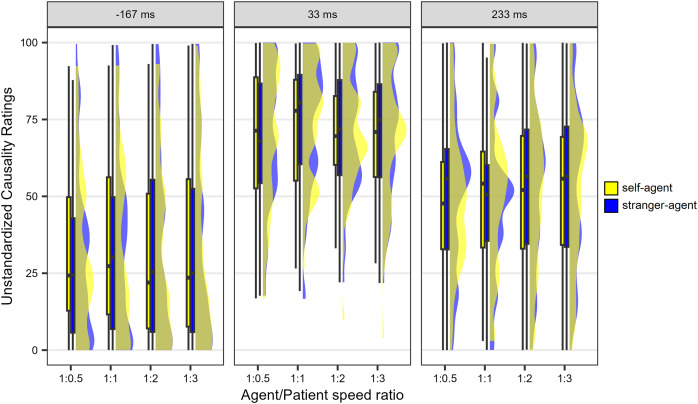
People tend to overestimate the causal contribution of the self to the observed outcome in various situations, a cognitive bias known as the 'illusion of control.' This study delves into whether this cognitive bias impacts causality judgments in animations depicting physical and social causal interactions. In two experiments, participants were instructed to associate themselves and a hypothetical stranger identity with two geometrical shapes (a circle and a square). Subsequently, they viewed animations portraying these shapes assuming the roles of agent and patient in causal interactions. Within one block, the shape related to the self served as the agent, while the shape associated with the stranger played the role of the patient. Conversely, in the other block, the identity-role association was reversed. We posited that the perception of the self as a causal agent might influence explicit judgments of physical and social causality. Experiment 1 demonstrated that physical causality ratings were solely shaped by kinematic cues. In Experiment 2, emphasising social causality, the dominance of kinematic parameters was confirmed. Therefore, contrary to the hypothesis anticipating diminished causality ratings with specific identity-role associations, results indicated negligible impact of our manipulation. The study contributes to understanding the interplay between kinematic and non-kinematic cues in human causal reasoning. It suggests that explicit judgments of causality in simple animations primarily rely on low-level kinematic cues, with the cognitive bias of overestimating the self's contribution playing a negligible role.
人们在各种情况下往往会高估自己对观察到的结果的因果贡献,这种认知偏差被称为“控制错觉”。本研究探讨了这种认知偏差是否会影响描述物理和社会因果相互作用的动画中的因果判断。在两项实验中,参与者被指示将自己和一个假设的陌生人身份与两个几何形状(圆形和方形)联系起来。然后,他们观看了动画,这些动画描绘了这些形状在因果相互作用中扮演主体和客体的角色。在一个模块中,与自己相关联的形状充当主体,而与陌生人相关联的形状扮演客体的角色。相反,在另一个模块中,身份-角色的关联被颠倒了。我们假设将自己视为因果主体的感知可能会影响对物理和社会因果关系的明确判断。实验 1 表明,物理因果关系的评价仅由运动学线索决定。在实验 2 中,强调社会因果关系,证实了运动学参数的主导地位。因此,与预期特定身份-角色关联会降低因果评价的假设相反,结果表明我们的操作几乎没有影响。这项研究有助于理解人类因果推理中运动学和非运动学线索之间的相互作用。它表明,在简单的动画中,对因果关系的明确判断主要依赖于低层次的运动学线索,而高估自己贡献的认知偏差的作用可以忽略不计。