Taiwo Oluseyi Rotimi, Onyeaka Helen, Oladipo Elijah K, Oloke Julius Kola, Chukwugozie Deborah C
Genomics Unit, Helix Biogen Institute, Ogbomosho, Oyo, Nigeria.
School of Chemical Engineering, University of Birmingham, Edgbaston B15 2TT, Birmingham, UK.
Int J Microbiol. 2024 May 17;2024:6612162. doi: 10.1155/2024/6612162. eCollection 2024.
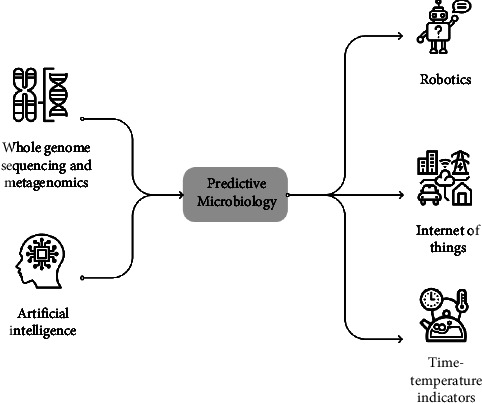
Predictive microbiology is a rapidly evolving field that has gained significant interest over the years due to its diverse application in food safety. Predictive models are widely used in food microbiology to estimate the growth of microorganisms in food products. These models represent the dynamic interactions between intrinsic and extrinsic food factors as mathematical equations and then apply these data to predict shelf life, spoilage, and microbial risk assessment. Due to their ability to predict the microbial risk, these tools are also integrated into hazard analysis critical control point (HACCP) protocols. However, like most new technologies, several limitations have been linked to their use. Predictive models have been found incapable of modeling the intricate microbial interactions in food colonized by different bacteria populations under dynamic environmental conditions. To address this issue, researchers are integrating several new technologies into predictive models to improve efficiency and accuracy. Increasingly, newer technologies such as whole genome sequencing (WGS), metagenomics, artificial intelligence, and machine learning are being rapidly adopted into newer-generation models. This has facilitated the development of devices based on robotics, the Internet of Things, and time-temperature indicators that are being incorporated into food processing both domestically and industrially globally. This study reviewed current research on predictive models, limitations, challenges, and newer technologies being integrated into developing more efficient models. Machine learning algorithms commonly employed in predictive modeling are discussed with emphasis on their application in research and industry and their advantages over traditional models.
预测微生物学是一个快速发展的领域,由于其在食品安全中的广泛应用,近年来受到了极大的关注。预测模型在食品微生物学中被广泛用于估计食品中微生物的生长情况。这些模型将食品内在和外在因素之间的动态相互作用表示为数学方程,然后应用这些数据来预测保质期、腐败情况以及微生物风险评估。由于它们能够预测微生物风险,这些工具也被整合到危害分析关键控制点(HACCP)协议中。然而,与大多数新技术一样,它们的使用也存在一些局限性。已发现预测模型无法对动态环境条件下由不同细菌群体定殖的食品中复杂的微生物相互作用进行建模。为了解决这个问题,研究人员正在将几种新技术整合到预测模型中,以提高效率和准确性。越来越多的新技术,如全基因组测序(WGS)、宏基因组学、人工智能和机器学习,正迅速被应用于新一代模型中。这推动了基于机器人技术、物联网和时间 - 温度指示器的设备的开发,这些设备正在全球范围内被应用于家庭和工业食品加工中。本研究综述了关于预测模型、局限性、挑战以及正在被整合到开发更高效模型中的新技术的当前研究。讨论了预测建模中常用的机器学习算法,重点介绍了它们在研究和行业中的应用以及相对于传统模型的优势。