Institute of Social Sciences CSPS SAS, Košice, Slovakia.
Faculty of Humanities and Social Sciences, University of Jyväskylä, Jyväskylä, Finland.
Int J Methods Psychiatr Res. 2024 Jun;33(2):e2021. doi: 10.1002/mpr.2021.
There are dozens of screening instruments purporting to measure the (Internet) gaming disorder (IGD/GD). The two prominent diagnostic manuals, DSM-5 and ICD-11, list several additional diagnostic or clinical features and problems (e.g., neglect of sleep, neglect of daily duties, health deterioration) that should co-occur or be caused by the IGD/GD. It remains unclear how specific IGD/GD operationalizations (different screening scales) are related to these functional impairments.
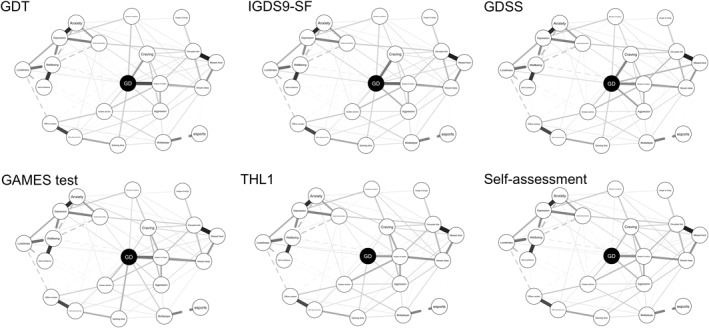
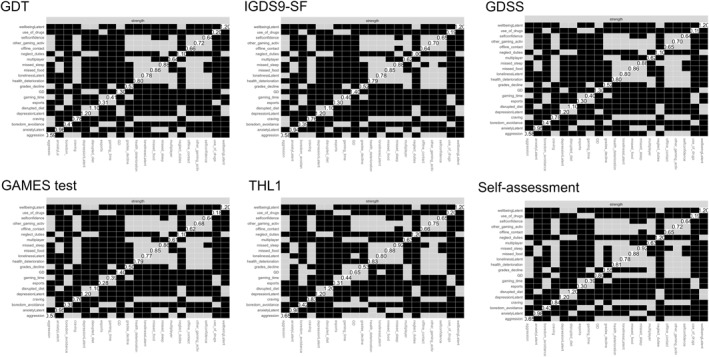
To explore this, data on six measures of IGD/GD (IGDS9-SF, GDSS, GDT, GAMES test, two self-assessments) and 18 additional diagnostic features were collected from a sample of 1009 players who play digital games at least 13 h per week. A network approach was utilized to determine which operationalization is most strongly associated with functional impairment.
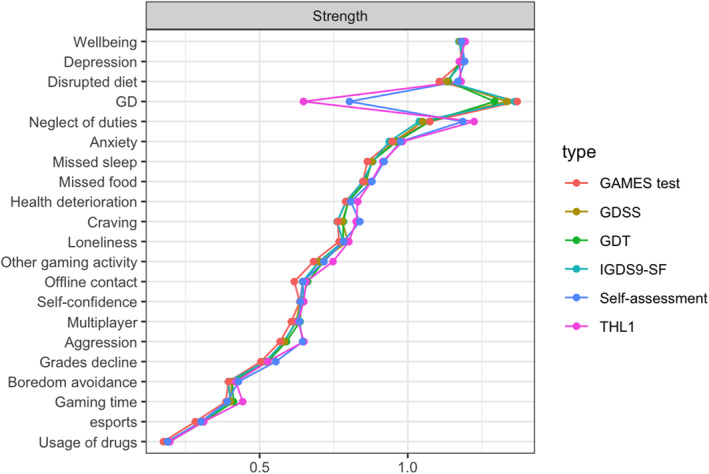
In most of the networks, IGD/GD consistently emerged as the most central node.
The similar centrality of IGD/GD, irrespective of its definition (DSM-5 or ICD-11) or operationalization, provides support for the valid comparison or synthesis of results from studies that used instruments coming from both DSM-5 and ICD-11 ontologies, but only if the goal is to evaluate IGD/GD relationships to other phenomena, not the relationships between the symptoms themselves.
有数十种声称可以测量(互联网)游戏障碍(IGD/GD)的筛选工具。DSM-5 和 ICD-11 这两个主要的诊断手册列出了其他一些附加的诊断或临床特征和问题(例如,忽视睡眠、忽视日常职责、健康恶化),这些特征和问题应该同时出现或由 IGD/GD 引起。目前尚不清楚特定的 IGD/GD 操作化(不同的筛选量表)与这些功能障碍之间的关系如何。
为了探讨这一点,从每周至少玩 13 小时数字游戏的 1009 名玩家中收集了六种 IGD/GD 测量方法(IGDS9-SF、GDSS、GDT、GAMES 测试、两种自我评估)和 18 种其他诊断特征的数据。采用网络方法来确定哪种操作化与功能障碍的关联最强。
在大多数网络中,IGD/GD 始终是最中心的节点。
无论 IGD/GD 的定义(DSM-5 或 ICD-11)或操作化如何,其相似的中心性都为使用来自 DSM-5 和 ICD-11 两种本体论的工具的研究结果的有效比较或综合提供了支持,但前提是目标是评估 IGD/GD 与其他现象的关系,而不是症状本身之间的关系。