Okinawa Prefecture Commission for Epidemiological and Statistical Analysis, Naha-shi, Okinawa, Japan.
Okinawa Chubu Hospital, 281, Miyazato, Uruma, Okinawa, 904-2293, Japan.
BMC Infect Dis. 2024 May 30;24(1):542. doi: 10.1186/s12879-024-09427-5.
While airport screening measures for COVID-19 infected passengers at international airports worldwide have been greatly relaxed, observational studies evaluating fever screening alone at airports remain scarce. The purpose of this study is to retrospectively assess the effectiveness of fever screening at airports in preventing the influx of COVID-19 infected persons.
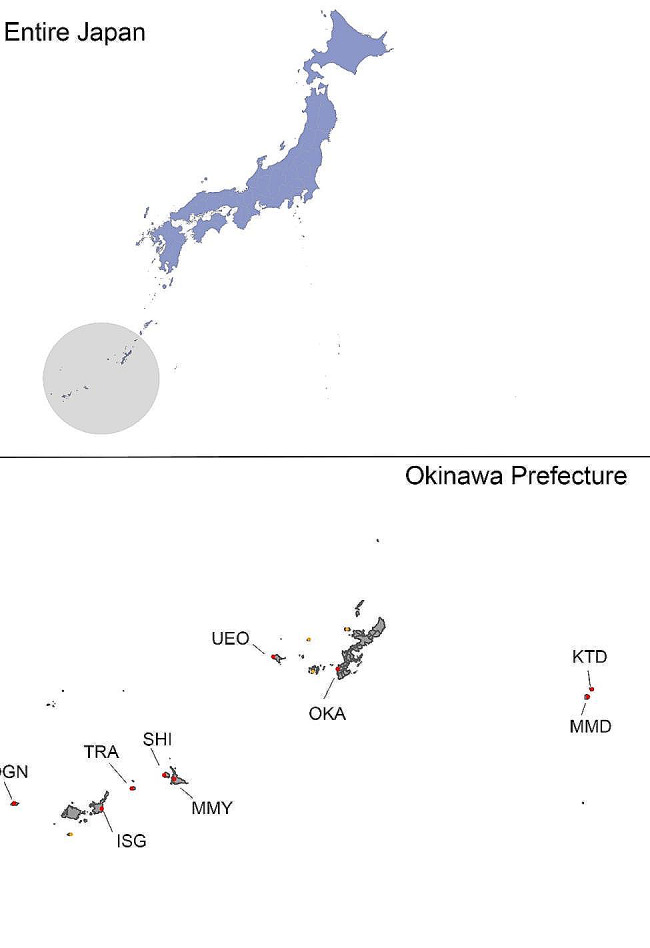
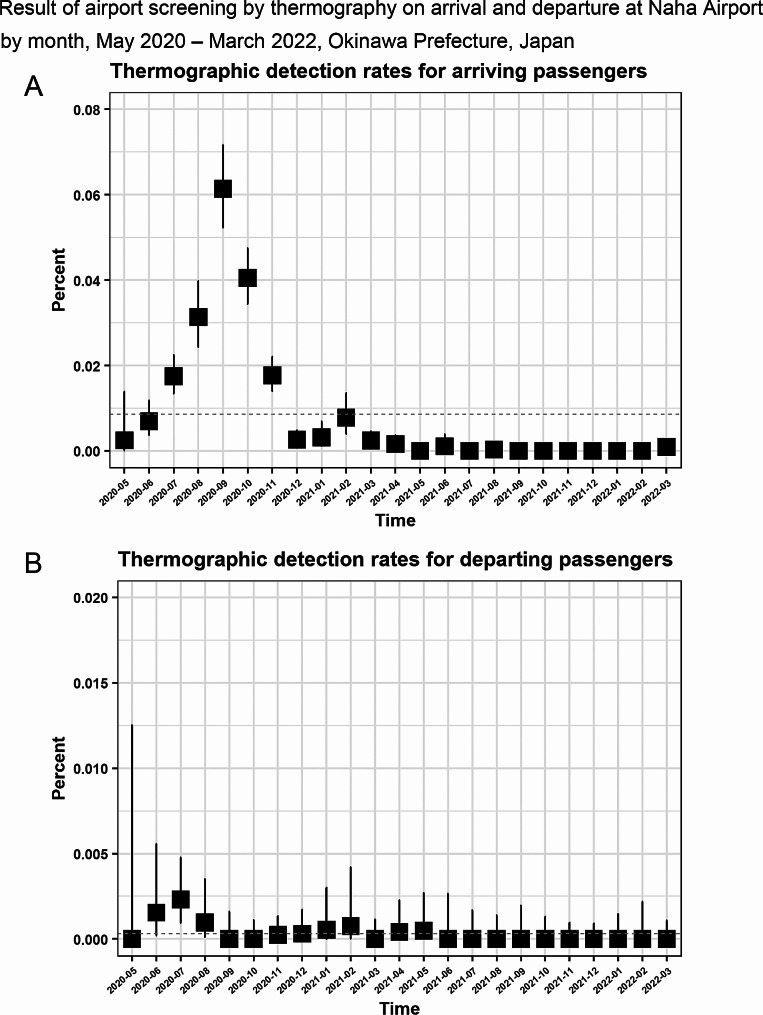
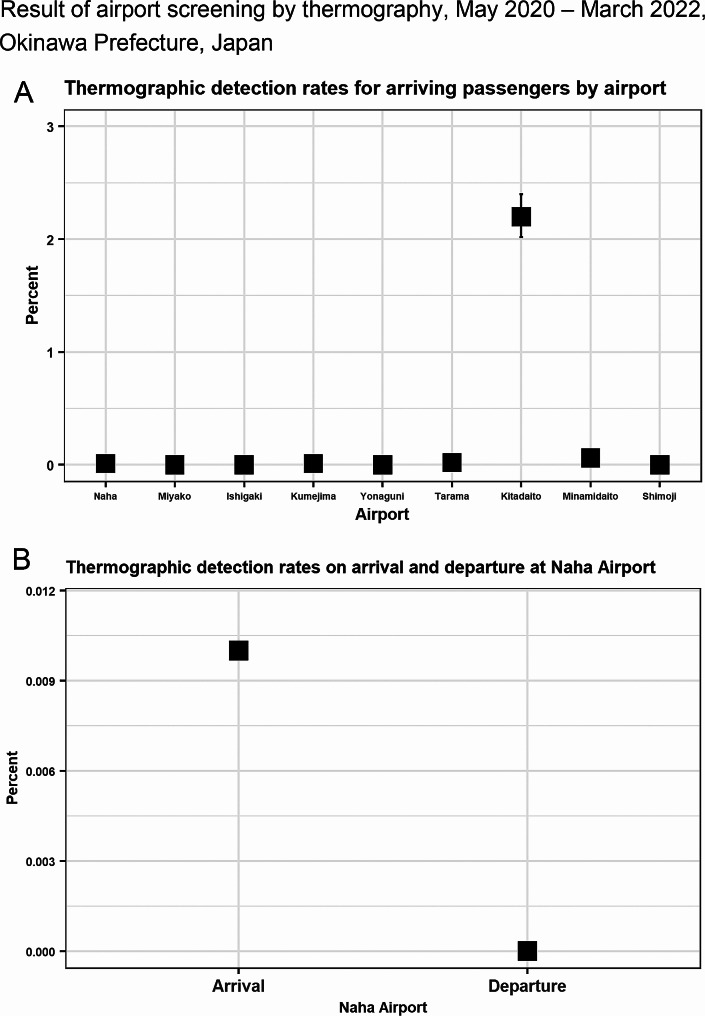
We conducted a retrospective epidemiological analysis of fever screening implemented at 9 airports in Okinawa Prefecture from May 2020 to March 2022. The number of passengers covered during the same period was 9,003,616 arriving at 9 airports in Okinawa Prefecture and 5,712,983 departing passengers at Naha Airport. The capture rate was defined as the proportion of reported COVID-19 cases who would have passed through airport screening to the number of suspected cases through fever screening at the airport, and this calculation used passengers arriving at Naha Airport and surveillance data collected by Okinawa Prefecture between May 2020 and March 2021.
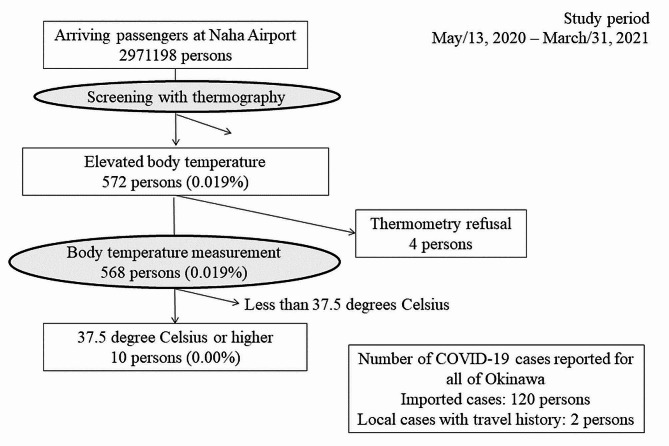
From May 2020 to March 2021, 4.09 million people were reported to pass through airports in Okinawa. During the same period, at least 122 people with COVID-19 infection arrived at the airports in Okinawa, but only a 10 suspected cases were detected; therefore, the capture rate is estimated to be up to 8.2% (95% CI: 4.00-14.56%). Our result of a fever screening rate is 0.0002% (95%CI: 0.0003-0.0006%) (10 suspected cases /2,971,198 arriving passengers). The refusal rate of passengers detected by thermography who did not respond to temperature measurements was 0.70% (95% CI: 0.19-1.78%) (4 passengers/572 passengers).
This study revealed that airport screening based on thermography alone missed over 90% of COVID-19 infected cases, indicating that thermography screening may be ineffective as a border control measure. The fact that only 10 febrile cases were detected after screening approximately 3 million passengers suggests the need to introduce measures targeting asymptomatic infections, especially with long incubation periods. Therefore, other countermeasures, e.g. preboarding RT-PCR testing, are highly recommended during an epidemic satisfying World Health Organization (WHO) Public Health Emergency of International Concern (PHEIC) criteria with pathogen characteristics similar or exceeding SARS-CoV-2, especially when traveling to rural cities with limited medical resources.
尽管全球各国际机场对 COVID-19 感染乘客的机场筛查措施已大大放宽,但评估机场仅进行发热筛查效果的观察性研究仍然很少。本研究旨在回顾性评估机场发热筛查在防止 COVID-19 感染人员入境方面的效果。
我们对 2020 年 5 月至 2022 年 3 月冲绳县 9 个机场实施的发热筛查进行了回顾性流行病学分析。同期,覆盖了 9 个机场入境的 9003616 名乘客和 5712983 名那霸机场出发的乘客。捕获率定义为通过机场发热筛查发现的报告 COVID-19 病例数与通过机场发热筛查发现的疑似病例数之比,该计算使用了 2020 年 5 月至 2021 年 3 月期间那霸机场入境乘客和冲绳县收集的监测数据。
2020 年 5 月至 2021 年期间,有 409 万人通过冲绳机场。同期,至少有 122 名 COVID-19 感染人员抵达冲绳机场,但仅发现 10 例疑似病例,因此,捕获率估计高达 8.2%(95%CI:4.00-14.56%)。我们的发热筛查率为 0.0002%(95%CI:0.0003-0.0006%)(10 例疑似病例/2971198 名入境乘客)。未对体温测量无反应的热成像检测乘客的拒绝率为 0.70%(95%CI:0.19-1.78%)(4 名乘客/572 名乘客)。
本研究表明,仅基于热成像的机场筛查漏检了超过 90%的 COVID-19 感染病例,表明热成像筛查作为边境管控措施可能无效。在筛查约 300 万名乘客后仅发现 10 例发热病例这一事实表明,需要引入针对无症状感染的措施,尤其是针对潜伏期较长的无症状感染。因此,当旅行目的地为感染风险高且医疗资源有限的农村城市时,建议在符合世界卫生组织(WHO)国际关注的突发公共卫生事件(PHEIC)标准且病原体特征与 SARS-CoV-2 相似或超过 SARS-CoV-2 的大流行期间,采用其他对策,例如登机前 RT-PCR 检测。