PRESTO, Japan Science and Technology Agency, 4-1-8 Honcho, Kawaguchi, Saitama 332-0012, Japan.
BMC Infect Dis. 2011 May 3;11:111. doi: 10.1186/1471-2334-11-111.
Entry screening tends to start with a search for febrile international passengers, and infrared thermoscanners have been employed for fever screening in Japan. We aimed to retrospectively assess the feasibility of detecting influenza cases based on fever screening as a sole measure.
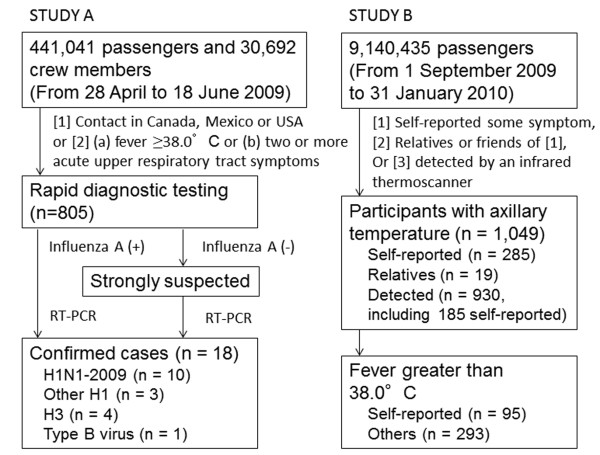
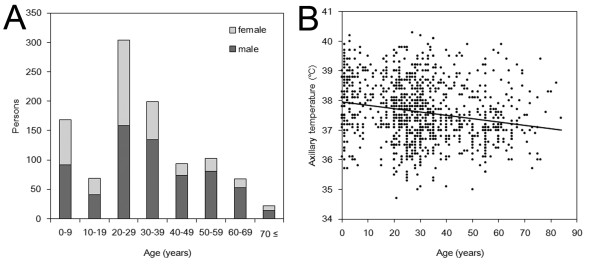
Two datasets were collected at Narita International Airport during the 2009 pandemic. The first contained confirmed influenza cases (n = 16) whose diagnosis took place at the airport during the early stages of the pandemic, and the second contained a selected and suspected fraction of passengers (self-reported or detected by an infrared thermoscanner; n = 1,049) screened from September 2009 to January 2010. The sensitivity of fever (38.0 °C) for detecting H1N1-2009 was estimated, and the diagnostic performances of the infrared thermoscanners in detecting hyperthermia at cut-off levels of 37.5 °C, 38.0 °C and 38.5 °C were also estimated.
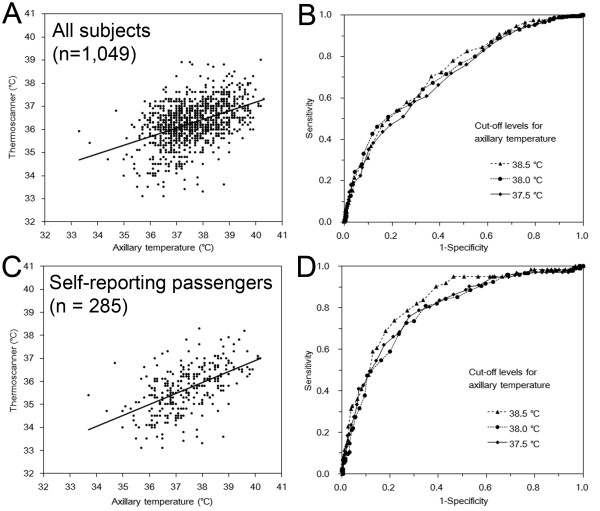
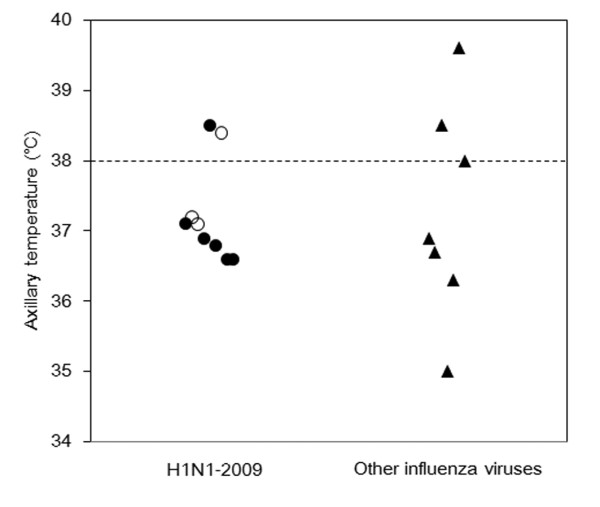
The sensitivity of fever for detecting H1N1-2009 cases upon arrival was estimated to be 22.2% (95% confidence interval: 0, 55.6) among nine confirmed H1N1-2009 cases, and 55.6% of the H1N1-2009 cases were under antipyretic medications upon arrival. The sensitivity and specificity of the infrared thermoscanners in detecting hyperthermia ranged from 50.8-70.4% and 63.6-81.7%, respectively. The positive predictive value appeared to be as low as 37.3-68.0%.
The sensitivity of entry screening is a product of the sensitivity of fever for detecting influenza cases and the sensitivity of the infrared thermoscanners in detecting fever. Given the additional presence of confounding factors and unrestricted medications among passengers, reliance on fever alone is unlikely to be feasible as an entry screening measure.
入境筛查通常从寻找发热的国际旅客开始,日本已经使用红外热像仪进行发热筛查。我们旨在回顾性评估仅通过发热筛查作为单一措施来检测流感病例的可行性。
在 2009 年大流行期间,我们在成田国际机场收集了两个数据集。第一个数据集包含确诊的流感病例(n=16),这些病例是在大流行早期在机场确诊的,第二个数据集包含 2009 年 9 月至 2010 年 1 月期间从选定的和疑似的旅客(自述或红外热像仪检测;n=1049)中筛选出的样本。我们估计了发热(38.0°C)检测 H1N1-2009 的敏感性,并估计了红外热像仪在设定 37.5°C、38.0°C 和 38.5°C 作为发热检测截定点时的诊断性能。
在 9 例确诊的 H1N1-2009 病例中,发热检测入境时 H1N1-2009 病例的敏感性估计为 22.2%(95%置信区间:0,55.6),9 例确诊的 H1N1-2009 病例中,55.6%的病例在抵达时服用了退烧药。红外热像仪检测发热的敏感性和特异性分别为 50.8-70.4%和 63.6-81.7%。阳性预测值似乎低至 37.3-68.0%。
入境筛查的敏感性是发热检测流感病例的敏感性和红外热像仪检测发热的敏感性的产物。鉴于旅客中存在混杂因素和不受限制的药物使用,仅依赖发热作为入境筛查措施不太可行。