Alqarawi Firas K, Gad Mohammed M
Department of Substitutive Dental Sciences, College of Dentistry, Imam Abdulrahman Bin Faisal University, Dammam, Saudi Arabia.
Front Oral Health. 2024 May 16;5:1375186. doi: 10.3389/froh.2024.1375186. eCollection 2024.
Digital denture fabrication became an alternative method to conventional denture fabrication. However reviewing the antimicrobial performance of newly introduced digital fabrication methods in comparison to the conventional method is neglected. Aim of study: this review was to compare the antiadherence properties of various CAD-CAM subtractive (milled), additive (3D printed) conventional denture base resins. In order to answer the developed PICO question: "Does CAD-CAM milled and 3D printed denture base resins have microbiological antiadherence properties over the conventional ones?" We included comparative studies on digitally fabricated Denture base resins with conventionally fabricated one in term of microbial adhesion.
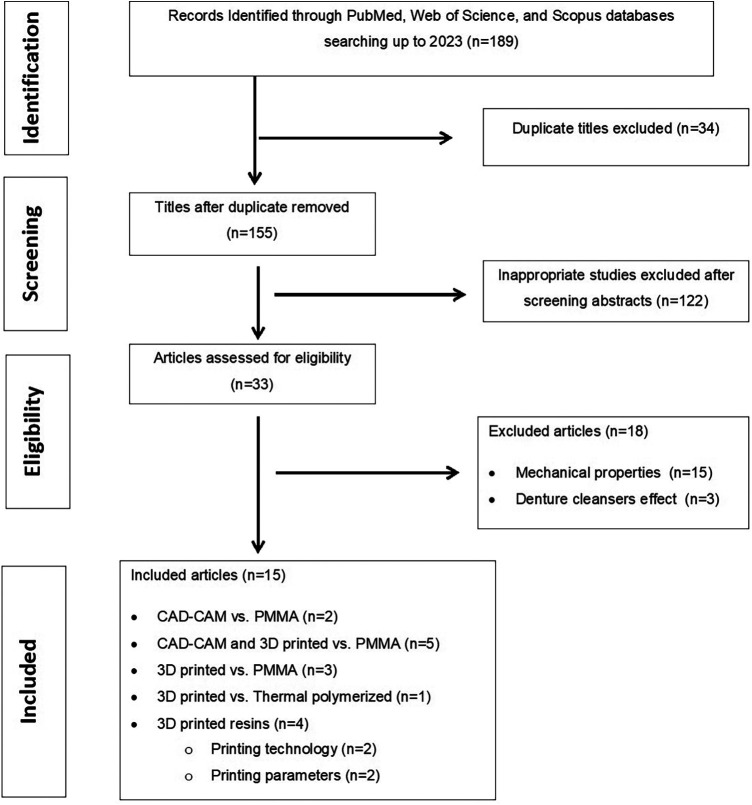
All studies investigated the microbial adherence to CAD-CAM milled and 3D printed denture base resins in comparison to conventional were searched in the PubMed, Web of Sciences, and Scopus databases up to December 2023.
Fifteen studies have been investigated the microbial adhesion to milled and 3D printed denture base resins. CAD-CAM milled resins significantly decreased the microbial adhesion when compared with the conventional resins and 3D printed resins, while the later showed a high tendency for microbial adhesion. The addition of antifungal agents to 3D printed resins significantly reduced adhesion. In terms of 3D printing parameters, printing orientation affected adherence while printing technology had no effect on microbial adhesion.
Denture base materials and fabrication methods significantly affect the microbial adhesion. CAD-CAM milled denture base resins demonstrated low microbial adhesion. 3D-printed resins showed high tendency for adhesion. The antiadherent properties of 3D-printed resins can be improved by incorporating antifungal agents or changing the printing parameters, but further investigations are required to validate these modifications.
数字化义齿制作成为传统义齿制作的一种替代方法。然而,与传统方法相比,新引入的数字化制作方法的抗菌性能却被忽视了。研究目的:本综述旨在比较各种计算机辅助设计与制造(CAD-CAM)减法(铣削)、加法(3D打印)传统义齿基托树脂的抗黏附特性。为了回答所提出的PICO问题:“CAD-CAM铣削和3D打印的义齿基托树脂是否比传统义齿基托树脂具有微生物抗黏附特性?”我们纳入了关于数字化制作的义齿基托树脂与传统制作的义齿基托树脂在微生物黏附方面的比较研究。
在截至2023年12月的PubMed、科学网和Scopus数据库中搜索了所有将CAD-CAM铣削和3D打印义齿基托树脂与传统义齿基托树脂在微生物黏附方面进行比较的研究。
已有15项研究调查了铣削和3D打印义齿基托树脂的微生物黏附情况。与传统树脂和3D打印树脂相比,CAD-CAM铣削树脂显著降低了微生物黏附,而后者显示出较高的微生物黏附倾向。向3D打印树脂中添加抗真菌剂可显著降低黏附。在3D打印参数方面,打印方向影响黏附,而打印技术对微生物黏附没有影响。
义齿基托材料和制作方法显著影响微生物黏附。CAD-CAM铣削义齿基托树脂显示出低微生物黏附。3D打印树脂显示出较高的黏附倾向。通过加入抗真菌剂或改变打印参数可以改善3D打印树脂的抗黏附性能,但需要进一步研究来验证这些改进。