Rahiminejad Sara, Mukund Kavitha, Maurya Mano Ram, Subramaniam Shankar
University of California, San Diego.
Res Sq. 2024 May 24:rs.3.rs-4402565. doi: 10.21203/rs.3.rs-4402565/v1.
An understanding of mechanisms underlying colorectal cancer (CRC) development and progression is yet to be fully elucidated. This study aims to employ network theoretic approaches to analyse single cell transcriptomic data from CRC to better characterize its progression and sided-ness.
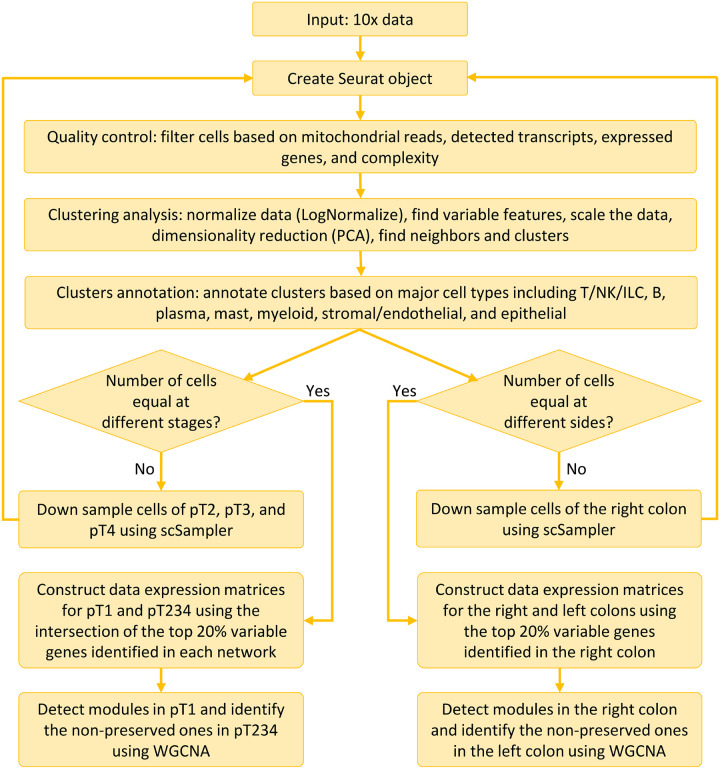
We utilized a recently published single-cell RNA sequencing data (GEO-GSE178341) and parsed the cell X gene data by stage and side (right and left colon). Using Weighted Gene Co-expression Network Analysis (WGCNA), we identified gene modules with varying preservation levels (weak or strong) of network topology between early (pT1) and late stages (pT234), and between right and left colons. Spearman's rank correlation () was used to assess the similarity or dissimilarity in gene connectivity.
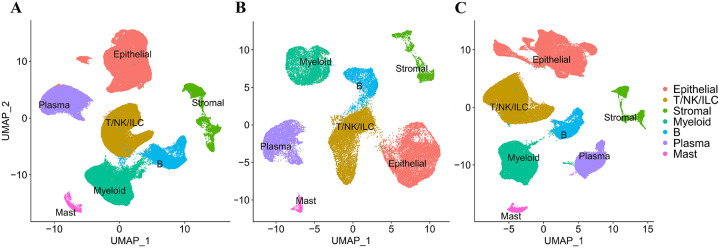
Equalizing cell counts across different stages, we detected 13 modules for the early stage, two of which were non-preserved in late stages. Both non-preserved modules displayed distinct gene connectivity patterns between the early and late stages, characterized by low values. One module predominately dealt with myeloid cells, with genes mostly enriched for cytokine-cytokine receptor interaction potentiallystimulating myeloid cells to participate in angiogenesis. The second module, representing a subset of epithelial cells, was mainly enriched for carbohydrate digestion and absorption, influencing the gut microenvironment through the breakdown of carbohydrates. In the comparison of left vs. right colons, two of 12 modules identified in the right colon were non-preserved in the left colon. One captured a small fraction of epithelial cells and was enriched for transcriptional misregulation in cancer, potentially impacting communication between epithelial cells and the tumor microenvironment. The other predominantly contained B cells with a crucial role in maintaining human gastrointestinal health and was enriched for B-cell receptor signalling pathway.
We identified modules with topological and functional differences specific to cell types between the early and late stages, and between the right and left colons. This study enhances the understanding of roles played by different cell types at different stages and sides, providing valuable insights for future studies focused on the diagnosis and treatment of CRC.
结直肠癌(CRC)发生和发展的潜在机制尚未完全阐明。本研究旨在采用网络理论方法分析CRC的单细胞转录组数据,以更好地表征其进展和部位差异。
我们利用最近发表的单细胞RNA测序数据(GEO-GSE178341),并按阶段和部位(右半结肠和左半结肠)解析细胞X基因数据。使用加权基因共表达网络分析(WGCNA),我们确定了在早期(pT1)和晚期(pT234)之间以及右半结肠和左半结肠之间具有不同网络拓扑保留水平(弱或强)的基因模块。使用斯皮尔曼等级相关性()来评估基因连通性的相似性或差异。
在不同阶段均衡细胞计数后,我们在早期检测到13个模块,其中两个在晚期未保留。两个未保留的模块在早期和晚期之间均显示出独特的基因连通性模式,其特征为值较低。一个模块主要涉及髓样细胞,其基因大多富集于细胞因子-细胞因子受体相互作用,可能刺激髓样细胞参与血管生成。第二个模块代表上皮细胞的一个子集,主要富集于碳水化合物消化和吸收,通过碳水化合物的分解影响肠道微环境。在左半结肠与右半结肠的比较中,在右半结肠中鉴定出的12个模块中有两个在左半结肠中未保留。一个捕获了一小部分上皮细胞,并富集于癌症中的转录失调,可能影响上皮细胞与肿瘤微环境之间的通讯。另一个主要包含在维持人类胃肠道健康中起关键作用的B细胞,并富集于B细胞受体信号通路。
我们确定了在早期和晚期之间以及右半结肠和左半结肠之间特定于细胞类型的具有拓扑和功能差异的模块。本研究增强了对不同细胞类型在不同阶段和部位所起作用的理解,为未来专注于CRC诊断和治疗的研究提供了有价值的见解。