Chen L, Rhoads D, Tai P C
J Bacteriol. 1985 Mar;161(3):973-80. doi: 10.1128/jb.161.3.973-980.1985.
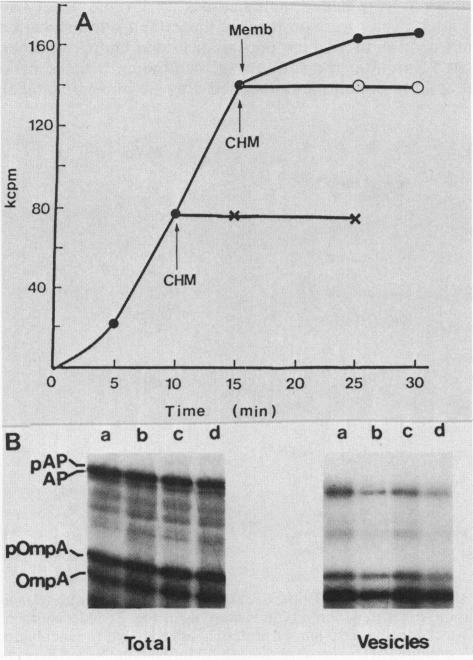
We previously described a system for translocating the periplasmic enzyme alkaline phosphatase and the outer membrane protein OmpA into inverted membrane vesicles of Escherichia coli. We have now optimized and substantially improved the translocation system by including polyamines and by reducing the amount of membrane used. Under these conditions, efficient translocation was seen even posttranslationally, i.e., when vesicles were not added until after protein synthesis was stopped. This was the case not only with the OmpA protein, which is synthesized by free polysomes and hence is presumably exported posttranslationally in the cell, but also with alkaline phosphatase, which is synthesized only by membrane-bound polysomes and has been shown to be secreted cotranslationally in the cells. Prolonged incubation rendered the precursors inactive for subsequent translocation. Posttranslational translocation was impaired, like cotranslational translocation, by inhibitors of the proton motive force and by treatment of the vesicles with protease. Since it appears that E. coli can translocate the same proteins either cotranslationally or posttranslationally, the cotranslational mode may perhaps be more efficient, but not obligatory, for the secretion of bacterial proteins.
我们之前描述了一种将周质酶碱性磷酸酶和外膜蛋白OmpA转运到大肠杆菌反向膜泡中的系统。现在,我们通过加入多胺并减少膜用量,对该转运系统进行了优化并显著改进。在这些条件下,即使在翻译后(即蛋白质合成停止后才加入膜泡)也能观察到高效的转运。不仅由游离多核糖体合成、因此可能在细胞中翻译后输出的OmpA蛋白是这样,由膜结合多核糖体合成且已证明在细胞中是共翻译分泌的碱性磷酸酶也是如此。长时间孵育会使前体对后续转运失去活性。与共翻译转运一样,质子动力抑制剂和用蛋白酶处理膜泡会损害翻译后转运。由于大肠杆菌似乎可以共翻译或翻译后转运相同的蛋白质,所以共翻译模式对于细菌蛋白质的分泌可能更有效,但并非必需。