White Darrell, Schiller Gary J, Madan Sumit, Lentzsch Suzanne, Chubar Evgeni, Lavi Noa, Van Domelen Dane R, Bentur Ohad S, Baljevic Muhamed
Department of Medicine, Dalhousie University and Queen Elizabeth II Health Sciences Centre, Halifax, NS, Canada.
Department of Medicine, David Geffen School of Medicine at University of California, Los Angeles (UCLA), Los Angeles, CA, United States.
Front Oncol. 2024 May 17;14:1352281. doi: 10.3389/fonc.2024.1352281. eCollection 2024.
To identify the optimal dose of selinexor in combination with pomalidomide and dexamethasone (SPd).
An analysis of efficacy and safety of 2 once-weekly selinexor regimens (60 mg and 40 mg) with pomalidomide and dexamethasone (SPd-60 and SPd-40, respectively) given to patients with relapsed/refractory multiple myeloma (RRMM) in the STOMP (NCT02343042) and XPORT-MM-028 (NCT04414475) trials.
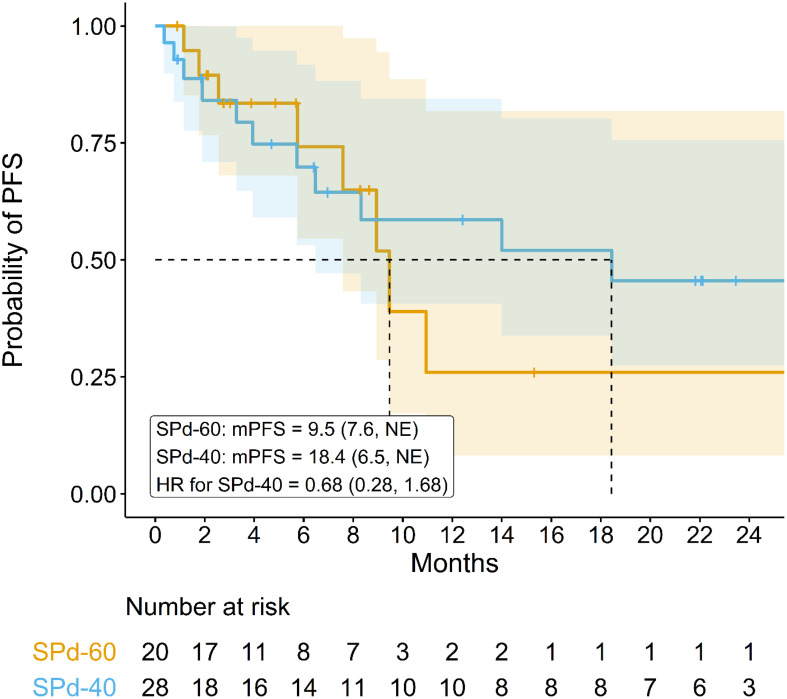
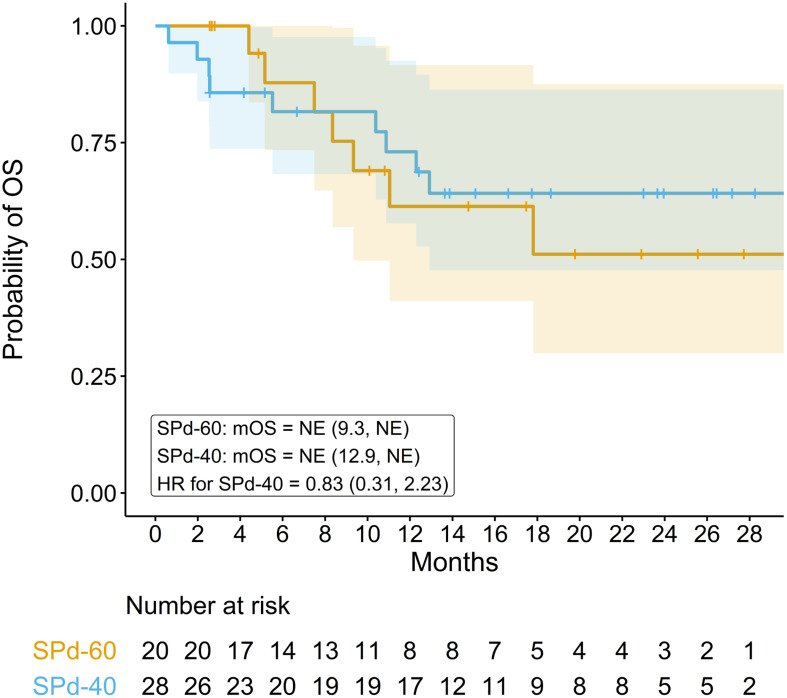
Twenty-eight patients (60.7% males, median age 67.5 years) and 20 patients (35.0% males, median age 65.5 years) were analyzed in the SPd-40 and SPd-60 cohorts, respectively. Overall response rate was 50% (95% confidence interval [CI] 30.6-69.4%) and 65% (95% CI 40.8-84.6%), respectively. Very good partial response or better was reported in 28.6% (95% CI 13.2-48.7%) and 30.0% (95% CI 11.9-54.3%) of patients, respectively. Among 27 responders in both cohorts, the 12-month sustained response rate was 83.3% (95% CI 64.7-100.0%) for SPd-40 and 28.1% (95% CI 8.9-88.8%) for SPd-60. Median progression-free survival was 18.4 months (95% CI 6.5 months, not evaluable [NE]) and 9.5 months (95% CI 7.6 months-NE) for SPd-40 and SPd-60, respectively. Twenty-four-month survival rates were 64.2% (95% CI 47.7-86.3%) for SPd-40 and 51.1% (95% CI 29.9-87.5%) for SPd-60. Treatment-emergent adverse events (TEAEs) included neutropenia (all grades: SPd-40 64.3% versus SPd-60 75.0%), anemia (46.4% versus 65.0%), thrombocytopenia (42.9% versus 45.0%), fatigue (46.4% versus 75.0%), nausea (32.1% versus 70.0%) and diarrhea (28.6% versus 35.0%).
The all-oral combination of SPd exhibited preliminary signs of efficacy and was generally tolerable in patients with RRMM. The overall risk-benefit profile favored the SPd-40 regimen.
确定塞利尼索与泊马度胺和地塞米松(SPd)联合使用的最佳剂量。
对STOMP(NCT02343042)和XPORT-MM-028(NCT04414475)试验中接受两种每周一次塞利尼索方案(60毫克和40毫克)联合泊马度胺和地塞米松(分别为SPd-60和SPd-40)治疗的复发/难治性多发性骨髓瘤(RRMM)患者的疗效和安全性进行分析。
分别在SPd-40和SPd-60队列中分析了28例患者(60.7%为男性,中位年龄67.5岁)和20例患者(35.0%为男性,中位年龄65.5岁)。总体缓解率分别为50%(95%置信区间[CI]30.6 - 69.4%)和65%(95%CI 40.8 - 84.6%)。分别有28.6%(95%CI 13.2 - 48.7%)和30.0%(95%CI 11.9 - 54.3%)的患者达到非常好的部分缓解或更好。在两个队列的27例缓解者中,SPd-40的12个月持续缓解率为83.3%(95%CI 64.7 - 100.0%),SPd-60为28.1%(95%CI 8.9 - 88.8%)。SPd-40和SPd-60的中位无进展生存期分别为18.4个月(95%CI 6.5个月,不可评估[NE])和9.5个月(95%CI 7.6个月 - NE)。SPd-40和SPd-60的24个月生存率分别为64.2%(95%CI 47.7 - 86.3%)和51.1%(95%CI 29.9 - 87.5%)。治疗中出现的不良事件(TEAE)包括中性粒细胞减少(所有级别:SPd-40为64.3%,SPd-60为75.0%)、贫血(46.4%对65.0%)、血小板减少(42.9%对45.0%)、疲劳(46.4%对75.0%)、恶心(32.1%对70.0%)和腹泻(28.6%对35.0%)。
SPd的全口服联合方案显示出初步疗效迹象,并且在RRMM患者中总体耐受性良好。总体风险效益状况有利于SPd-40方案。