
表达人STXBP1基因的临床变异揭示了一类新的致病变异,并对意义未明的变异进行了分类。
Clinical variants in expressing human STXBP1 reveal a novel class of pathogenic variants and classify variants of uncertain significance.
作者信息
Hopkins Christopher E, McCormick Kathryn, Brock Trisha, Wood Matthew, Ruggiero Sarah, Mcbride Kolt, Kim Christine, Lawson Jennifer A, Helbig Ingo, Bainbridge Matthew N
机构信息
InVivo Biosystems, Eugene, OR.
Codified Genomics, LLC, Houston, TX.
出版信息
Genet Med Open. 2023;1(1). doi: 10.1016/j.gimo.2023.100823. Epub 2023 Jun 7.
PURPOSE
Modeling disease variants in animals is useful for drug discovery, understanding disease pathology, and classifying variants of uncertain significance (VUS) as pathogenic or benign.
METHODS
Using Clustered Regularly Interspaced Short Palindromic Repeats, we performed a Whole-gene Humanized Animal Model procedure to replace the coding sequence of the animal model's ortholog with the coding sequence for the human gene. Next, we used Clustered Regularly Interspaced Short Palindromic Repeats to introduce precise point variants in the Whole-gene Humanized Animal Model-humanized locus from 3 clinical categories (benign, pathogenic, and VUS). Twenty-six phenotypic features extracted from video recordings were used to train machine learning classifiers on 25 pathogenic and 32 benign variants.
RESULTS
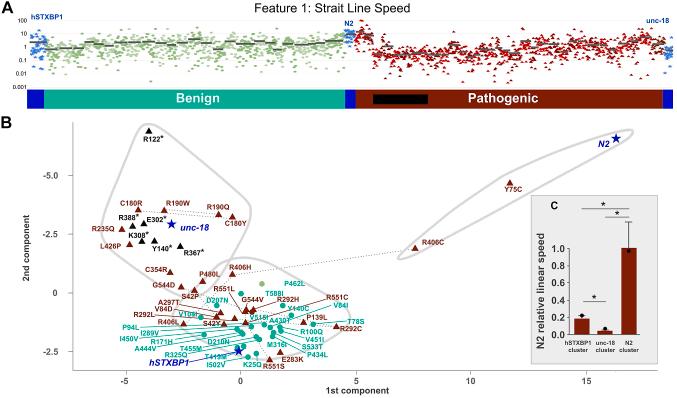
Using multiple models, we were able to obtain a diagnostic sensitivity near 0.9. Twenty-three VUS were also interrogated and 8 of 23 (34.8%) were observed to be functionally abnormal. Interestingly, unsupervised clustering identified 2 distinct subsets of known pathogenic variants with distinct phenotypic features; both p.Tyr75Cys and p.Arg406Cys cluster away from other variants and show an increase in swim speed compared with hSTXBP1 worms. This leads to the hypothesis that the mechanism of disease for these 2 variants may differ from most STXBP1-mutated patients and may account for some of the clinical heterogeneity observed in the patient population.
CONCLUSION
We have demonstrated that automated analysis of a small animal system is an effective, scalable, and fast way to understand functional consequences of variants in and identify variant-specific intensities of aberrant activity suggesting a genotype-to-phenotype correlation is likely to occur in human clinical variations of .
目的
在动物中构建疾病变体模型有助于药物研发、理解疾病病理以及将意义不明确的变体(VUS)分类为致病性或良性。
方法
我们使用成簇规律间隔短回文重复序列(CRISPR),进行全基因人源化动物模型构建程序,用人类基因的编码序列替换动物模型直系同源基因的编码序列。接下来,我们使用CRISPR在全基因人源化动物模型的人源化位点引入来自3种临床类别(良性、致病性和VUS)的精确点变体。从视频记录中提取的26个表型特征用于训练针对25个致病性变体和32个良性变体的机器学习分类器。
结果
使用多种模型,我们能够获得接近0.9的诊断敏感性。还对23个VUS进行了研究,发现23个中有8个(34.8%)功能异常。有趣的是,无监督聚类识别出具有不同表型特征的2个已知致病性变体的不同子集;与hSTXBP1蠕虫相比,p.Tyr75Cys和p.Arg406Cys这两个变体都与其他变体聚类不同,且游泳速度增加。这导致了这样一种假设,即这2个变体的疾病机制可能与大多数STXBP1突变患者不同,可能解释了在患者群体中观察到的一些临床异质性。
结论
我们已经证明,对小型动物系统进行自动化分析是一种有效、可扩展且快速的方法,可用于理解变体的功能后果,并识别异常活动的变体特异性强度,这表明在人类临床变体中可能会出现基因型与表型的相关性。


 Zotero 插件