Li Xicong, Chen Yubiao, Liu Baiyun, Ye Mingyuan, Liu Bei, Lu Lifei, Guo Ruiwei
Department of Cardiovascular, Kunming Medical University, Kunming, Yunnan, People's Republic of China.
Department of Cardiovascular, 920th Hospital of Joint Logistics Support Force, Chinese People's Liberation Army (PLA), Kunming, Yunnan, People's Republic of China.
Clin Epidemiol. 2024 May 28;16:367-377. doi: 10.2147/CLEP.S457054. eCollection 2024.
The study aimed to analyze the associations between estimated pulse wave velocity (ePWV) and 5-year mortality in atherosclerotic cardiovascular disease (ASCVD) patients with and without standard modifiable risk factors (SMuRFs), which included smoking status, hypertension, diabetes, and hypercholesterolemia.
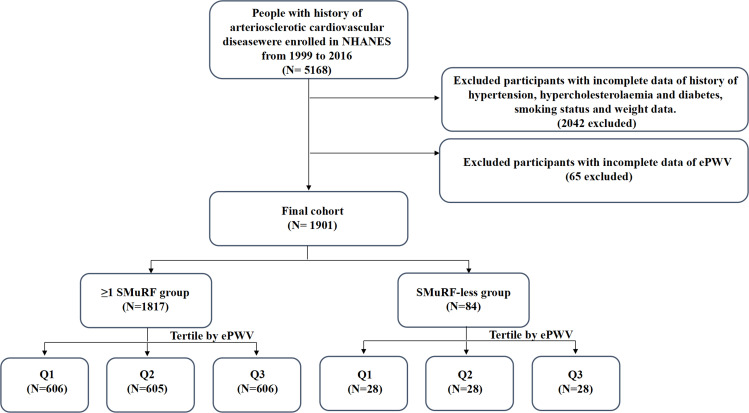
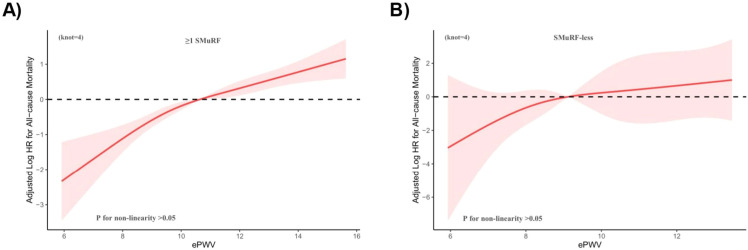
The present retrospective cohort study utilized data from the National Health and Nutrition Examination Survey (NHANES) between 1999 and 2016. Patients with ASCVD who completed both the questionnaire survey and serum testing were included. Patients were categorized into the ≥1 SMuRF group if they had at least one SMuRF, while those without any SMuRFs were classified into the SMuRF-less group. The ePWV, which was calculated using the age and mean blood pressure, was evenly divided into three categories: low (Q1), medium (Q2), and high (Q3). Multivariable weighted Cox proportional-hazard regression analyses were utilized to explore the risk factors associated with 5-year mortality in patients with and without SMuRFs. And restricted cubic spline curve (RCS) was used to assess their nonlinear correlation.
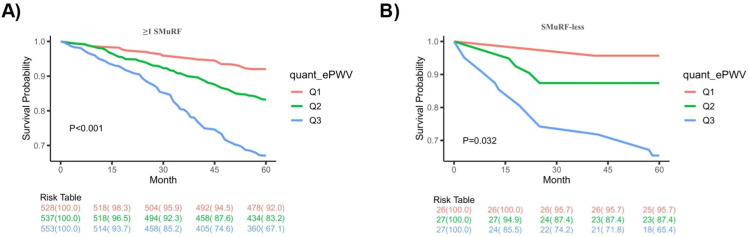
A total of 1901 patients with ASCVD were included in the study. For the patients in ≥1 SMuRF group, the Q3 group included patients who were older, with a higher proportion of males, more comorbidities, and a lower body mass index than the Q1 group (P<0.05). The Cox proportional-hazard regression model results revealed, the Q3 group had a higher risk of 5-year mortality than the Q1 group [hazard ratio (HR) 4.30, 95% confidence interval (CI) (2.66, 6.95), P<0.001]. RCS demonstrated a linear trend between high level of ePWV and decreased risks of mortality. Similar results were observed in the SMuRF-less group [HR 10.62, 95% CI (1.22, 92.06), P=0.032].
A high level of ePWV signified a higher risk of 5-year mortality in ASCVD patients with and without SMuRFs.
本研究旨在分析有和没有标准可改变风险因素(SMuRFs,包括吸烟状况、高血压、糖尿病和高胆固醇血症)的动脉粥样硬化性心血管疾病(ASCVD)患者中,估计脉搏波速度(ePWV)与5年死亡率之间的关联。
本回顾性队列研究利用了1999年至2016年美国国家健康与营养检查调查(NHANES)的数据。纳入完成问卷调查和血清检测的ASCVD患者。如果患者至少有一项SMuRF,则将其分类为≥1 SMuRF组,而没有任何SMuRF的患者则分类为无SMuRF组。使用年龄和平均血压计算的ePWV被均匀分为三类:低(Q1)、中(Q2)和高(Q3)。采用多变量加权Cox比例风险回归分析来探索有和没有SMuRFs的患者中与5年死亡率相关的风险因素。并使用受限立方样条曲线(RCS)来评估它们的非线性相关性。
本研究共纳入1901例ASCVD患者。对于≥1 SMuRF组的患者,与Q1组相比,Q3组患者年龄更大,男性比例更高,合并症更多,体重指数更低(P<0.05)。Cox比例风险回归模型结果显示,Q3组5年死亡率风险高于Q1组[风险比(HR)4.30,95%置信区间(CI)(2.66,6.95),P<0.001]。RCS显示ePWV高水平与死亡率风险降低之间呈线性趋势。在无SMuRF组中观察到类似结果[HR 10.62,95%CI(1.22,92.06),P=0.032]。
高水平的ePWV表明有和没有SMuRFs的ASCVD患者5年死亡率风险更高。