Biomimetic and Bioinspired Biomaterials Research Laboratory, Institute of Biomedical Engineering, Boğaziçi University, 34684, Istanbul, Turkey.
Department of Biomedical Engineering, School of Engineering and Natural Sciences, Istanbul Medipol University, 34810, Istanbul, Turkey.
Sci Rep. 2024 Jun 3;14(1):12721. doi: 10.1038/s41598-024-62484-3.
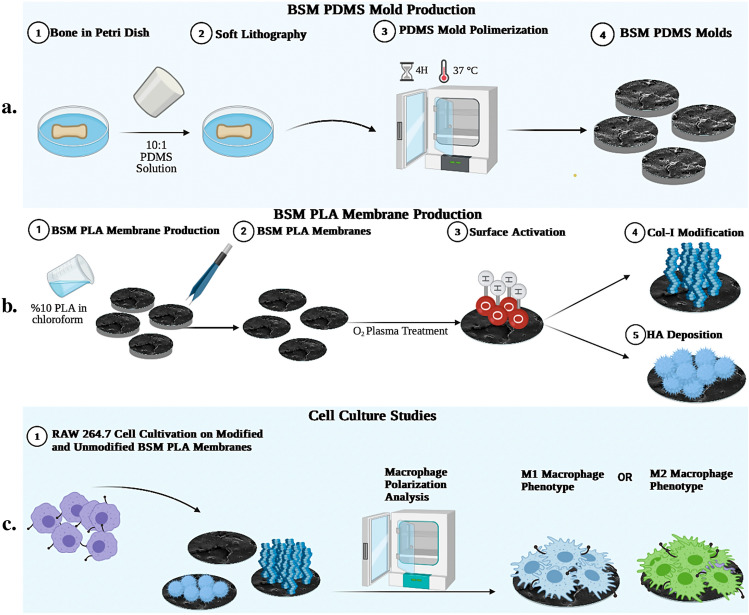
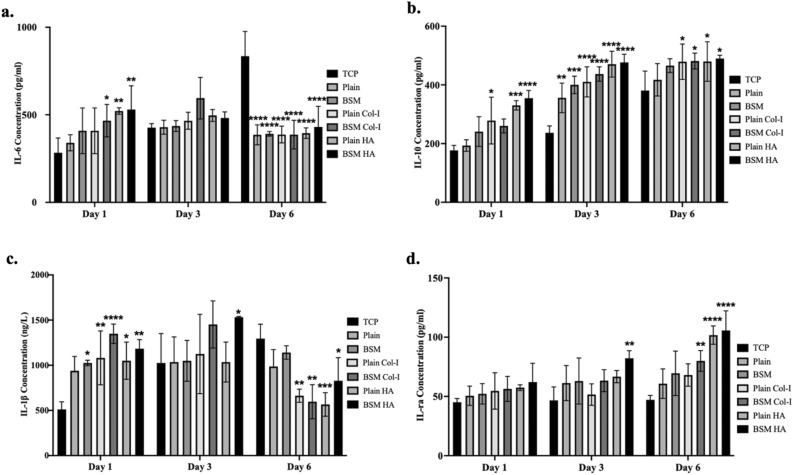
Surface structure plays a crucial role in determining cell behavior on biomaterials, influencing cell adhesion, proliferation, differentiation, as well as immune cells and macrophage polarization. While grooves and ridges stimulate M2 polarization and pits and bumps promote M1 polarization, these structures do not accurately mimic the real bone surface. Consequently, the impact of mimicking bone surface topography on macrophage polarization remains unknown. Understanding the synergistic sequential roles of M1 and M2 macrophages in osteoimmunomodulation is crucial for effective bone tissue engineering. Thus, exploring the impact of bone surface microstructure mimicking biomaterials on macrophage polarization is critical. In this study, we aimed to sequentially activate M1 and M2 macrophages using Poly-L-Lactic acid (PLA) membranes with bone surface topographical features mimicked through the soft lithography technique. To mimic the bone surface topography, a bovine femur was used as a model surface, and the membranes were further modified with collagen type-I and hydroxyapatite to mimic the bone surface microenvironment. To determine the effect of these biomaterials on macrophage polarization, we conducted experimental analysis that contained estimating cytokine release profiles and characterizing cell morphology. Our results demonstrated the potential of the hydroxyapatite-deposited bone surface-mimicked PLA membranes to trigger sequential and synergistic M1 and M2 macrophage polarizations, suggesting their ability to achieve osteoimmunomodulatory macrophage polarization for bone tissue engineering applications. Although further experimental studies are required to completely investigate the osteoimmunomodulatory effects of these biomaterials, our results provide valuable insights into the potential advantages of biomaterials that mimic the complex microenvironment of bone surfaces.
表面结构在决定细胞在生物材料上的行为方面起着至关重要的作用,影响细胞黏附、增殖、分化以及免疫细胞和巨噬细胞极化。虽然凹槽和脊线刺激 M2 极化,而凹坑和凸块促进 M1 极化,但这些结构并不能准确模拟真实的骨表面。因此,模拟骨表面形貌对巨噬细胞极化的影响尚不清楚。了解 M1 和 M2 巨噬细胞在骨免疫调节中的协同序贯作用对于有效的骨组织工程至关重要。因此,探索模拟骨表面微观结构的生物材料对巨噬细胞极化的影响至关重要。在这项研究中,我们旨在使用通过软光刻技术模拟骨表面形貌特征的聚乳酸(PLA)膜序贯激活 M1 和 M2 巨噬细胞。为了模拟骨表面形貌,使用牛股骨作为模型表面,并且进一步用胶原蛋白 I 和羟基磷灰石修饰膜以模拟骨表面微环境。为了确定这些生物材料对巨噬细胞极化的影响,我们进行了实验分析,包括估计细胞因子释放谱和细胞形态特征。我们的结果表明,具有羟基磷灰石沉积的骨表面模拟 PLA 膜具有触发序贯和协同的 M1 和 M2 巨噬细胞极化的潜力,表明它们在骨组织工程应用中实现骨免疫调节巨噬细胞极化的能力。尽管需要进一步的实验研究来完全研究这些生物材料的骨免疫调节作用,但我们的结果为模拟骨表面复杂微环境的生物材料的潜在优势提供了有价值的见解。