Department of Orthopedic Surgery, Inje University Sanggye Paik Hospital, College of Medicine, Inje University, Seoul, Republic of Korea.
Informatization Department, Ewha Womans University Seoul Hospital, Seoul, Republic of Korea.
Mol Psychiatry. 2024 Nov;29(11):3635-3643. doi: 10.1038/s41380-024-02627-0. Epub 2024 Jun 4.
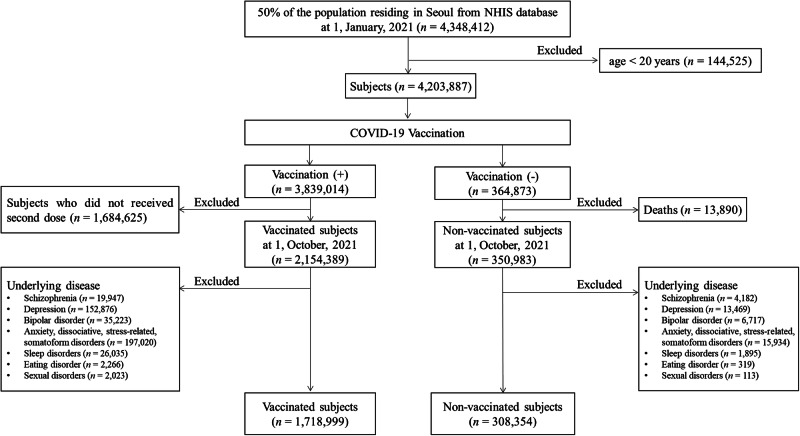
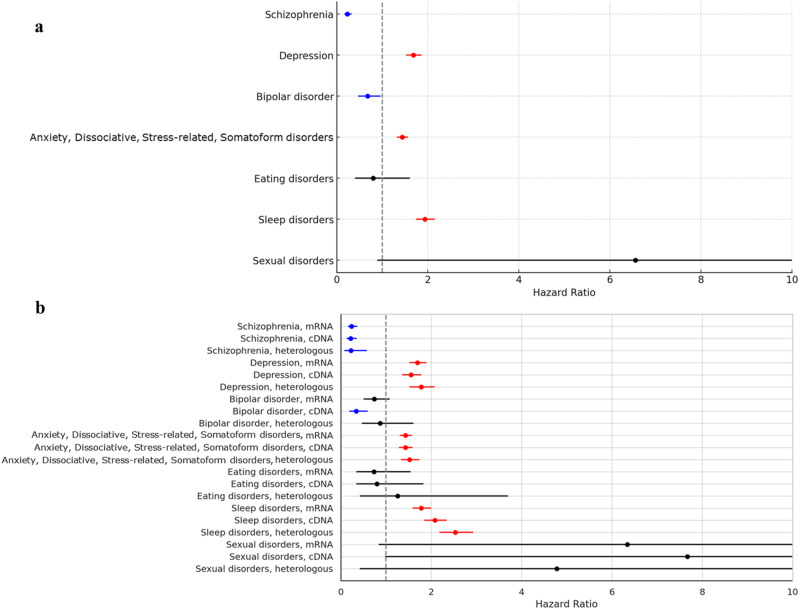
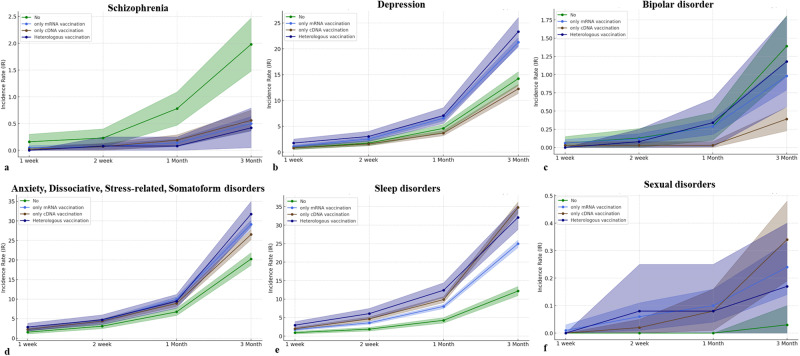
Evidence has suggested an increased risk of psychiatric manifestations following viral infections including coronavirus disease-2019 (COVID-19). However, psychiatric adverse events (AEs) after COVID-19 vaccination, which were documented in case reports and case series, remain unclear. This study is aimed to investigate the psychiatric AEs after COVID-19 vaccination from a large population-based cohort in Seoul, South Korea. We recruited 50% of the Seoul-resident population randomly selected from the Korean National Health Insurance Service (KNHIS) claims database on 1, January, 2021. The included participants (n = 2,027,353) from the Korean National Health Insurance Service claims database were divided into two groups according to COVID-19 vaccination. The cumulative incidences per 10,000 of psychiatric AEs were assessed on one week, two weeks, one month, and three months after COVID-19 vaccination. Hazard ratios (HRs) and 95% Confidence interval (CIs) of psychiatric AEs were measured for the vaccinated population. The cumulative incidence of depression, anxiety, dissociative, stress-related, and somatoform disorders, sleep disorders, and sexual disorders at three months following COVID-19 vaccination were higher in the vaccination group than no vaccination group. However, schizophrenia and bipolar disorders showed lower cumulative incidence in the vaccination group than in the non-vaccinated group. Depression (HR [95% CI] = 1.683 [1.520-1.863]), anxiety, dissociative, stress-related, and somatoform disorders (HR [95% CI] = 1.439 [1.322-1.568]), and sleep disorders (HR [95% CI] = 1.934 [1.738-2.152]) showed increased risks after COVID-19 vaccination, whereas the risks of schizophrenia (HR [95% CI] = 0.231 [0.164-0.326]) and bipolar disorder (HR [95% CI] = 0.672 [0.470-0.962]). COVID-19 vaccination increased the risks of depression, anxiety, dissociative, stress-related, and somatoform disorders, and sleep disorders while reducing the risk of schizophrenia and bipolar disorder. Therefore, special cautions are necessary for administering additional COVID-19 vaccinations to populations vulnerable to psychiatric AEs.
有证据表明,病毒性感染(包括 2019 年冠状病毒病(COVID-19))后出现精神表现的风险增加。然而,COVID-19 疫苗接种后出现的精神不良事件(AE),在病例报告和病例系列中已有记载,但仍不清楚。本研究旨在从韩国首尔的一个大型基于人群的队列中调查 COVID-19 疫苗接种后的精神 AE。我们于 2021 年 1 月 1 日从韩国国民健康保险服务(KNHIS)索赔数据库中随机抽取了 50%的首尔居民作为研究对象。从 KNHIS 索赔数据库中纳入的参与者(n=2,027,353)根据 COVID-19 疫苗接种情况分为两组。评估 COVID-19 疫苗接种后一周、两周、一个月和三个月时每 10,000 人出现精神 AE 的累积发生率。测量接种人群中精神 AE 的危害比(HR)和 95%置信区间(CI)。COVID-19 疫苗接种后三个月时,抑郁症、焦虑症、分离性、应激相关和躯体形式障碍、睡眠障碍和性障碍的累积发生率在接种组高于未接种组。然而,接种组的精神分裂症和双相障碍的累积发生率低于未接种组。抑郁症(HR[95%CI]=1.683[1.520-1.863])、焦虑症、分离性、应激相关和躯体形式障碍(HR[95%CI]=1.439[1.322-1.568])和睡眠障碍(HR[95%CI]=1.934[1.738-2.152])的风险增加,而精神分裂症(HR[95%CI]=0.231[0.164-0.326])和双相障碍(HR[95%CI]=0.672[0.470-0.962])的风险降低。COVID-19 疫苗接种增加了抑郁症、焦虑症、分离性、应激相关和躯体形式障碍以及睡眠障碍的风险,同时降低了精神分裂症和双相障碍的风险。因此,对于易发生精神 AE 的人群,在接种 COVID-19 疫苗时需要特别谨慎。