Population Health Sciences, University of Bristol, Bristol, United Kingdom.
Medical Research Council Integrative Epidemiology Unit, University of Bristol, Bristol, United Kingdom.
JAMA Psychiatry. 2024 Nov 1;81(11):1071-1080. doi: 10.1001/jamapsychiatry.2024.2339.
Associations have been found between COVID-19 and subsequent mental illness in both hospital- and population-based studies. However, evidence regarding which mental illnesses are associated with COVID-19 by vaccination status in these populations is limited.
To determine which mental illnesses are associated with diagnosed COVID-19 by vaccination status in both hospitalized patients and the general population.
DESIGN, SETTING, AND PARTICIPANTS: This study was conducted in 3 cohorts, 1 before vaccine availability followed during the wild-type/Alpha variant eras (January 2020-June 2021) and 2 (vaccinated and unvaccinated) during the Delta variant era (June-December 2021). With National Health Service England approval, OpenSAFELY-TPP was used to access linked data from 24 million people registered with general practices in England using TPP SystmOne. People registered with a GP in England for at least 6 months and alive with known age between 18 and 110 years, sex, deprivation index information, and region at baseline were included. People were excluded if they had COVID-19 before baseline. Data were analyzed from July 2022 to June 2024.
Confirmed COVID-19 diagnosis recorded in primary care secondary care, testing data, or the death registry.
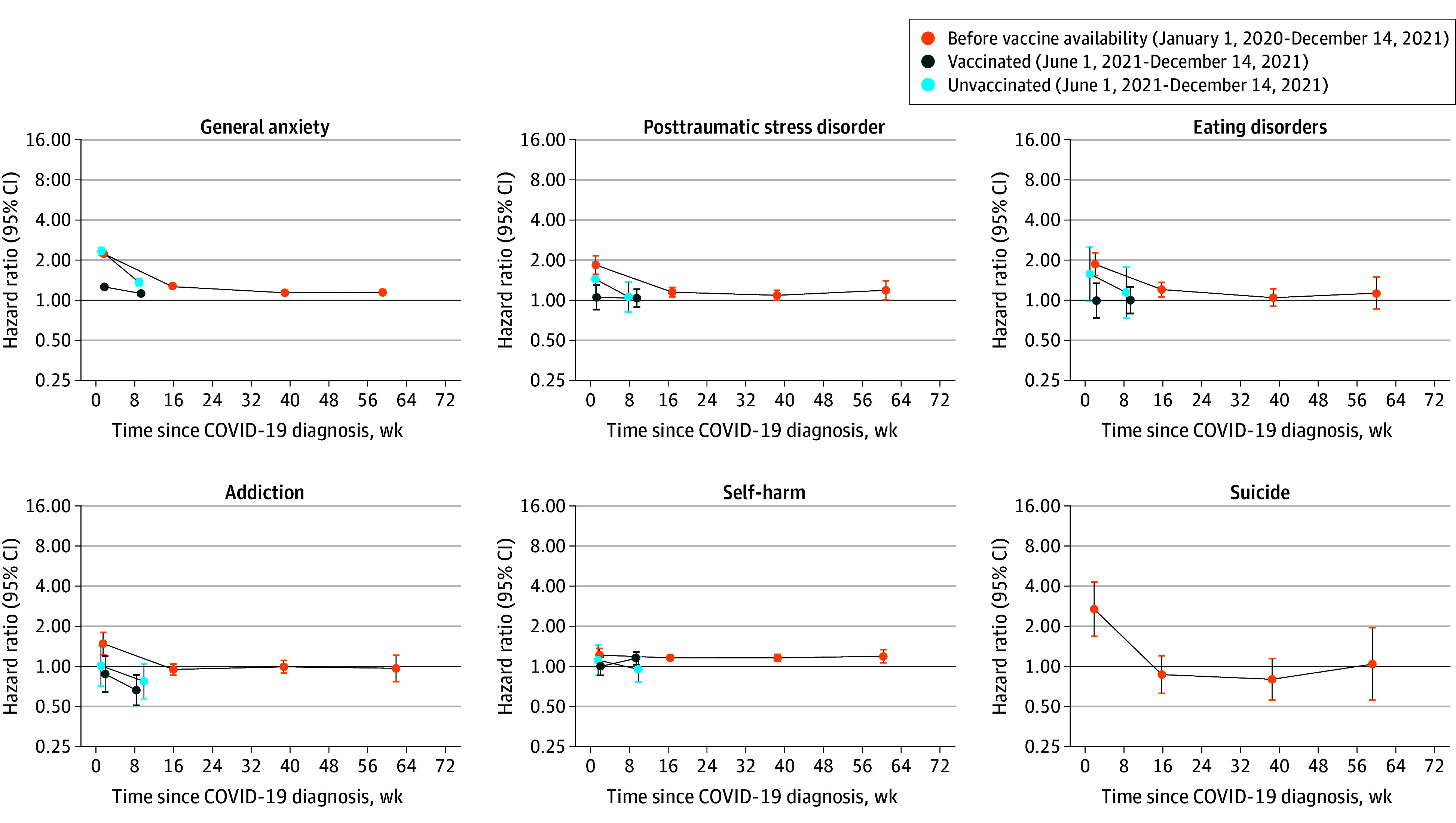
Adjusted hazard ratios (aHRs) comparing the incidence of mental illnesses after diagnosis of COVID-19 with the incidence before or without COVID-19 for depression, serious mental illness, general anxiety, posttraumatic stress disorder, eating disorders, addiction, self-harm, and suicide.
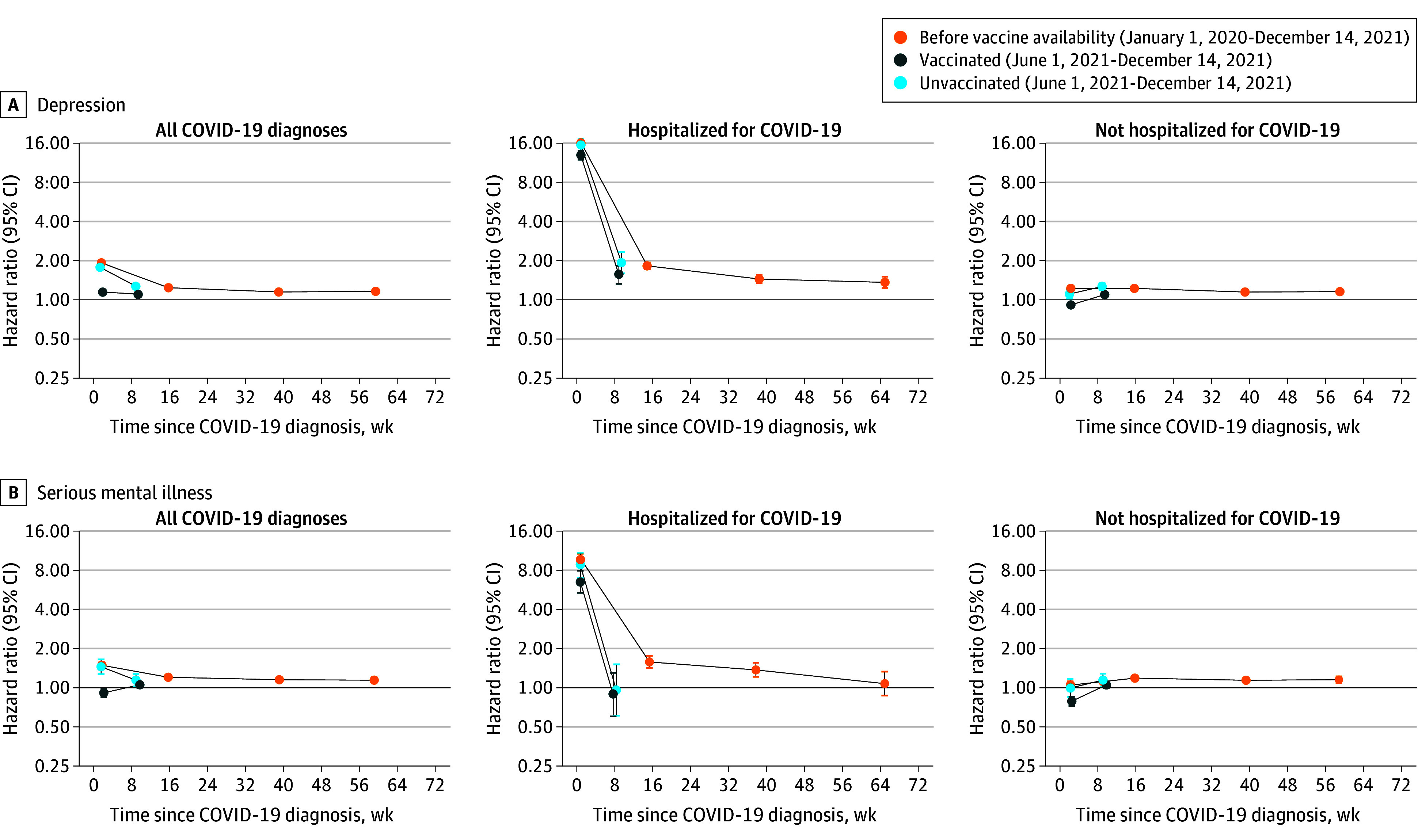
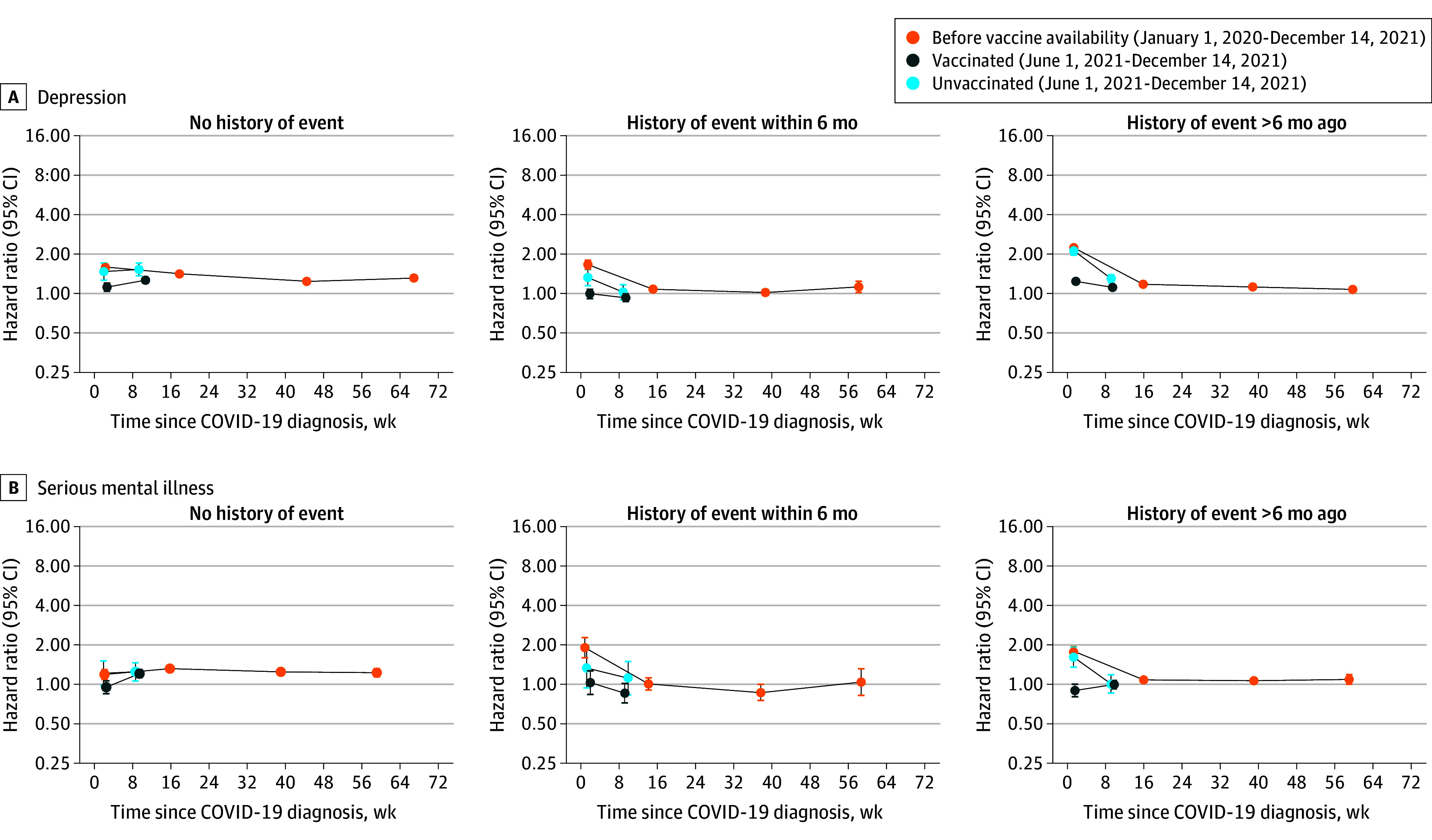
The largest cohort, the pre-vaccine availability cohort, included 18 648 606 people (9 363 710 [50.2%] female and 9 284 896 [49.8%] male) with a median (IQR) age of 49 (34-64) years. The vaccinated cohort included 14 035 286 individuals (7 308 556 [52.1%] female and 6 726 730 [47.9%] male) with a median (IQR) age of 53 (38-67) years. The unvaccinated cohort included 3 242 215 individuals (1 363 401 [42.1%] female and 1 878 814 [57.9%] male) with a median (IQR) age of 35 (27-46) years. Incidence of most outcomes was elevated during weeks 1 through 4 after COVID-19 diagnosis, compared with before or without COVID-19, in each cohort. Incidence of mental illnesses was lower in the vaccinated cohort compared with the pre-vaccine availability and unvaccinated cohorts: aHRs for depression and serious mental illness during weeks 1 through 4 after COVID-19 were 1.93 (95% CI, 1.88-1.98) and 1.49 (95% CI, 1.41-1.57) in the pre-vaccine availability cohort and 1.79 (95% CI, 1.68-1.90) and 1.45 (95% CI, 1.27-1.65) in the unvaccinated cohort compared with 1.16 (95% CI, 1.12-1.20) and 0.91 (95% CI, 0.85-0.98) in the vaccinated cohort. Elevation in incidence was higher and persisted longer after hospitalization for COVID-19.
In this study, incidence of mental illnesses was elevated for up to a year following severe COVID-19 in unvaccinated people. These findings suggest that vaccination may mitigate the adverse effects of COVID-19 on mental health.
在医院和基于人群的研究中,都发现了 COVID-19 与随后的精神疾病之间存在关联。然而,关于这些人群中哪些精神疾病与 COVID-19 疫苗接种状况有关的证据有限。
确定在住院患者和一般人群中,哪些精神疾病与 COVID-19 疫苗接种状况有关。
设计、设置和参与者:这项研究在 3 个队列中进行,1 个队列在疫苗可用之前,在野生型/Alpha 变异时期(2020 年 1 月至 2021 年 6 月)进行,2 个队列(接种组和未接种组)在 Delta 变异时期(2021 年 6 月至 12 月)进行。在获得英国国家医疗服务体系(NHS England)的批准后,使用 TPP SystmOne 从英格兰的一般实践中访问了 2400 万人的链接数据。包括在英格兰注册全科医生至少 6 个月、年龄在 18 至 110 岁之间、性别、贫困指数信息和基线地区的人群。如果他们在基线前患有 COVID-19,则排除在外。数据于 2022 年 7 月至 2024 年 6 月进行分析。
在初级保健、二级保健、检测数据或死亡登记处记录的确诊 COVID-19 诊断。
调整后的危害比(aHR)比较了 COVID-19 诊断后精神疾病的发病率与 COVID-19 前或无 COVID-19 时的发病率,包括抑郁症、严重精神疾病、广泛性焦虑症、创伤后应激障碍、饮食失调、成瘾、自残和自杀。
最大的队列,即疫苗可用前的队列,包括 18648606 人(9363710 名女性[50.2%]和 9284896 名男性[49.8%]),中位(IQR)年龄为 49(34-64)岁。接种疫苗的队列包括 14035286 人(7308556 名女性[52.1%]和 6726730 名男性[47.9%]),中位(IQR)年龄为 53(38-67)岁。未接种疫苗的队列包括 3242215 人(1363401 名女性[42.1%]和 1878814 名男性[57.9%]),中位(IQR)年龄为 35(27-46)岁。与 COVID-19 前或无 COVID-19 相比,在每个队列中,COVID-19 诊断后的前 4 周内,大多数结果的发病率都升高。与疫苗可用前和未接种疫苗的队列相比,接种疫苗的队列中精神疾病的发病率较低:COVID-19 诊断后第 1 至 4 周期间,抑郁症和严重精神疾病的 aHR 分别为 1.93(95%CI,1.88-1.98)和 1.49(95%CI,1.41-1.57),在疫苗可用前的队列中为 1.79(95%CI,1.68-1.90)和 1.45(95%CI,1.27-1.65),在未接种疫苗的队列中为 1.16(95%CI,1.12-1.20)和 0.91(95%CI,0.85-0.98)。住院治疗 COVID-19 后,发病率升高更高且持续时间更长。
在这项研究中,未接种疫苗的人在严重 COVID-19 后长达一年的时间内,精神疾病的发病率升高。这些发现表明,疫苗接种可能减轻 COVID-19 对精神健康的不利影响。