Kaimakamis Evangelos, Kotoulas Serafeim, Tzimou Myrto, Karachristos Christos, Giannaki Chrysavgi, Kilintzis Vassileios, Stefanopoulos Leandros, Chatzis Evangelos, Beredimas Nikolaos, Rocha Bruno, Pessoa Diogo, Paiva Rui Pedro, Maglaveras Nicos, Bitzani Militsa
1st Intensive Care Unit, "G. Papanikolaou" General Hospital, Exochi Thessalonikis, 57010, Greece.
Lab of Computing, Medical Informatics and Biomedical Imaging Technologies, The Medical School, Aristotle University, Thessaloniki, Greece.
Pneumonia (Nathan). 2024 Jun 5;16(1):9. doi: 10.1186/s41479-024-00131-1.
The Covid-19 pandemic has caused immense pressure on Intensive Care Units (ICU). In patients with severe ARDS due to Covid-19, respiratory mechanics are important for determining the severity of lung damage. Lung auscultation could not be used during the pandemic despite its merit. The main objective of this study was to investigate associations between lung auscultatory sound features and lung mechanical properties, length of stay (LOS) and survival, in adults with severe Covid-19 ARDS.
Consecutive patients admitted to a large ICU between 2020 and 2021 (n = 173) were included. Digital stethoscopes obtained auscultatory sounds and stored them in an on-line database for replay and further processing using advanced AI techniques. Correlation and regression analysis explored relationships between digital auscultation findings and lung mechanics or the ICU outcome. The resulting annotated lung sounds database is also publicly available as supplementary material.
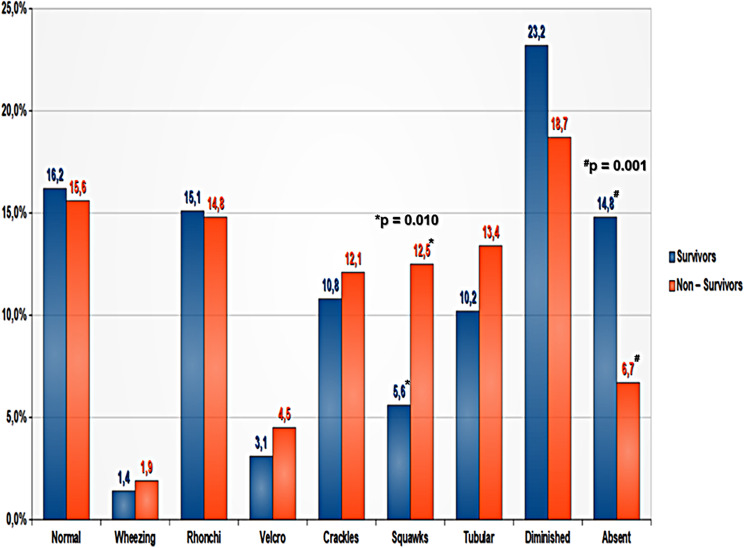
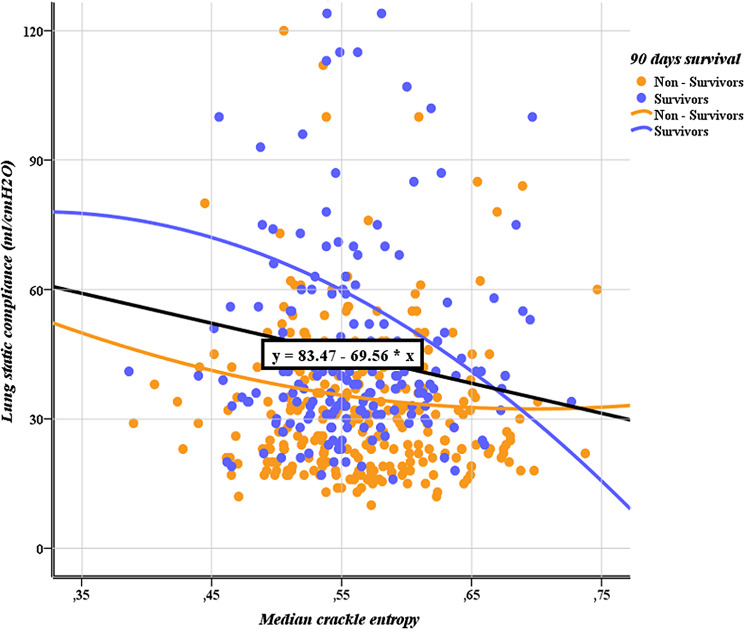
The presence of squawks was associated with the ICU LOS, outcome and 90-day mortality. Other features (age, SOFA score & oxygenation index upon admission, minimum crackle entropy) had significant impact on outcome. Additional features affecting the 90-d survival were age and mean crackle entropy. Multivariate logistic regression showed that survival was affected by age, baseline SOFA, baseline oxygenation index and minimum crackle entropy.
Respiratory mechanics were associated with various adventitious sounds, whereas the lung sound analytics and the presence of certain adventitious sounds correlated with the ICU outcome and the 90-d survival. Spectral features of crackles sounds can serve as prognostic factors for survival, highlighting the importance of digital auscultation.
新冠疫情给重症监护病房(ICU)带来了巨大压力。在因新冠病毒感染导致的严重急性呼吸窘迫综合征(ARDS)患者中,呼吸力学对于确定肺损伤的严重程度至关重要。尽管肺部听诊有其优点,但在疫情期间无法使用。本研究的主要目的是调查重症新冠病毒感染ARDS成年患者的肺部听诊声音特征与肺力学特性、住院时间(LOS)和生存率之间的关联。
纳入2020年至2021年间连续入住一家大型ICU的患者(n = 173)。数字听诊器获取听诊声音并将其存储在在线数据库中,以便使用先进的人工智能技术进行回放和进一步处理。相关性和回归分析探讨了数字听诊结果与肺力学或ICU结局之间的关系。最终得到的带有注释的肺部声音数据库也作为补充材料公开提供。
粗糙呼吸音的出现与ICU住院时间、结局和90天死亡率相关。其他特征(年龄、入院时的序贯器官衰竭评估(SOFA)评分和氧合指数、最小啰音熵)对结局有显著影响。影响90天生存率的其他特征是年龄和平均啰音熵。多因素逻辑回归显示,生存率受年龄、基线SOFA、基线氧合指数和最小啰音熵的影响。
呼吸力学与各种附加音相关,而肺部声音分析和某些附加音的存在与ICU结局和90天生存率相关。啰音的频谱特征可作为生存的预后因素,突出了数字听诊的重要性。