Tölgyesi Borbála, Altbäcker Anna, Barkaszi Irén, Stuckenschneider Tim, Braunsmann Leonard, Takács Endre, Ehmann Bea, Balázs László, Abeln Vera
Institute of Cognitive Neuroscience and Psychology, HUN-REN Research Centre for Natural Sciences, Budapest, Hungary.
Interaction and Immersion Hub, Innovation Center, Moholy-Nagy University of Art and Design, Budapest, Hungary.
NPJ Microgravity. 2024 Jun 5;10(1):59. doi: 10.1038/s41526-024-00405-4.
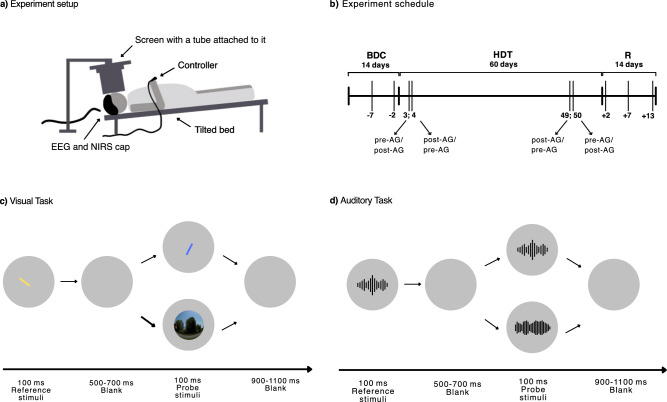
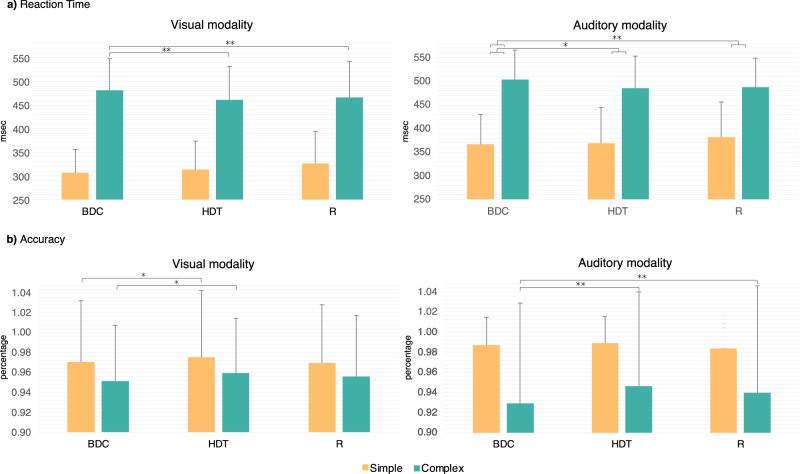
This study evaluated the acute and chronic effects of intermittent and continuous Artificial Gravity (AG) on cognitive performance during 60 days of Head-down tilt bedrest (HDTBR), a well-established ground-based spaceflight analogue method. Participants were randomly assigned to three groups: intermittent AG, continuous AG, and HDTBR control group without AG exposure. Task performance and electrophysiological measures of attention and working memory were investigated during Simple and Complex tasks in the Visual and the Auditory modality. Compared to baseline, faster reaction time and better accuracy was present during HDTBR regarding the Complex tasks, however, the practice effect was diminished in the three HDTBR groups compared to an ambulatory control group. Brain potentials showed a modality-specific decrease, as P3a was decreased only in the Auditory, while P3b decreased in the Visual modality. No evidence for acute or chronic AG-related cognitive impairments during HDTBR was found.
本研究评估了间歇性和持续性人工重力(AG)对为期60天的头低位卧床休息(HDTBR)期间认知表现的急性和慢性影响,HDTBR是一种成熟的地面模拟太空飞行方法。参与者被随机分为三组:间歇性AG组、持续性AG组和无AG暴露的HDTBR对照组。在视觉和听觉模式下的简单和复杂任务中,研究了任务表现以及注意力和工作记忆的电生理指标。与基线相比,HDTBR期间复杂任务的反应时间更快、准确性更高,然而,与动态对照组相比,三个HDTBR组的练习效果有所减弱。脑电显示出特定模式的下降,因为仅在听觉模式下P3a降低,而在视觉模式下P3b降低。未发现HDTBR期间存在与急性或慢性AG相关的认知障碍的证据。