• 文献检索
  • 文档翻译
  • 深度研究
  • 学术资讯
  • Suppr Zotero 插件Zotero 插件
  • 邀请有礼
  • 套餐&价格
  • 历史记录
应用&插件
Suppr Zotero 插件Zotero 插件浏览器插件Mac 客户端Windows 客户端微信小程序
定价
高级版会员购买积分包购买API积分包
服务
文献检索文档翻译深度研究API 文档MCP 服务
关于我们
关于 Suppr公司介绍联系我们用户协议隐私条款
关注我们

Suppr 超能文献

核心技术专利:CN118964589B侵权必究
粤ICP备2023148730 号-1Suppr @ 2026

文献检索

告别复杂PubMed语法,用中文像聊天一样搜索,搜遍4000万医学文献。AI智能推荐,让科研检索更轻松。

立即免费搜索

文件翻译

保留排版,准确专业,支持PDF/Word/PPT等文件格式,支持 12+语言互译。

免费翻译文档

深度研究

AI帮你快速写综述,25分钟生成高质量综述,智能提取关键信息,辅助科研写作。

立即免费体验

加拿大献血者中 COVID-19 血清阳性率差异的时间趋势。

Temporal trends in disparities in COVID-19 seropositivity among Canadian blood donors.

机构信息

School of Population and Global Health, McGill University, Montreal, Canada.

Canadian Blood Services, Ottawa, Canada.

出版信息

Int J Epidemiol. 2024 Apr 11;53(3). doi: 10.1093/ije/dyae078.

DOI:10.1093/ije/dyae078
PMID:38840559
原文链接:https://pmc.ncbi.nlm.nih.gov/articles/PMC11153835/
Abstract

BACKGROUND

In Canada's largest COVID-19 serological study, SARS-CoV-2 antibodies in blood donors have been monitored since 2020. No study has analysed changes in the association between anti-N seropositivity (a marker of recent infection) and geographic and sociodemographic characteristics over the pandemic.

METHODS

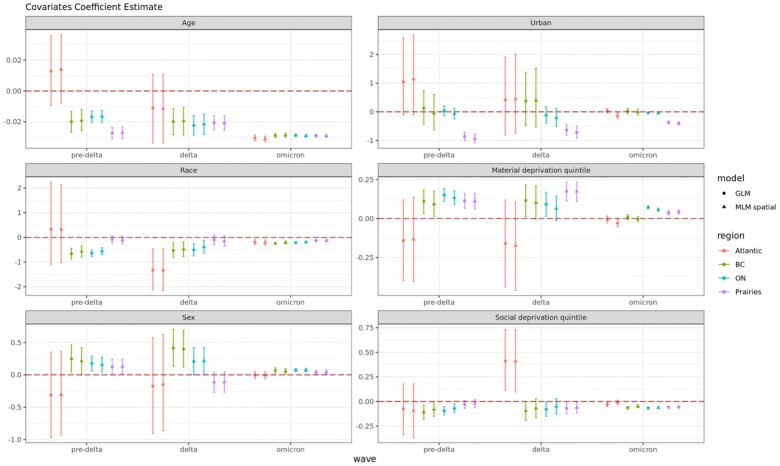
Using Bayesian multi-level models with spatial effects at the census division level, we analysed changes in correlates of SARS-CoV-2 anti-N seropositivity across three periods in which different variants predominated (pre-Delta, Delta and Omicron). We analysed disparities by geographic area, individual traits (age, sex, race) and neighbourhood factors (urbanicity, material deprivation and social deprivation). Data were from 420 319 blood donations across four regions (Ontario, British Columbia [BC], the Prairies and the Atlantic region) from December 2020 to November 2022.

RESULTS

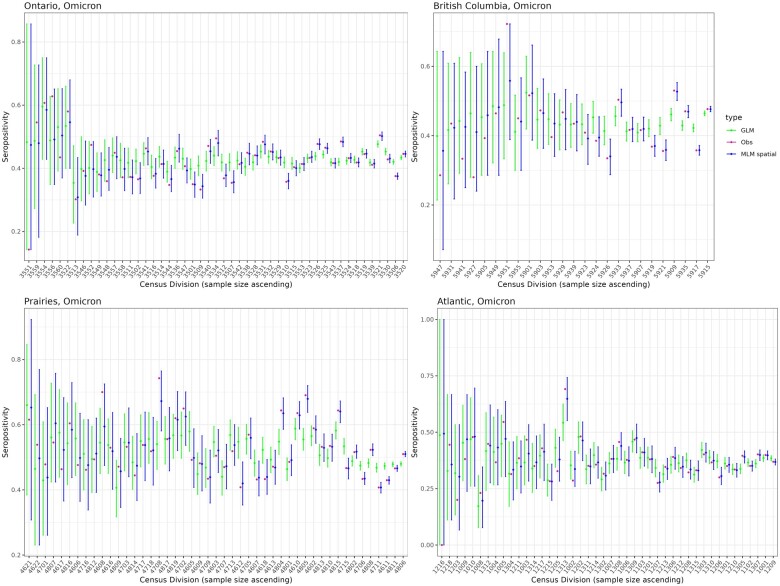
Seropositivity was higher for racialized minorities, males and individuals in more materially deprived neighbourhoods in the pre-Delta and Delta waves. These subgroup differences dissipated in the Omicron wave as large swaths of the population became infected. Across all waves, seropositivity was higher in younger individuals and those with lower neighbourhood social deprivation. Rural residents had high seropositivity in the Prairies, but not other regions. Compared to generalized linear models, multi-level models with spatial effects had better fit and lower error when predicting SARS-CoV-2 anti-N seropositivity by geographic region.

CONCLUSIONS

Correlates of recent COVID-19 infection have evolved over the pandemic. Many disparities lessened during the Omicron wave, but public health intervention may be warranted to address persistently higher burden among young people and those with less social deprivation.

摘要

背景

在加拿大最大的 COVID-19 血清学研究中,自 2020 年以来一直在监测献血者血液中的 SARS-CoV-2 抗体。没有研究分析过在大流行期间,抗-N 血清阳性(近期感染的标志物)与地理和社会人口特征之间的关联变化。

方法

使用具有空间效应的贝叶斯多层次模型,并以普查分区为水平,我们分析了在不同变体占主导地位的三个时期(Delta 之前、Delta 和奥密克戎期间)中,SARS-CoV-2 抗-N 血清阳性的相关性变化。我们按地理区域、个体特征(年龄、性别、种族)和社区因素(城市化、物质匮乏和社会匮乏)分析了差异。数据来自 2020 年 12 月至 2022 年 11 月期间来自四个地区(安大略省、不列颠哥伦比亚省[BC]、草原地区和大西洋地区)的 420319 份献血。

结果

在 Delta 和 Delta 波期间,少数族裔、男性和物质匮乏社区的个体的血清阳性率更高。随着大量人群感染,这些亚组差异在奥密克戎波中消失了。在所有波中,血清阳性率在年轻个体和社会剥夺程度较低的个体中较高。草原地区的农村居民血清阳性率较高,但在其他地区则不然。与广义线性模型相比,具有空间效应的多层次模型在预测 SARS-CoV-2 抗-N 血清阳性率的地理区域时具有更好的拟合度和更低的误差。

结论

近期 COVID-19 感染的相关因素在大流行期间发生了演变。在奥密克戎波期间,许多差异有所减少,但可能需要采取公共卫生干预措施,以解决年轻人和社会剥夺程度较低的人负担过重的问题。
https://cdn.ncbi.nlm.nih.gov/pmc/blobs/cebf/11153835/e91620d3971e/dyae078f2.jpg
https://cdn.ncbi.nlm.nih.gov/pmc/blobs/cebf/11153835/a76df7aead95/dyae078f1.jpg
https://cdn.ncbi.nlm.nih.gov/pmc/blobs/cebf/11153835/e91620d3971e/dyae078f2.jpg
https://cdn.ncbi.nlm.nih.gov/pmc/blobs/cebf/11153835/a76df7aead95/dyae078f1.jpg
https://cdn.ncbi.nlm.nih.gov/pmc/blobs/cebf/11153835/e91620d3971e/dyae078f2.jpg

相似文献

1
Temporal trends in disparities in COVID-19 seropositivity among Canadian blood donors.加拿大献血者中 COVID-19 血清阳性率差异的时间趋势。
Int J Epidemiol. 2024 Apr 11;53(3). doi: 10.1093/ije/dyae078.
2
SARS-CoV-2 seroprevalence among blood donors after the first COVID-19 wave in Canada.加拿大第一波 COVID-19 疫情后献血者中的 SARS-CoV-2 血清流行率。
Transfusion. 2021 Mar;61(3):862-872. doi: 10.1111/trf.16296. Epub 2021 Feb 23.
3
Cross-Canada Variability in Blood Donor SARS-CoV-2 Seroprevalence by Social Determinants of Health.基于健康社会决定因素的全加 SARS-CoV-2 血清流行率的血液捐赠者的跨加拿大变异性。
Microbiol Spectr. 2023 Feb 14;11(1):e0335622. doi: 10.1128/spectrum.03356-22. Epub 2023 Jan 10.
4
Pre-Vaccine Positivity of SARS-CoV-2 Antibodies in Alberta, Canada during the First Two Waves of the COVID-19 Pandemic.加拿大艾伯塔省 COVID-19 大流行前两波期间 SARS-CoV-2 抗体的预疫苗阳性率。
Microbiol Spectr. 2021 Sep 3;9(1):e0029121. doi: 10.1128/Spectrum.00291-21. Epub 2021 Aug 18.
5
SARS-CoV-2 seroprevalence among blood donors in Québec, and analysis of symptoms associated with seropositivity: a nested case-control study.魁北克省献血者中 SARS-CoV-2 的血清流行率,以及与血清阳性相关症状的分析:一项嵌套病例对照研究。
Can J Public Health. 2021 Aug;112(4):576-586. doi: 10.17269/s41997-021-00531-6. Epub 2021 May 17.
6
Association Between Social Vulnerability and SARS-CoV-2 Seroprevalence in Specimens Collected From Commercial Laboratories, United States, September 2021-February 2022.2021 年 9 月至 2022 年 2 月期间,从美国商业实验室采集的标本中社会脆弱性与 SARS-CoV-2 血清阳性率之间的关联。
Public Health Rep. 2024 Jul-Aug;139(4):501-511. doi: 10.1177/00333549231223140. Epub 2024 Feb 15.
7
Estimating SARS-CoV-2 Seroprevalence in Canadian Blood Donors, April 2020 to March 2021: Improving Accuracy with Multiple Assays.估算 2020 年 4 月至 2021 年 3 月加拿大献血者中的 SARS-CoV-2 血清流行率:使用多种检测方法提高准确性。
Microbiol Spectr. 2022 Feb 23;10(1):e0256321. doi: 10.1128/spectrum.02563-21.
8
Progression and Predictors of SARS-CoV-2 Antibody Seroreactivity In US Blood Donors.美国献血者中SARS-CoV-2抗体血清反应性的进展及预测因素
Transfus Med Rev. 2021 Jul;35(3):8-15. doi: 10.1016/j.tmrv.2021.07.003. Epub 2021 Jul 30.
9
Seropositivity of SARS-CoV-2 in an unvaccinated cohort in British Columbia, Canada: a cross-sectional survey with dried blood spot samples.在加拿大不列颠哥伦比亚省的未接种疫苗人群中,SARS-CoV-2 的血清阳性率:一项使用干血斑样本的横断面调查。
BMJ Open. 2022 Aug 29;12(8):e062567. doi: 10.1136/bmjopen-2022-062567.
10
SARS-CoV-2 Seroprevalence among Canadian Blood Donors: The Advance of Omicron.加拿大献血者中 SARS-CoV-2 血清流行率:奥密克戎的进展。
Viruses. 2022 Oct 25;14(11):2336. doi: 10.3390/v14112336.

引用本文的文献

1
SCORE: Serologic evidence of COVID-19 and social and occupational contacts in healthcare workers in long-term care and acute care facilities in Southeastern Ontario (SCORE).SCORE:安大略省东南部长期护理和急症护理机构医护人员中COVID-19的血清学证据以及社交和职业接触情况(SCORE)。
PLoS One. 2025 Aug 13;20(8):e0303813. doi: 10.1371/journal.pone.0303813. eCollection 2025.
2
Anti-SARS-CoV-2 Antibody Levels in a Cohort of Health Care Workers Before and After the Omicron Wave in Canada.加拿大奥密克戎毒株浪潮前后一组医护人员体内的抗新冠病毒 2 抗体水平
J Assoc Med Microbiol Infect Dis Can. 2025 May 29;10(2):127-145. doi: 10.3138/jammi-2024-0029. eCollection 2025 Jun.
3

本文引用的文献

1
The evolution of SARS-CoV-2 seroprevalence in Canada: a time-series study, 2020-2023.SARS-CoV-2 血清流行率在加拿大的演变:2020-2023 年的时间序列研究。
CMAJ. 2023 Aug 14;195(31):E1030-E1037. doi: 10.1503/cmaj.230249.
2
Socioeconomic inequalities in COVID-19 incidence during the first six waves in Barcelona.巴塞罗那前六波 COVID-19 发病中的社会经济不平等。
Int J Epidemiol. 2023 Dec 25;52(6):1687-1695. doi: 10.1093/ije/dyad105.
3
Impact of social and demographic factors on the spread of the SARS-CoV-2 epidemic in the town of Nice.
Sociodemographic characteristics of SARS-CoV-2 serosurveillance studies with diverse recruitment strategies, Canada, 2020 to 2023.
2020年至2023年加拿大采用不同招募策略的新冠病毒血清学监测研究的社会人口学特征
BMC Public Health. 2025 Jun 3;25(1):2057. doi: 10.1186/s12889-025-22975-y.
社会和人口因素对尼斯镇 SARS-CoV-2 疫情传播的影响。
BMC Public Health. 2023 Jun 6;23(1):1098. doi: 10.1186/s12889-023-15917-z.
4
Socioeconomic disparities and concentration of the spread of the COVID-19 pandemic in the province of Quebec, Canada.加拿大魁北克省 COVID-19 大流行的社会经济差异和传播集中程度。
BMC Public Health. 2023 Jun 6;23(1):1096. doi: 10.1186/s12889-023-15983-3.
5
Cross-Canada Variability in Blood Donor SARS-CoV-2 Seroprevalence by Social Determinants of Health.基于健康社会决定因素的全加 SARS-CoV-2 血清流行率的血液捐赠者的跨加拿大变异性。
Microbiol Spectr. 2023 Feb 14;11(1):e0335622. doi: 10.1128/spectrum.03356-22. Epub 2023 Jan 10.
6
An expanded role for blood donor emerging pathogens surveillance.献血者新发病原体监测的作用扩大。
CMAJ. 2023 Jan 9;195(1):E16. doi: 10.1503/cmaj.147635-l.
7
Serial cross-sectional estimation of vaccine-and infection-induced SARS-CoV-2 seroprevalence in British Columbia, Canada.在加拿大不列颠哥伦比亚省,对疫苗和感染引起的 SARS-CoV-2 血清流行率进行连续的横断面估计。
CMAJ. 2022 Dec 5;194(47):E1599-E1609. doi: 10.1503/cmaj.221335.
8
Research partnerships between blood services and public health authorities: An international, cross-sectional survey.血液服务机构与公共卫生当局之间的研究伙伴关系:一项国际横断面调查。
Vox Sang. 2022 Dec;117(12):1368-1374. doi: 10.1111/vox.13374. Epub 2022 Nov 10.
9
SARS-CoV-2 Seroprevalence among Canadian Blood Donors: The Advance of Omicron.加拿大献血者中 SARS-CoV-2 血清流行率:奥密克戎的进展。
Viruses. 2022 Oct 25;14(11):2336. doi: 10.3390/v14112336.
10
Global SARS-CoV-2 seroprevalence from January 2020 to April 2022: A systematic review and meta-analysis of standardized population-based studies.全球 2020 年 1 月至 2022 年 4 月 SARS-CoV-2 血清流行率:基于人群的标准化研究的系统评价和荟萃分析。
PLoS Med. 2022 Nov 10;19(11):e1004107. doi: 10.1371/journal.pmed.1004107. eCollection 2022 Nov.