Faculty of Medicine and Health Sciences, Department of Public Health and Primary Care, Research Group Equity in Health Care, Ghent University, University Hospital Campus, C. Heymanslaan 10, Ghent, 9000, Belgium.
Department of Sociology, Faculty of Political and Social Sciences, Ghent University, Sint-Pietersnieuwstraat 41, Ghent, 9000, Belgium.
Int J Equity Health. 2024 Jun 6;23(1):118. doi: 10.1186/s12939-024-02200-9.
Culturally sensitive care is integral to effective and equitable healthcare delivery, necessitating an understanding and acknowledgment of patients' cultural needs, preferences, and expectations. This study investigates the perceptions of cultural sensitivity among general practitioners (GPs), focusing on their intentions, willingness and perceived responsibilities in providing care tailored to cultural needs.
In-depth interviews were conducted with 21 Flemish GPs to explore their perspectives on culturally sensitive care. Data analysis followed a conventional qualitative content analysis approach within a constructivist framework. A coding scheme was developed to identify recurring themes and patterns in the GPs' responses.
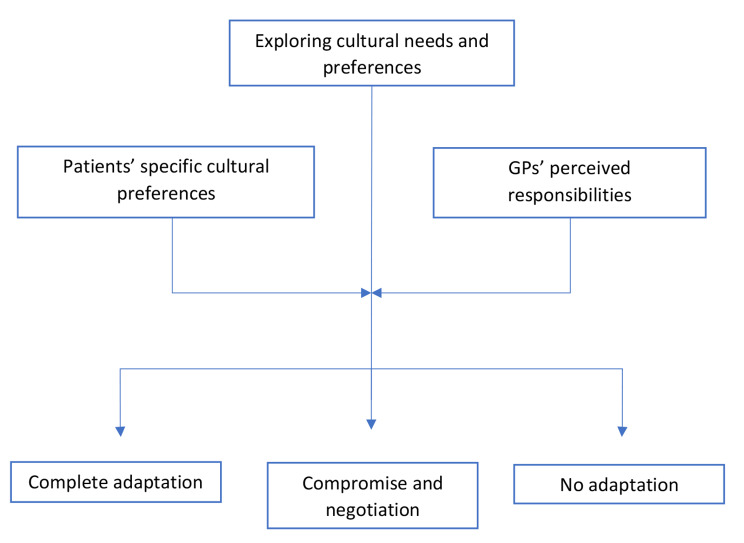
Findings reveal that culturally sensitive care provision is perceived as a multifaceted process, initiated by an exploration phase where GPs inquire about patients' cultural needs and preferences. Two pivotal factors shaping culturally sensitive care emerged: patients' specific cultural expectations and GPs' perceived responsibilities. These factors guided the process of culturally sensitive care towards three distinct outcomes, ranging from complete adaptation to patients' cultural requirements driven by a high sense of responsibility, through negotiation and compromise, to a paternalistic approach where GPs expect patients to conform to GPs' values and expectations. Three typologies of GPs in providing culturally sensitive care were identified: genuinely culturally sensitive, surface-level culturally sensitive, and those perceiving diversity as a threat. Stereotyping and othering persist in healthcare, underscoring the importance of critical consciousness and cultural reflexivity in providing patient-centered and equitable care.
This study emphasizes the significance of empathy and underscores the necessity for GPs to embrace the exploration and acknowledgement of patients' preferences and cultural needs as integral aspects of their professional role. It highlights the importance of shared decision-making, critical consciousness, cultural desire and empathy. Understanding these nuances is essential for enhancing culturally sensitive care and mitigating healthcare disparities.
文化敏感性护理是有效和公平医疗服务的组成部分,需要了解和承认患者的文化需求、偏好和期望。本研究调查了全科医生(GP)对文化敏感性护理的看法,重点是他们在提供符合文化需求的护理方面的意图、意愿和感知责任。
对 21 名佛兰德全科医生进行了深入访谈,以探讨他们对文化敏感性护理的看法。数据分析遵循建构主义框架内的常规定性内容分析方法。制定了一个编码方案,以确定 GP 反应中的反复出现的主题和模式。
研究结果表明,文化敏感性护理的提供被视为一个多方面的过程,由探索阶段发起,在此阶段,GP 询问患者的文化需求和偏好。有两个关键因素影响文化敏感性护理:患者的特定文化期望和 GP 感知到的责任。这些因素引导文化敏感性护理朝着三个不同的结果发展,从完全适应患者的文化需求,这种情况是由高度责任感驱动的,到协商和妥协,再到家长式的方法,即 GP 期望患者遵守 GP 的价值观和期望。确定了三种提供文化敏感性护理的 GP 类型:真正的文化敏感性、表面文化敏感性和那些将多样性视为威胁的人。在医疗保健中仍然存在刻板印象和他者化,强调在提供以患者为中心和公平的护理时培养批判性意识和文化反思的重要性。
本研究强调了同理心的重要性,并强调了 GP 作为其专业角色不可或缺的一部分,需要培养探索和承认患者偏好和文化需求的能力。它强调了共同决策、批判性意识、文化愿望和同理心的重要性。理解这些细微差别对于增强文化敏感性护理和减轻医疗保健差距至关重要。