Amante Eric Jason B, David-Wang Aileen S, Tee Michael L, Punzalan Felix Eduardo R, Añonuevo John C, Fernandez Lenora C, Albay Albert B, Malabad John Carlo M, Climacosa Fresthel Monica M, Pajes A Nico Nahar I, Cuaño Patricia Maria Gregoria M, Alejandría Marissa M
Department of Medicine, Philippine General Hospital, University of the Philippines Manila.
College of Medicine, University of the Philippines Manila.
Acta Med Philipp. 2024 Apr 15;58(6):7-13. doi: 10.47895/amp.vi0.6175. eCollection 2024.
Severe and critical COVID-19 disease is characterized by hyperinflammation involving pro-inflammatory cytokines, particularly IL-6. Tocilizumab is a monoclonal antibody that blocks IL-6 receptors.
This study evaluated the efficacy of tocilizumab in Filipino patients with severe to critical COVID-19 disease.
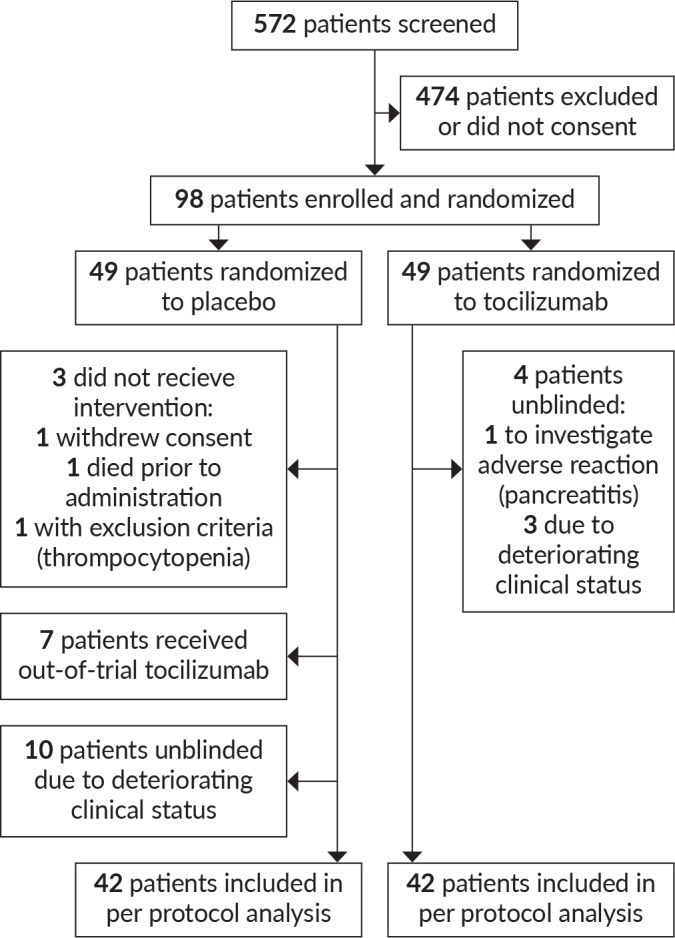
This phase 3 randomized double-blind trial, included patients hospitalized for severe or critical COVID-19 in a 1:1 ratio to receive either tocilizumab plus local standard of care or placebo plus standard of care. Patients were eligible for a repeat IV infusion within 24-48 hours if they deteriorated or did not improve. Treatment success or clinical improvement was defined as at least two categories of improvement from baseline in the WHO 7-point Ordinal Scale of patient status, in an intention-to-treat manner.
Forty-nine (49) patients were randomized in the tocilizumab arm and 49 in the placebo arm. There was no significant difference in age, comorbidities, COVID-19 severity, need for mechanical ventilation, presence of acute respiratory distress syndrome, or biomarker levels between groups. Use of adjunctive therapy was similar between groups, with corticosteroid used in 91.8% in tocilizumab group and 81.6% in the placebo group, while remdesivir was used in 98% of participants in both groups.There was no significant difference between groups in terms of treatment success in both the intention-to-treat analysis (relative risk=1.05, 95% CI: 0.85-1.30) and per-protocol analysis (relative risk=0.98, 95% CI: 0.80 to 1.21). There was no significant difference in time to improvement of at least two categories relative to baseline on the 7-point Ordinal Scale of clinical status.
The use of tocilizumab on top of standard of care in the management of patients with severe to critical COVID-19 did not result in significant improvement as defined by the WHO 7-point Ordinal Scale of patient status, nor in significant improvement in incidence of mechanical ventilation, incidence of ICU admission, length of ICU stay, and mortality rate.
重症和危重症新型冠状病毒肺炎(COVID-19)的特征是涉及促炎细胞因子,尤其是白细胞介素-6(IL-6)的过度炎症反应。托珠单抗是一种阻断IL-6受体的单克隆抗体。
本研究评估托珠单抗对菲律宾重症至危重症COVID-19患者的疗效。
这项3期随机双盲试验纳入因重症或危重症COVID-19住院的患者,按1:1比例接受托珠单抗加当地标准治疗或安慰剂加标准治疗。如果患者病情恶化或无改善,可在24 - 48小时内重复静脉输注。治疗成功或临床改善定义为在意向性治疗分析中,患者状态的WHO 7分序贯量表中至少有两类从基线得到改善。
托珠单抗组随机分配49例患者,安慰剂组49例。两组在年龄、合并症、COVID-19严重程度、机械通气需求、急性呼吸窘迫综合征的存在或生物标志物水平方面无显著差异。两组辅助治疗的使用相似,托珠单抗组91.8%使用了皮质类固醇,安慰剂组81.6%使用;两组98%的参与者使用了瑞德西韦。在意向性治疗分析(相对风险 = 1.05,95%可信区间:0.85 - 1.30)和符合方案分析(相对风险 = 0.98,95%可信区间:0.80至1.21)中,两组在治疗成功方面无显著差异。在临床状态7分序贯量表上,相对于基线至少有两类改善的时间上无显著差异。
在重症至危重症COVID-19患者的管理中,在标准治疗基础上加用托珠单抗,并未导致按照WHO 7分序贯量表定义的患者状态显著改善,也未使机械通气发生率、重症监护病房(ICU)入住率、ICU住院时间和死亡率显著改善。