Modan M, Halkin H, Almog S, Lusky A, Eshkol A, Shefi M, Shitrit A, Fuchs Z
J Clin Invest. 1985 Mar;75(3):809-17. doi: 10.1172/JCI111776.
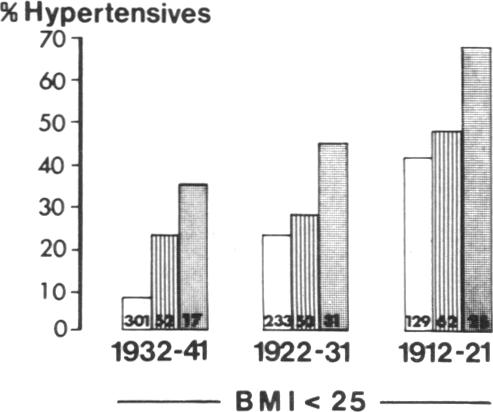
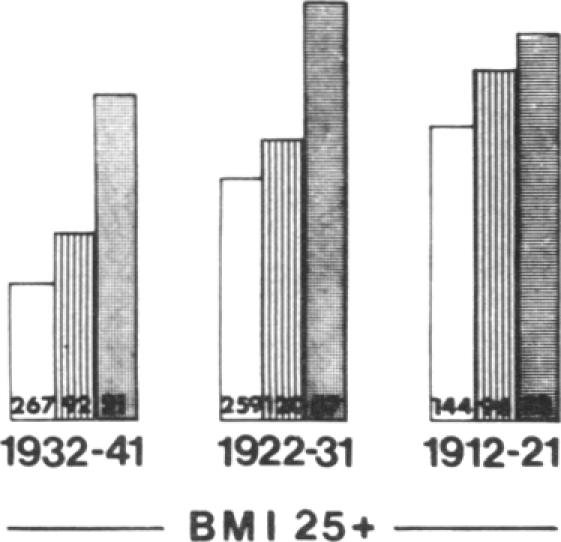
Hypertension and glucose intolerance, determined in a random population sample (n = 2,475), showed a highly significant (P less than 0.001) association from the mildest levels of both conditions, independent of the confounding effects of age, sex, obesity, and antihypertensive medications. Summary rate ratios for hypertension were 1.48 (1.18-1.87) in abnormal tolerance and 2.26 (1.69-2.84) in diabetes compared with normal tolerance. Altogether, 83.4% of the hypertensives were either glucose-intolerant or obese--both established insulin-resistant conditions. Fasting and post-load insulin levels in a representative subgroup (n = 1,241) were significantly elevated in hypertension independent of obesity, glucose intolerance, age, and antihypertensive medications. The mean increment in summed 1- and 2-h insulin levels (milliunits per liter) compared with nonobese normotensives with normal tolerance was 12 for hypertension alone, 47 for obesity alone, 52 for abnormal tolerance alone, and 124 when all three conditions were present. The prevalence of concentrations (milliequivalents per liter) of erythrocyte Na+ greater than or equal to 7.0, K+ less than 92.5, and plasma K+ greater than or equal to 4.5 in a subsample of 59 individuals with all combinations of abnormal tolerance obesity and hypertension was compared with those in 30 individuals free of these conditions. Altogether, 88.1% of the former vs. 40.0% of the latter group presented at least one of these three markers of internal cation imbalance (P less than 0.001). We conclude that insulin resistance and/or hyperinsulinemia (a) are present in the majority of hypertensives, (b) constitute a common pathophysiologic feature of obesity, glucose intolerance, and hypertension, possibly explaining their ubiquitous association, and (c) may be linked to the increased peripheral vascular resistance of hypertension, which is putatively related to elevated intracellular sodium concentration.
在一个随机人群样本(n = 2475)中测定的高血压和糖耐量异常显示,从这两种情况最轻微的水平开始就存在高度显著的关联(P < 0.001),且不受年龄、性别、肥胖和抗高血压药物的混杂影响。与糖耐量正常相比,糖耐量异常时高血压的汇总率比为1.48(1.18 - 1.87),糖尿病时为2.26(1.69 - 2.84)。总体而言,83.4%的高血压患者存在糖耐量异常或肥胖——这两种都是已确定的胰岛素抵抗状态。在一个代表性亚组(n = 1241)中,高血压患者的空腹和负荷后胰岛素水平显著升高,且不受肥胖、糖耐量异常、年龄和抗高血压药物的影响。与非肥胖且糖耐量正常的血压正常者相比,单纯高血压患者1小时和2小时胰岛素水平总和(毫单位/升)的平均增加值为12,单纯肥胖者为47,单纯糖耐量异常者为52,三种情况都存在时为124。在59名具有糖耐量异常、肥胖和高血压所有组合的个体亚组中,将红细胞Na +浓度(毫当量/升)≥7.0、K +浓度<92.5以及血浆K +浓度≥4.5的患病率与30名无这些情况的个体进行了比较。前一组中88.1%的人出现了这三种细胞内阳离子失衡标志物中的至少一种,而后一组中这一比例为40.0%(P < 0.001)。我们得出结论:胰岛素抵抗和/或高胰岛素血症(a)在大多数高血压患者中存在;(b)构成肥胖、糖耐量异常和高血压的共同病理生理特征,可能解释了它们普遍存在的关联;(c)可能与高血压患者外周血管阻力增加有关,而外周血管阻力增加据推测与细胞内钠浓度升高有关。