Fareed Zahid, Rana Aysha, Hadi Syeda Anum, Geluk Annemieke, Hope Jayne C, Khalid Hamza
Veterinary Research Institute, Lahore, Punjab, Pakistan.
Consultant-Technical Coordinator, Health Security Partners, Islamabad, Pakistan.
One Health. 2024 May 23;18:100763. doi: 10.1016/j.onehlt.2024.100763. eCollection 2024 Jun.
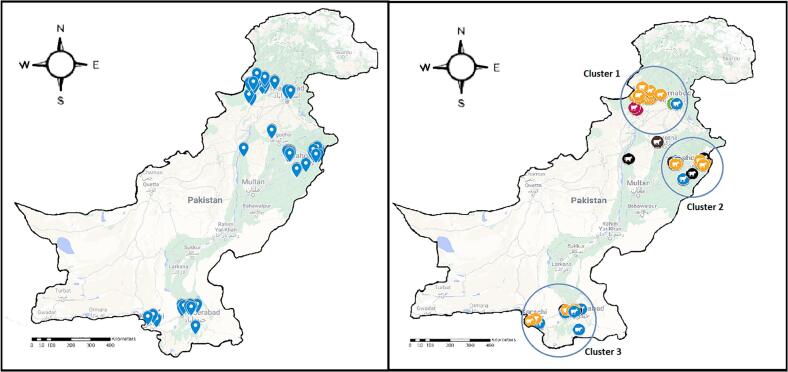
Bovine tuberculosis (bTB), caused by (), is a globally prevalent zoonotic infectious disease. World Organization for Animal Health (WOAH) estimates indicate that up to 10% of the total human TB cases in developing countries are attributed to . Pakistan ranks 4th in global milk production with a livestock population of over 212 million animals. Over 8 million families are involved in raising these animals as a means of livelihood. To date, there is an absence of national-level data on the prevalence of bTB and an effective control program is still lacking. The multifaceted impacts and substantial economic losses render addressing bTB a daunting, but highly important challenge. In this review, we summarise all the freely available literature on infection from Pakistan using Google scholar and PubMed databases. A total of 40 animal studies were identified using search terms: "bovine tuberculosis in Pakistan, bTB, Pakistan, in Pakistan, in Pakistan"; while seven human studies were identified using the terms: zoonotic tuberculosis in Pakistan', ' in humans Pakistan', 'zTB in TB patients in Pakistan". We have summarized all these studies to identify critical risk factors involved in transmission of bTB among animals and humans. Despite lack of comprehensive and geographically representative studies, the literature suggests a varying prevalence of bTB in animals, ranging from as low as 2% to as high as 19%. Regarding zTB prevalence in humans, estimates range from 1.5% to 13% in high-risk group of farm and abattoir workers, with notably higher percentages in extra-pulmonary TB cases. The review also addresses the challenges that Pakistan faces in formulating an effective policy for the control and eradication of bTB. We conclude with one-health based recommendations as a way forward for controlling TB caused by in cattle and humans.
牛结核病(bTB)由()引起,是一种全球流行的人畜共患传染病。世界动物卫生组织(WOAH)的估计表明,发展中国家高达10%的人类结核病病例归因于()。巴基斯坦的牛奶产量位居全球第四,牲畜存栏量超过2.12亿头。超过800万个家庭以饲养这些动物为生。迄今为止,尚无关于牛结核病流行率的国家级数据,且仍缺乏有效的防控计划。多方面的影响和巨大的经济损失使得应对牛结核病成为一项艰巨但极其重要的挑战。在本综述中,我们使用谷歌学术和PubMed数据库总结了巴基斯坦所有关于()感染的免费可得文献。使用搜索词“巴基斯坦的牛结核病、bTB、巴基斯坦、巴基斯坦的()、巴基斯坦的()”共确定了40项动物研究;而使用“巴基斯坦的人畜共患结核病”“巴基斯坦人类中的()”“巴基斯坦结核病患者中的zTB”等术语确定了7项人类研究。我们总结了所有这些研究,以确定牛结核病在动物和人类之间传播所涉及的关键风险因素。尽管缺乏全面且具有地理代表性的研究,但文献表明牛结核病在动物中的流行率各不相同,低至2%,高至19%。关于人类中的人畜共患结核病流行率,农场和屠宰场工人等高危人群的估计范围为1.5%至13%,肺外结核病病例中的比例明显更高。本综述还探讨了巴基斯坦在制定有效控制和根除牛结核病政策方面面临的挑战。我们以基于“同一健康”的建议作为控制牛和人类由()引起的结核病的前进方向进行总结。