Laboratory of Rare Circulating Human Cells - Liquid Biopsy Lab, Institut Universitaire de Recherche Clinique (IURC), University Medical Center of Montpellier, 641, Avenue du Doyen Gaston Giraud, Cedex 5 34093, Montpellier, France.
CREEC/CANECEV MIVEGEC (CREES), University of Montpellier, CNRS, Montpellier, IRD, France.
BMC Cancer. 2024 Jun 10;24(1):709. doi: 10.1186/s12885-024-12463-8.
Pancreatic cancer, predominantly characterized by ductal adenocarcinoma (PDAC) accounts for 90% of cases and is the fourth leading cause of cancer-related deaths globally. Its incidence is notably increasing. This poor prognosis is primarily due to late-stage diagnosis (approximately 70% to 80% of patients are diagnosed at an advanced stage), aggressive tumor biology, and low sensitivity to chemotherapy. Consequently, it is crucial to identify and develop a simple, feasible and reproducible blood-based signature (i.e., combination of biomarkers) for early detection of PDAC.
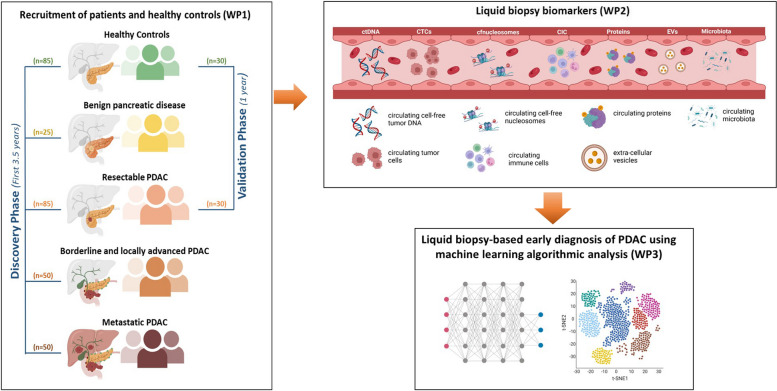
The PANLIPSY study is a multi-center, non-interventional prospective clinical trial designed to achieve early detection of PDAC with high specificity and sensitivity, using a combinatorial approach in blood samples. These samples are collected from patients with resectable, borderline or locally advanced, and metastatic stage PDAC within the framework of the French Biological and Clinical Database for PDAC cohort (BACAP 2). All partners of the BACAP consortium are eligible to participate. The study will include 215 PDAC patients, plus 25 patients with benign pancreatic conditions from the PAncreatic Disease Cohort of TOuLouse (PACTOL) cohort, and 115 healthy controls, totaling 355 individuals. Circulating biomarkers will be collected in a total volume of 50 mL of blood, divided into one CellSave tube (10 mL), two CELL-FREE DNA BCT® preservative tubes (18 mL), and five EDTA tubes (22 mL in total). Samples preparation will adhere to the guidelines of the European Liquid Biopsy Society (ELBS). A unique feature of the study is the AI-based comparison of these complementary liquid biopsy biomarkers. Main end-points: i) to define a liquid biopsy signature that includes the most relevant circulating biomarkers, ii) to validate the multi-marker panel in an independent cohort of healthy controls and patients, with resectable PDAC, and iii) to establish a unique liquid biopsy biobank for PDAC study.
The PANLIPSY study is a unique prospective non-interventional clinical trial that brings together liquid biopsy experts. The aim is to develop a biological signature for the early detection of PDAC based on AI-assisted detection of circulating biomarkers in blood samples (CTCs, ctDNA, EVs, circulating immune system, circulating cell-free nucleosomes, proteins, and microbiota).
ClinicalTrials.gov Identifier: NCT06128343 / NCT05824403. Registration dates: June 8,2023 and April 21, 2023.
胰腺癌主要表现为导管腺癌(PDAC),占病例的 90%,是全球癌症相关死亡的第四大主要原因。其发病率显著增加。这种不良预后主要是由于晚期诊断(约 70%至 80%的患者在晚期诊断)、侵袭性肿瘤生物学和对化疗的低敏感性所致。因此,识别和开发一种简单、可行和可重复的基于血液的标志物(即生物标志物组合)对于早期检测 PDAC 至关重要。
PANLIPSY 研究是一项多中心、非干预性前瞻性临床试验,旨在使用血液样本中的组合方法实现 PDAC 的高特异性和灵敏度的早期检测。这些样本是从可切除、交界性或局部晚期和转移性阶段的 PDAC 患者中收集的,这些患者是在法国 PDAC 生物和临床数据库队列(BACAP 2)的框架内收集的。BACAP 联盟的所有合作伙伴都有资格参与。该研究将包括 215 名 PDAC 患者,加上 25 名来自图卢兹胰腺疾病队列(PACTOL)的良性胰腺疾病患者,以及 115 名健康对照者,总计 355 人。循环生物标志物将在总共 50 毫升血液中收集,分为一个 CellSave 管(10 毫升)、两个 CELL-FREE DNA BCT®防腐剂管(18 毫升)和五个 EDTA 管(总共 22 毫升)。样本制备将遵循欧洲液体活检学会(ELBS)的指南。该研究的一个独特特点是基于人工智能的这些互补液体活检生物标志物的比较。主要终点:i)定义包含最相关循环生物标志物的液体活检特征,ii)在可切除 PDAC 的健康对照者和患者的独立队列中验证多标志物组,iii)为 PDAC 研究建立独特的液体活检生物库。
PANLIPSY 研究是一项独特的前瞻性非干预性临床试验,汇集了液体活检专家。目的是基于人工智能辅助检测血液样本中的循环生物标志物(CTC、ctDNA、EVs、循环免疫系统、循环无细胞核小体、蛋白质和微生物群),开发 PDAC 的早期检测生物标志物。
ClinicalTrials.gov 标识符:NCT06128343/NCT05824403。注册日期:2023 年 6 月 8 日和 2023 年 4 月 21 日。